Writ Petition Not A Substitute For Statutory Remedies Under BNSS For FIR Registration Absent Imminent Threat To Life Or Liberty: Supreme Court
 |
|The Court held that where a complete statutory mechanism exists under the BNSS for registration of FIR, writ jurisdiction cannot be invoked in the first instance, particularly in the absence of urgency involving life or liberty.
The Supreme Court has held that Article 226 of the Constitution cannot be invoked as a substitute for the statutory remedies provided under the Bharatiya Nagarik Suraksha Sanhita, 2023, for registration of an FIR, particularly in the absence of any imminent threat to life or liberty.
The Court was hearing criminal appeals arising from an interim order of the Bombay High Court directing the police to record the statement of the complainant and take action in accordance with law, pursuant to which an FIR came to be registered against the appellants.
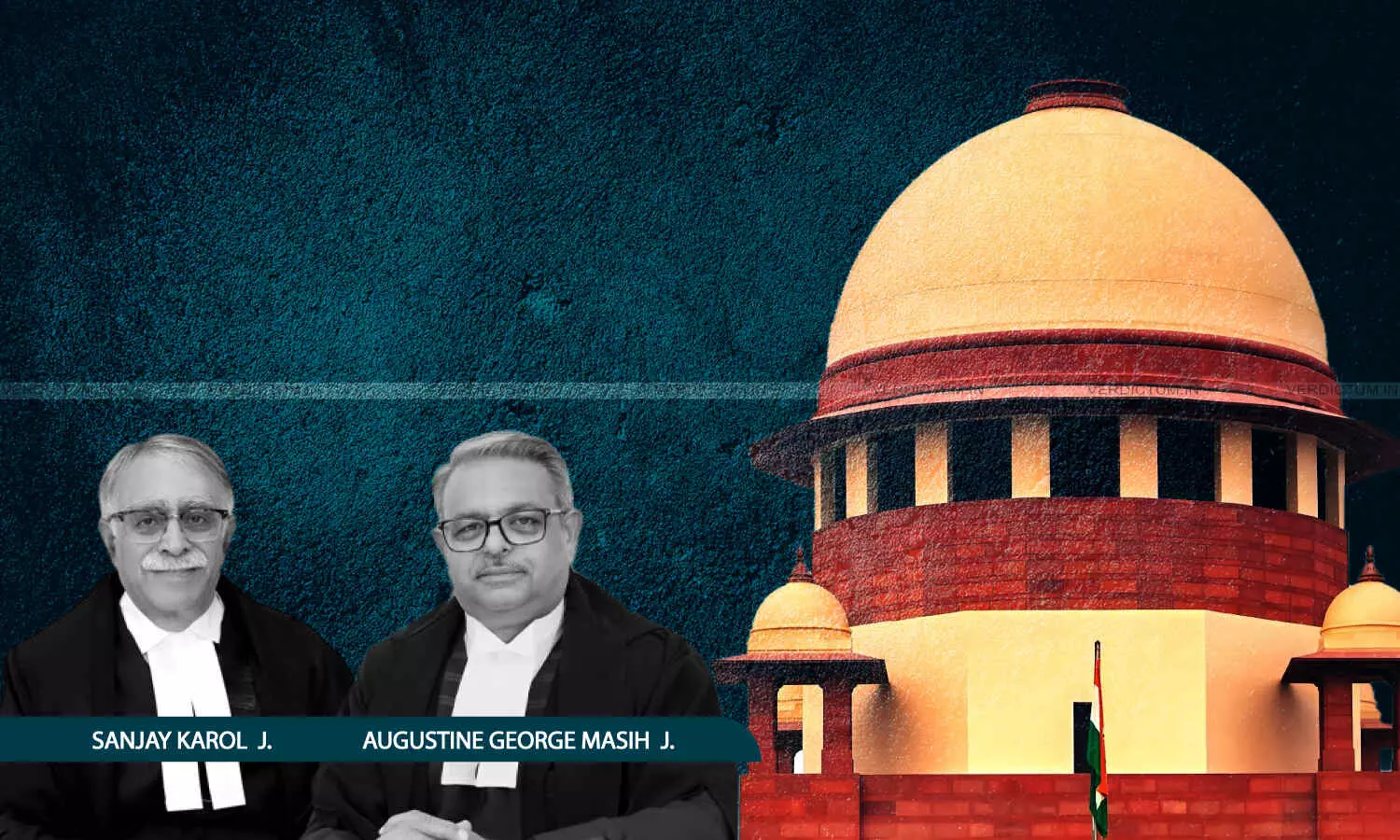
A Bench of Justice Sanjay Karol and Justice Augustine George Masih observed: “In the present case, it is evident from the record that the complainant Company initially approached the Land Record Authority, by way of complaints dated 13.06.2025 and 09.07.2025, with copies thereof being sent to the police authority. However, it did not avail any of the statutory remedies provided under BNSS and instead directly invoked the writ jurisdiction of the High Court, inter alia, seeking directions for registration of FIR”.
The Bench accordingly held: “In our considered view, such a recourse, in the first instance, is contrary to the settled principles of law. Particularly in the absence of imminent danger of violation of the life or liberty of an individual. Article 226 is not a panacea for all grievances”.
Geeta Luthra, Senior Advocate, appeared for the appellants; P.D. Naik, Senior Advocate, appeared for the respondents.
Background
The dispute arose from commercial transactions concerning a resort property situated in Nashik, involving multiple agreements, lease arrangements, and pending civil litigation between the parties.
The complainant company alleged that certain accused persons had forged documents and impersonated its director in connection with an application for measurement of the property before the Land Records Authority.
Complaints were filed before the Land Records Authority, with copies marked to the police authorities. The Land Records Authority, however, declined to take coercive action and advised the complainant to seek redressal before the competent authority.
Subsequently, the matter was referred to the police, who returned the complaint for further inquiry by the Land Records Department, indicating that appropriate steps should be taken by the concerned authority.
Aggrieved by the inaction, the complainant company invoked the writ jurisdiction of the High Court under Article 226, seeking directions for registration of an FIR. The High Court, by an interim order, directed the recording of the complainant’s statement and initiation of action, pursuant to which FIR came to be registered.
Court’s Observation
At the outset, the Apex Court reiterated the settled principles governing the exercise of writ jurisdiction under Article 226. Referring to Radha Krishan Industries v. State of H.P. (2021), it held that the jurisdiction is discretionary and subject to self-imposed restrictions, particularly where an effective alternative remedy is available.
The Court emphasised that “resort to that jurisdiction is not intended as an alternative remedy for relief which may be obtained… in a mode prescribed by statute,” and that the statutory framework must ordinarily be followed.
The Court further relied upon Thansingh Nathmal v. Superintendent of Taxes (1964) and Rikhab Chand Jain v. Union of India (2025) to reiterate that bypassing statutory remedies is impermissible unless exceptional circumstances exist.
Turning to the issue of registration of FIR, the Court referred to Sakiri Vasu v. State of U.P. (2008) and held that where a person has a grievance regarding non-registration of FIR, the statutory remedies under criminal law must be followed.
It observed that “if a person has a grievance that his FIR has not been registered… his first remedy is to approach the Superintendent of Police… and thereafter the Magistrate,” and that writ jurisdiction should not be invoked in such cases.
The Court noted that entertaining such writ petitions would result in High Courts being flooded with matters seeking registration of FIR, thereby undermining the statutory scheme.
The Court then examined the framework under BNSS, noting that it provides a structured and sequential mechanism for registration of FIR and initiation of criminal proceedings. It recorded that the scheme requires the complainant to first approach the officer-in-charge of the police station; In case of refusal, approach the Superintendent of Police; Thereafter, recourse to the Magistrate.
In this context, the Court held that “the statutory framework contemplates that information relating to the commission of a cognizable offence is first placed before the officer-in-charge… and in the event of refusal… recourse lies before the Superintendent of Police… and thereafter before the Magistrate,” emphasising the sequential nature of remedies.
Applying these principles to the facts, the Court found that the complainant had not availed any of the remedies under BNSS and had directly approached the High Court. It observed that “the complainant Company… did not avail any of the statutory remedies provided under BNSS and instead directly invoked the writ jurisdiction… seeking directions for registration of FIR,” which was impermissible.
The Court further noted that there was no allegation of imminent threat to life or liberty that would justify bypassing the statutory mechanism. It held that entertaining the writ petition in such circumstances would effectively convert the High Court into a court of first instance, which is contrary to settled law.
The Court emphasised that “entertaining a writ petition… would in effect result in the High Court acting as a forum of first instance… this is impermissible,” reiterating the limited scope of Article 226.
Conclusion
The Court held that the writ petition filed before the High Court was premature and not maintainable in the absence of exhaustion of statutory remedies under BNSS.
Accordingly, the appeals were allowed, the impugned interim order of the High Court was set aside, and the FIR registered in connection therewith was quashed.
Liberty was granted to the parties to avail themselves of alternative remedies in accordance with the law, and it was clarified that the judgment shall not be construed as an expression of opinion on the merits of the allegations.
Cause Title: Sujal Vishwas Attavar & Anr. v. State of Maharashtra & Ors. (Neutral Citation: 2026 INSC 442)
Appearances
Appellants: Geeta Luthra, Senior Advocate; Advocates Nilesh Tribhuvan, Burzin Bharucha, Rohit Saraswat, Pururaj Aggarwal; AORs Shahrukh Ahmad, Anand Dilip Landge
Respondents: P.D. Naik, Senior Advocate, Samrat Krishnarao Shinde, Siddharth Dharmadhikari, Shrirang B. Varma;; Advocates Varad Kilor; AORs Aaditya Aniruddha Pande, Manjeet Kirpal