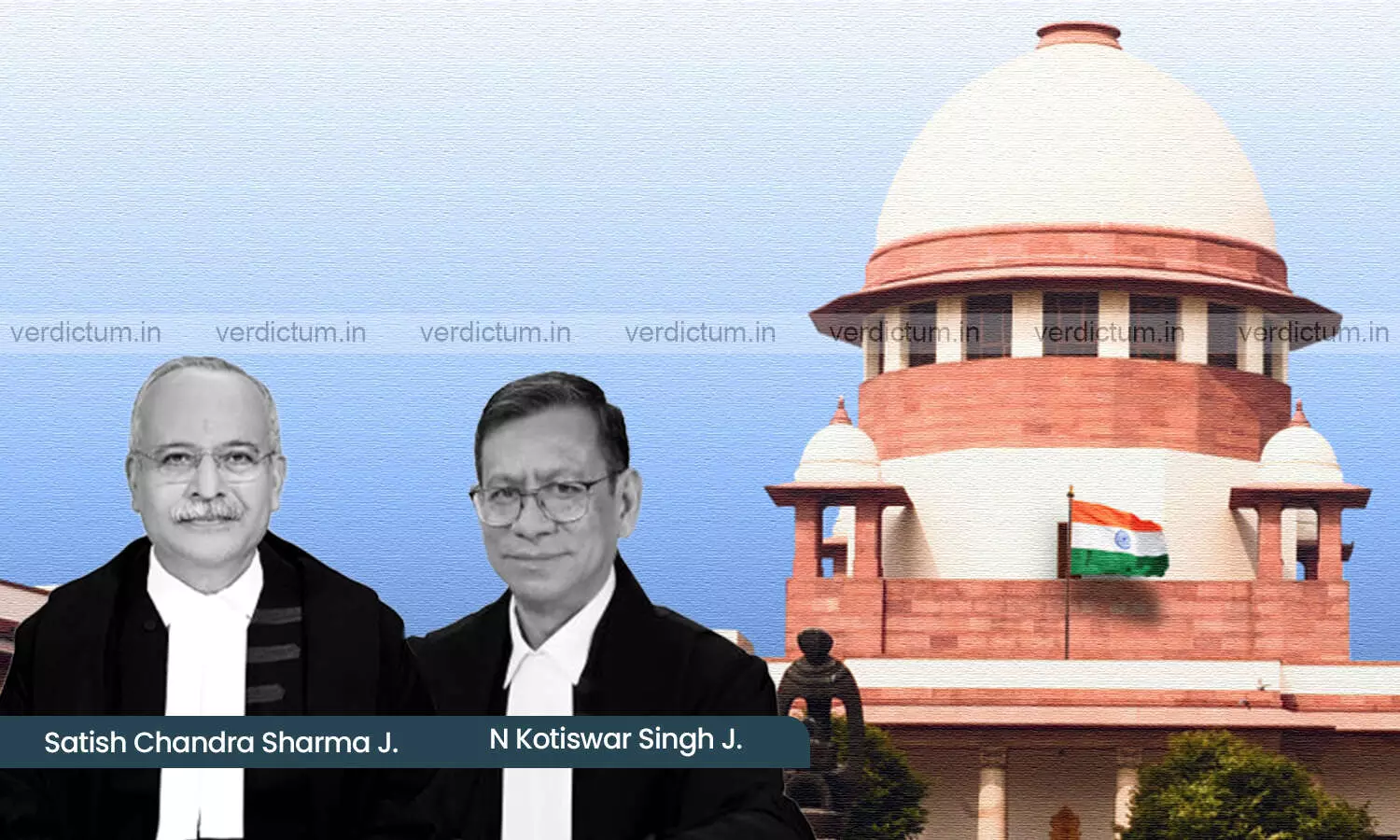
Tendency Of Litigants To Colourize Civil Disputes As Criminal Offences Is Open Secret: Supreme Court Quashes Cheating Case Involving Land Sale
 |
|The Supreme Court was considering a criminal appeal filed against the dismissal of a quashing petition.
While quashing a cheating case involving the sale of land, the Supreme Court has observed that the tendency of litigants to colourize civil disputes into criminal offences is an open secret, and the Courts have tried to put their foot down to prevent the litigants from obliterating the fine distinction between the two.
The Apex Court was considering a criminal appeal filed against the dismissal of a quashing petition.
The Division Bench of Justice Satish Chandra Sharma and Justice Nongmeikapam Kotiswar Singh stated, “The tendency of litigants to colourize civil disputes into criminal offences is an open secret in the present times. The courts have tried to put their foot down to prevent the litigants from obliterating the fine distinction between the two. We have done so to prevent the abuse of criminal process. The instant case presents a similar opportunity.”
AOR T. Mahipal represented the Appellant, while AOR Sanchit Garga represented the Respondent.
Factual Background
One Ganesh was the owner of a piece of land located in Channasandra Village, Karnataka. He died intestate, and after his demise, the said land was inherited by his wife and other legal heirs (landowners). The landowners entered into an agreement for sale purporting to sell the subject land in favour of the petitioner. They also executed a General Power of Attorney (GPA) in favour of the petitioner. Thereafter, the landowners, acting through their GPA holder/petitioner, entered into another agreement with the second respondent and one Kalpana Sure (prospective buyers) for the sale of the subject land. The petitioner and landowners waited till the expiry of the limitation period for seeking specific performance. The prospective buyers took no action, and the petitioner and landowners sold the subject land by executing a sale deed in favour of one Gaffar Baig (ultimate buyer).
The prospective buyers instituted a civil suit for specific performance of the agreement for sale. Subsequently, they also lodged a criminal complaint, which was registered as an FIR under Sections 420, 423, 120-B read with Section 34 of the Indian Penal Code, 1860 (IPC). The petitioner was named as an accused in the said FIR along with the landowners. After the filing of the final report, the Magistrate took cognisance of the offences. Against the said FIR and order of cognizance, the landowners preferred a quashing petition before the Karnataka High Court, which was allowed.
The petitioner also filed a quashing petition before the High Court, and the impugned order was passed dismissing such petition. Taking exception to the impugned order, the petitioner claimed that he was similarly placed with the landowners and the coordinate bench ought to have followed the earlier judgment, whereby the case against the landowners was quashed.
Reasoning
The Bench noted that after the institution of the civil suit, the second respondent also lodged an FIR for the commission of offences, and the petitioner’s petition for quashing of the same FIR was listed before a different bench. While denying similar relief to the petitioner, the coordinate bench distinguished the petitioner’s case from that of the landowners.
“The FIR alleges the commission of offence by the landowners as well as the petitioner. The allegation is based on the execution of sale deed, and the sale deed was executed by the landowners themselves. The petitioner was only a confirming party. If no criminality could be attributed to the landowners by virtue of the execution of sale deed, it cannot be sustained against the petitioner as well. For, there is nothing to attribute any aggravated role to the petitioner. The consideration was also received collectively by the landowners and petitioner. Merely because it was physically received by the petitioner on behalf of all of them, it does not place him at a different pedestal”, it added.
Considering that the landowners had not raised any allegation against the petitioner regarding misappropriation of sale consideration meant for them, the Bench held that, in order to distinguish the petitioner’s case, the High Court traversed beyond the scope of the allegations.
Noting that the property was not transferred on the basis of any deception, the Bench stated that the property could have legitimately been transferred in favour of the second respondent and there was no deception. The Bench held that the foundational ingredient of cheating was missing
The Bench further held that the foundational ingredient of cheating was missing as the subsequent sale took place in 2016, almost 4 years after the alleged delivery of money by the second respondent. Taking note of the fact that there was no false statement in the agreement or in the sale deed, the Bench held that Section 423 IPC was also mis-invoked, as the said provision requires a false statement for consideration in an instrument of transfer.
Thus, allowing the petition, the Bench quashed the impugned order of the High Court.
Cause Title: Sudha Rakesh v. The State Of Karnataka (Neutral Citation: 2026 INSC 1086)
Appearance
Appellant: AOR T. Mahipal
Respondent: AOR Sanchit Garga, Advocates Kunal Rana, Shashwat Jaiswal, Diksha Arora, Bhanu Pratap Singh, Oorja Goel, Vijender Kumar, Mohan Raj A, Ashok Karmadi, AOR Charulata Chaudhary, Advocate Vatanjeet Thakran