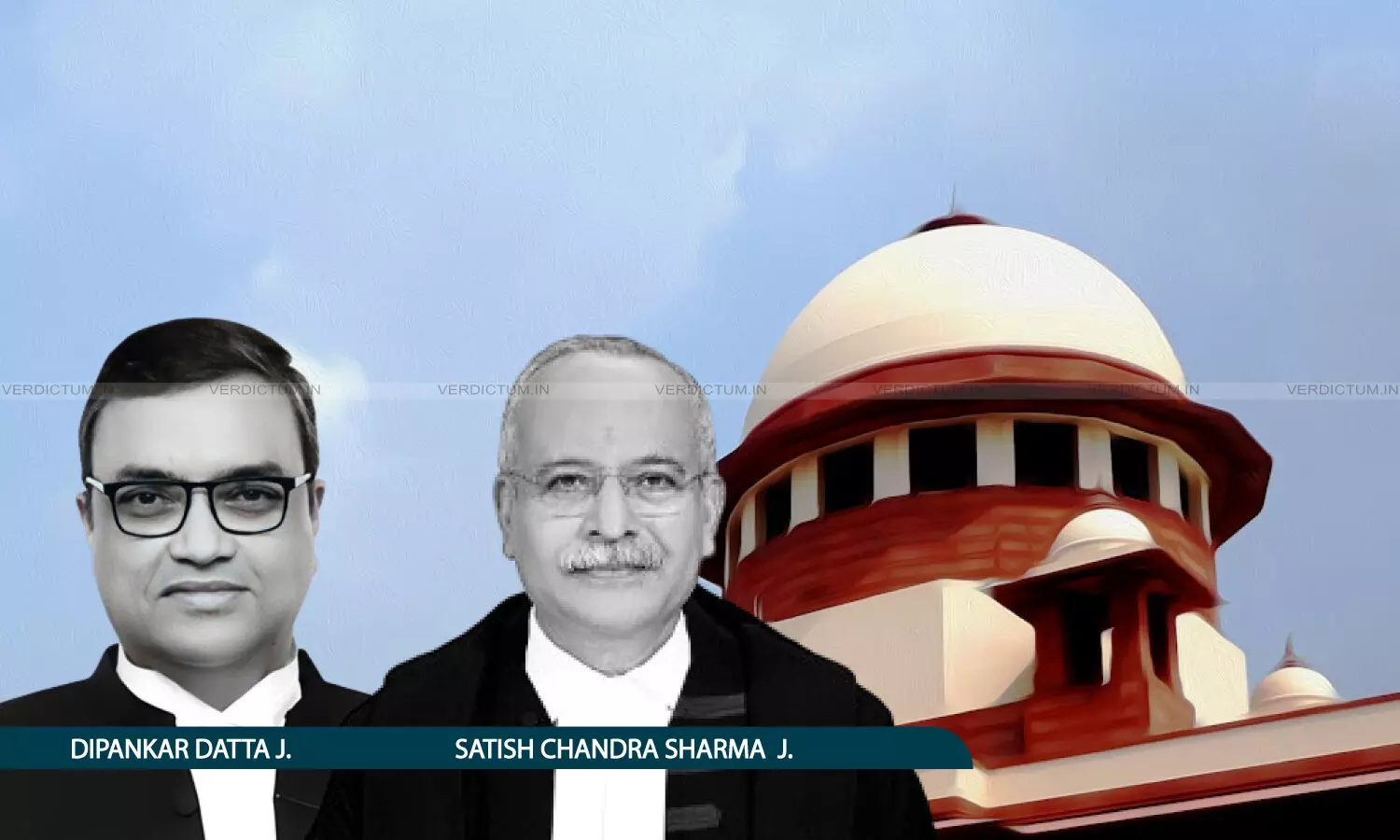
Justice Dipankar Datta, Justice Satish Chandra Sharma, Supreme Court
Victims of Heinous Crimes Cannot Be Repeatedly Subjected To Trauma of Cross-Examination: Supreme Court
 |
|The Court set aside an order allowing the recall of a rape survivor for further cross-examination, emphasizing that statutory powers cannot be exercised to inflict undue hardship on victims or to fill lacunae in the defence case after an inordinate delay.
The Supreme Court held that witnesses, especially survivors of heinous crimes like rape, cannot be expected to repeatedly face the ordeal of cross-examination in court due to subsequent changes in defence counsel or oversight.
The Court observed that while the power under Section 311 of the Code of Criminal Procedure (CrPC) is expansive, it must be exercised sparingly and balanced against the psychological trauma inflicted upon the victim by prolonged trials.
The Bench of Justice Dipankar Datta and Justice Satish Chandra Sharma observed, "It is important to mention that the prosecutrix has already been subjected to the ordeal of deposition and cross-examination on four separate occasions before the Trial Court, in addition to having her statement recorded during investigation and before the learned Magistrate under Section 164 CrPC. Directing recall would inflict further and unjustifiable hardship upon the prosecutrix. The witnesses cannot be expected to face hardship of appearing in court repeatedly, particularly in sensitive cases. It can result in undue hardship for the victims, especially so, of heinous crimes, if they are required to repeatedly appear in Court to face cross-examination."
AOR Shuvodeep Roy appeared for the State, while AOR Mayank Pandey appeared for the Respondent.
Brief Facts of the Case
The present criminal appeal arose out of a judgment passed by the High Court of Tripura, which set aside an order of the Trial Court and allowed an application filed by the Respondent-accused under Section 311 of the Code of Criminal Procedure for recalling the prosecutrix for further cross-examination.
The prosecution case commenced on the basis of a written complaint lodged by the prosecutrix alleging that the Respondent-accused forcibly confined her inside a room, tore her clothes, committed rape upon her, and criminal intimidation. Upon registration of the First Information Report (FIR), investigation was conducted, the statement of the prosecutrix was recorded before a Magistrate, and a chargesheet was subsequently filed.
During the trial, the prosecutrix was examined-in-chief and cross-examined extensively. Thereafter, upon an application moved by the prosecution, she was recalled and underwent further examination and re-cross-examination. After a considerable delay of approximately four years from her last examination, the Respondent-accused moved an application under Section 311 of the Code of Criminal Procedure, seeking to recall the prosecutrix yet again for further cross-examination on ninety-four specific questions. The primary ground cited by the defence was that due to an oversight, certain crucial contradictions and aspects emerging from the Call Detail Records (CDRs) of the mobile phones of the prosecutrix and the accused could not be brought on record.
The Trial Court rejected the application of the accused, observing that the prosecutrix had already been subjected to detailed examination on multiple occasions, the trial had been pending for over seven years, and the belated application was a mere strategy to protract the proceedings. However, the High Court reversed this decision in a petition filed under Section 482 of the Code of Criminal Procedure, allowing the recall of the witness solely for confrontation with the electronic records, which led the Appellant to approach the Supreme Court.
Contention of the Parties
It was contended by the Appellant-State that the prosecutrix had already been extensively examined, cross-examined, re-examined, and re-cross-examined on multiple occasions, proving that the accused was granted sufficient opportunity to contest her testimony. It was argued that the application for recall was preferred after an unexplained and inordinate delay of more than four years, demonstrating that the motion was a clear attempt to delay the conclusion of a trial that had been lingering for several years. It was submitted that the Call Detail Records were already part of the prosecution documents and well within the knowledge of the defence from the inception, and Section 311 could not be invoked to fill up the lacunae in the case of the defence.
The Accused contended that the Call Detail Records were vital to the defence as they reflected the frequency, duration, and nature of telephonic contacts between the parties during the relevant period, which had a direct and material bearing on the veracity of the prosecution's case. It was submitted that due to inadvertence and oversight of the previous defence counsel, material questions regarding the electronic records could not be put to the witness during her earlier cross-examination. It was argued that the statutory power under Section 311 of the Code of Criminal Procedure is expansive and cast a duty upon the Court to discover the truth, and a fair trial required that the accused be permitted to confront the witness with relevant evidence essential for a just adjudication.
Observations of the Court
The Court observed that Section 311 of the Code of Criminal Procedure confers wide discretionary power upon the Court to summon, recall, or re-examine any witness at any stage of an inquiry or trial, provided such evidence appears essential to the just decision of the case. However, the Court emphasized that this vast statutory power must be exercised sparingly, with great caution and circumspection, and never in an arbitrary or capricious manner.
Relying on a consistent line of precedents, the Court noted that an application under Section 311 must be bona fide and cannot be allowed to act as a disguise for a retrial, to alter the nature of the case, or to simply fill up lacunae in the case of either the prosecution or the defence. The Court held that while a party may be permitted to correct a bona fide error, the plea for recall must be carefully balanced against other competing and relevant considerations, such as causing uncalled-for hardship to witnesses and creating unnecessary delays in the conclusion of the trial.
Reviewing the matrix of the present case, the Court observed that the High Court was completely unjustified in interfering with the well-reasoned order of the Trial Court. It was noted that the prosecutrix had already been subjected to detailed and extensive examination-in-chief, cross-examination, re-examination, and re-cross-examination across multiple hearings spread over a considerable period of time. The Bench found that the Respondent-accused was afforded ample and sufficient opportunity to test the veracity of her deposition.
Furthermore, the Court took serious note of the fact that the application for recall was moved after an inordinate and unexplained lapse of nearly four years from the completion of the witness's last cross-examination. It observed that by the time the application was preferred, numerous other prosecution witnesses had already been examined, the trial had substantially progressed, and the entire proceedings had been lingering for over eight years. The Court reiterated that it is the bounden duty of the judiciary to ensure the expeditious conclusion of trials and to prevent any abuse of the process of law intended merely to protract proceedings.
The Bench rejected the contention of the accused regarding the necessity of confronting the prosecutrix with the Call Detail Records (CDRs). It was observed that since the said records were filed by the prosecution itself along with the chargesheet, they formed part of the judicial record from the very inception. The defence was fully aware of this material and possessed adequate opportunity to question the witness earlier; hence, the plea of oversight or inadvertence could not be entertained to help the defence fill up gaps in its case.
Lastly, the Court highlighted the severe psychological ordeal and unjustifiable hardship that a repetitive recall would inflict upon the prosecutrix. It was observed that witnesses, particularly victims of heinous and sensitive crimes like rape, cannot be expected to face the trauma of appearing in court repeatedly to face cross-examination.
Consequently, the Supreme Court held that the High Court erred in allowing the application under Section 311, set aside the impugned judgment, restored the order of the Trial Court, and directed the conclusion of the trial by the end of the year.
Cause Title: The State of Tripura v. Panna Ahmed [Neutral Citation: 2026 INSC 584]
Appearances:
Appellant: Advocate on Record Shuvodeep Roy, Advocate Deepayan Dutta, Advocate Saurabh Tripathi.
Respondent: Advocate on Record Mayank Pandey, Advocate Ashish Kumar Pandey, Advocate Shivraj Singh Tomar, Advocate Yasheeka Garg, Advocate Arun.