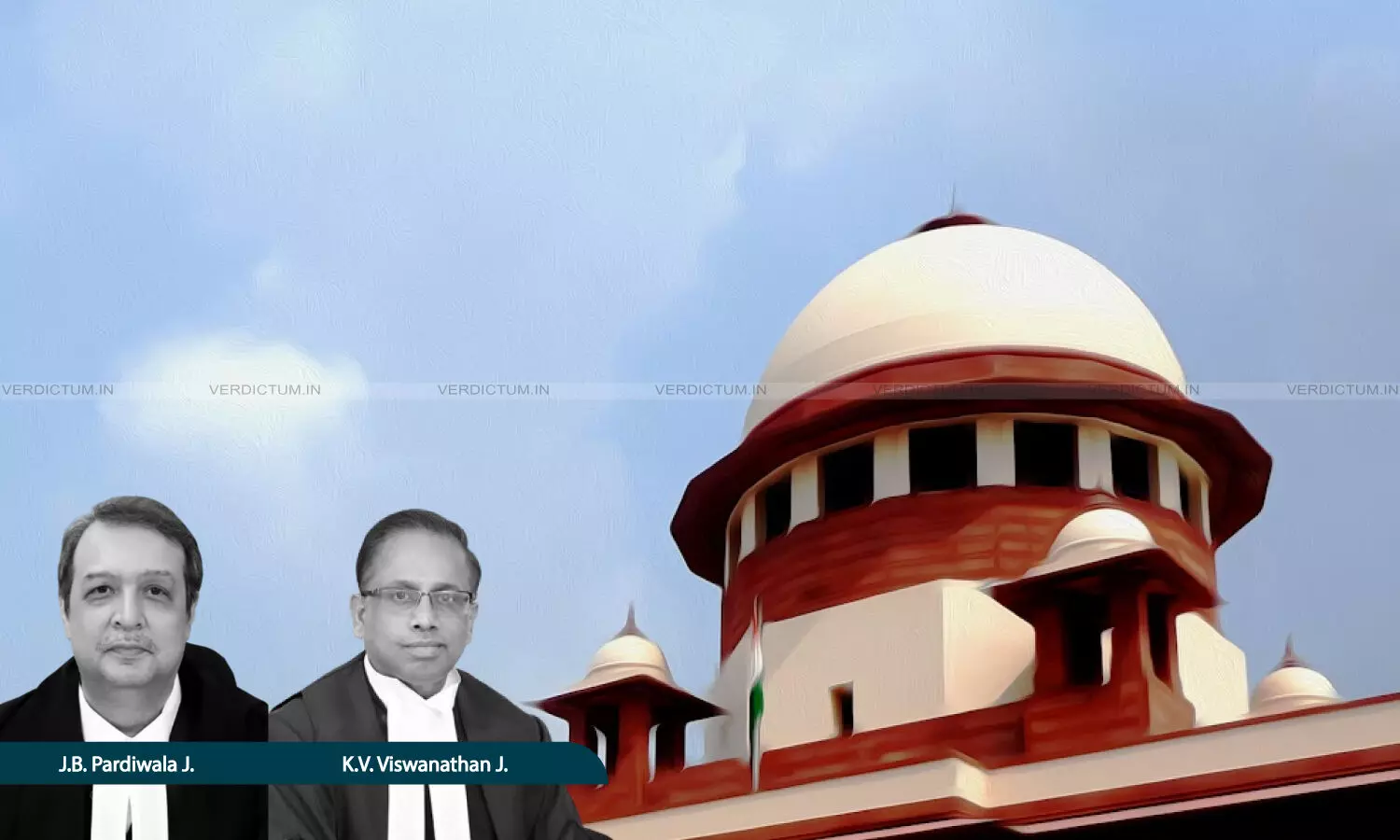
Justice J.B. Pardiwala, Justice K.V. Viswanathan, Supreme Court
Doctrine Of Promissory Estoppel Can’t Be Invoked To Create Entitlement Contrary To True Scope & Intent Of State Policy: Supreme Court
 |
|The Court particularly held that the doctrine cannot be invoked to compel extension of a fiscal benefit to a class of industries for which such benefit was never intended under the governing industrial policy.
The Supreme Court has held that although the Government remains bound by the doctrine of promissory estoppel where clear representations are made to induce industrial investment, it cannot be stretched to compel the State to grant fiscal incentives or concessions to industrial units falling outside the intended beneficiary class under the policy framework.
The Court was hearing an appeal filed by the State of Himachal Pradesh challenging the judgment of the Himachal Pradesh High Court directing the State to extend concessional electricity tariff benefits under the Himachal Pradesh Industrial Policy, 2019, to an existing industrial enterprise which had undertaken substantial expansion.
The dispute principally concerned the interpretation of Clause 16 of the Industrial Policy relating to concessional electricity charges and the applicability of the doctrine of promissory estoppel to the respondent industrial unit.
A Division Bench of Justice J.B. Pardiwala and Justice K.V. Viswanathan observed: “The doctrine applies with full force against the State, its departments, statutory corporations and instrumentalities, including authorities falling within Article 12 of the Constitution, which cannot arbitrarily resile from a solemn representation upon which another has acted”.
However, while taking note that in the case at hand, the impugned Clause 16(a) was never meant to extend the concessional tariff benefit to existing industrial enterprises undergoing substantial expansion, the Bench held that “the doctrine of promissory estoppel cannot be invoked to compel the State to grant a benefit which was never intended for the class of industry to which the respondent belonged”.
“… Even assuming that the respondent was entitled to invoke the doctrine of promissory estoppel, the same could not be stretched so as to create or found an entitlement contrary to the true scope and intent of the Industrial Policy of 2019”, the Bench additionally held.
Senior Advocates P. Chidambaram & Kapil Sibal, Vaibhav Srivastava, A.A.G., appeared for the appellants. Senior Advocate Navin Pahwa appeared for the respondent.
Background
The Himachal Pradesh Government notified the Industrial Policy of 2019 with the stated objective of encouraging industrialisation, generating employment opportunities and creating a favourable investment climate within the State. The policy contemplated several incentives and concessions for both new industrial enterprises and existing enterprises undertaking substantial expansion.
Clause 16 of the policy dealt specifically with concessional electricity charges. Under Clause 16(a), eligible enterprises were entitled to electricity charges at rates 15% lower than approved tariff rates for a period of three years. Clause 16(b), on the other hand, contemplated rebate benefits on additional power consumption for existing industrial enterprises undertaking substantial expansion.
The respondent industrial unit, which had originally commenced production years earlier, undertook expansion activities in 2020 and sought the benefit of concessional electricity charges under Clause 16(a). The State rejected the claim on the ground that Clause 16(a) was intended exclusively for new industrial enterprises, whereas existing units undertaking expansion were covered only under Clause 16(b).
During the pendency of the dispute, the State amended the Industrial Policy on 29.04.2022 by substituting the expression “eligible enterprises” appearing in Clause 16(a) with “new enterprises”. According to the State, the amendment merely clarified the original intent of the policy and corrected a drafting inconsistency. The High Court nevertheless ruled in favour of the respondent and directed the State to extend the concessional tariff benefit. Aggrieved thereby, the State approached the Supreme Court.
Court’s Observation
The Supreme Court undertook a detailed examination of the structure and scheme of Clause 16 of the Industrial Policy and held that the policy consciously maintained a distinction between new industrial enterprises and existing enterprises undertaking substantial expansion.
The Court observed that Clause 16(a) was designed specifically to attract fresh industries into the State by offering concessional electricity charges during the initial years of establishment, whereas Clause 16(b) separately dealt with incentives available to existing industrial units expanding their production capacity.
The Court observed that an alternate interpretation “would also lead to an anomalous consequence whereby a benefit specifically intended for new industrial enterprises, i.e., concessional lower energy charges for a period of 3 years aimed at encouraging the establishment of fresh industrial units within the State, would stand extended even to existing industrial enterprises merely because they had undertaken expansion.”
The Bench held that acceptance of the respondent’s interpretation would effectively permit existing industrial units to avail dual benefits under both Clause 16(a) and Clause 16(b), thereby distorting the policy framework and imposing unintended fiscal burdens upon the State.
The Supreme Court further held that the amendment carried out on 29.04.2022 by replacing the word “eligible” with “new” was merely clarificatory in nature and did not create or extinguish any substantive right. The Court observed that the amendment only clarified the original intention underlying the policy and removed ambiguity in drafting.
The Court observed: “The substitution of the word ‘eligible’ with the word ‘new’ in Clause 16(a) and Rule 16(i)(a), and the insertion of the expression ‘substantial expansion’ in Clause 16(b) and Rule 16(i)(b), did not introduce any new class of beneficiaries, nor did it create or extinguish any substantive right.”
The Court thereafter examined the scope and limitations of the doctrine of promissory estoppel by referring to several precedents, including Shree Sidhbali Steels Ltd. v. State of U.P. (2011), State of Rajasthan v. J.K. Udaipur Udyog Ltd. (2004), Arvind Industries v. State of Gujarat (1995) and IFGL Refractories Ltd. v. Orissa State Financial Corporation 2026.
The Bench reiterated that the doctrine is founded upon fairness, equity and constitutional obligations of non-arbitrariness imposed upon the State. The Court observed that industrial incentive schemes are ordinarily framed to induce entrepreneurs to invest capital and establish industries, and therefore representations contained in such schemes are capable of attracting promissory estoppel where industries alter their position acting upon such assurances.
The Court observed: “The doctrine rests upon the larger constitutional principle that State action must be fair, non-arbitrary, and consistent; governmental assurances are not empty declarations, but solemn representations on the faith of which citizens regulate their affairs.”
The Supreme Court further observed: “Where the State or its instrumentalities frame industrial or fiscal incentive schemes with the avowed object of attracting investment and establishing industries, the representations contained therein are intended to induce entrepreneurs to act upon them, and such representations are enforceable.”
“The grant of an exemption, concession or incentive under a statutory scheme is ordinarily defeasible, and the Government is competent to modify or revoke the same in exercise of the very power under which it was granted, … thus, what is granted can ordinarily be withdrawn, … however, the Government may be precluded from doing so on the ground of promissory estoppel, which principle itself remains subject to considerations of equity and public interest”, the Bench additionally held.
Applying the doctrine to the present facts, the Court, however, held that the respondent could not invoke promissory estoppel to claim a benefit that was never intended for the category of industrial units to which it belonged. The Court also noted that the respondent had already been extended the rebate benefit specifically available to existing industrial enterprises under Clause 16(b).
Conclusion
The Supreme Court held that Clause 16(a) of the Himachal Pradesh Industrial Policy, 2019, was intended exclusively for new industrial enterprises and not for existing industrial units undertaking substantial expansion. The Court further held that the amendment notification dated 29.04.2022 was clarificatory in nature and merely clarified the original intent underlying the policy framework.
The Court concluded that although the doctrine of promissory estoppel applies against the State in appropriate cases where industries alter their position acting upon governmental representations, the doctrine cannot be invoked to compel extension of a benefit to an industrial category for which such benefit was never intended under the governing policy.
Accordingly, the Court allowed the appeal and set aside the judgment of the Himachal Pradesh High Court.
Cause Title: State of Himachal Pradesh & Ors. v. M/s Kundlas Loh Udyog (Neutral Citation: 2026 INSC 534)
Appearances
Appellants: Senior Advocates P. Chidambaram and Kapil Sibal; Additional Advocate General Vaibhav Srivastava and Advocate-on-Record Sugandha Anand.
Respondent: Senior Advocate Navin Pahwa, Advocate-on-Record Sarthak Gaur and Advocate Manik Sethi.