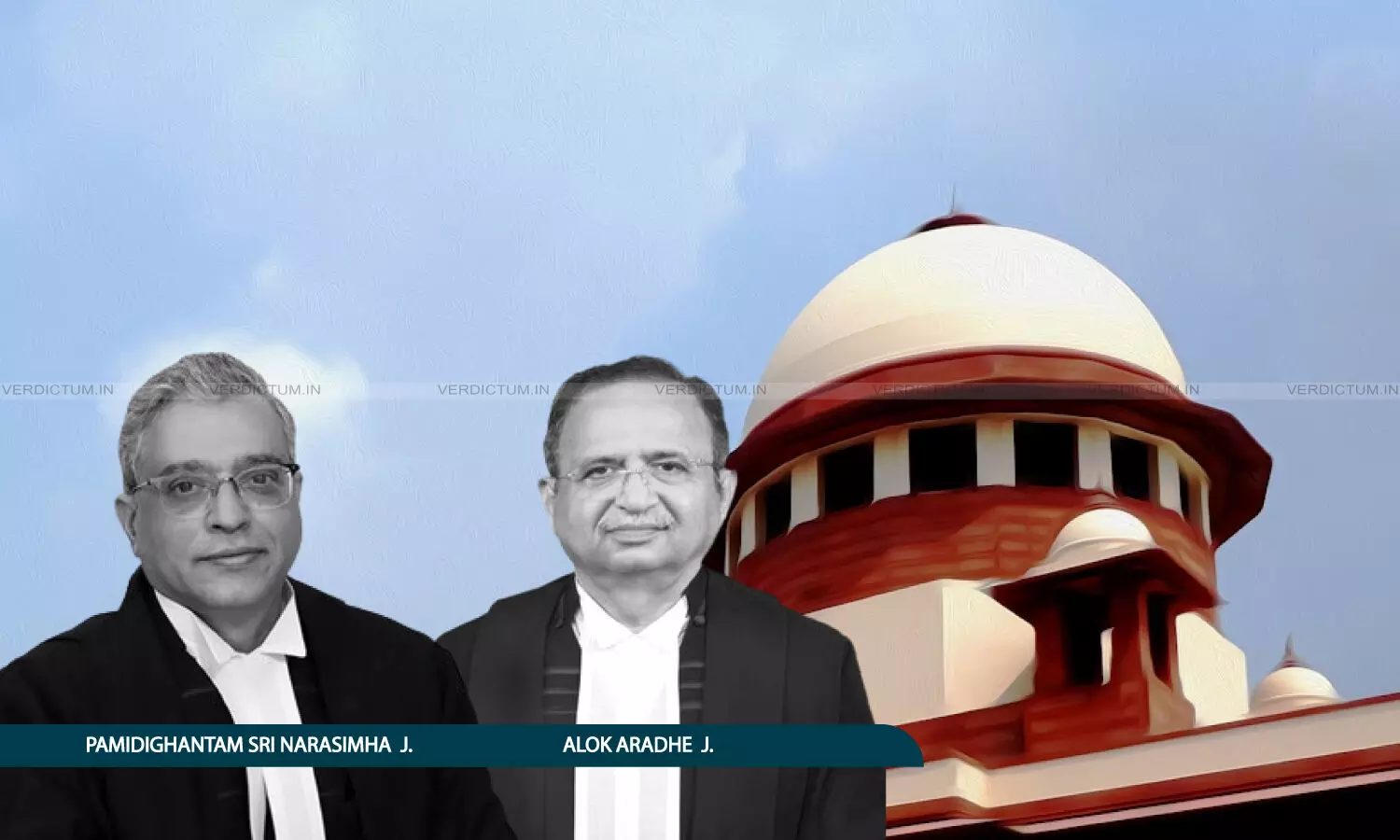
Justice Pamidighantam Sri Narasimha and Justice Alok Aradhe, Supreme Court
Corporate Guarantees Executed By Corporate Debtor Constitute "Financial Debt" U/S 5(8) IBC: Supreme Court
 |
|The Bench held that non-disclosure of guarantees in financial statements or technical stamping defects cannot strip lenders of financial creditor status.
The Supreme Court has held that liabilities arising from corporate guarantees squarely constitute "financial debt" within the meaning of Section 5(8) of the Insolvency and Bankruptcy Code, 2016 (IBC).
In a significant win for the State Bank of India (SBI) consortium, the Court held that the mere non-disclosure of such guarantees in a debtor's financial statements or technical defects in stamping cannot be used to strip lenders of their status as financial creditors. By reversing the concurrent findings of the lower tribunals, the Court reinforced the principle that a guarantor’s liability is coextensive with the principal borrower and remains enforceable throughout the Corporate Insolvency Resolution Process (CIRP).
Justice Pamidighantam Sri Narasimha and Justice Alok Aradhe observed, “…the corporate guarantees executed by the corporate debtor constitute “financial debt” within the meaning of Section 5(8) of the Code. The appellants are entitled to be recognized as financial creditors”.
N. Venkataraman, A.S.G. appeared for the appellant and Senior Advocates Narender Hooda, Neeraj Kishan Kaul, Gopal Jain, Abhishek Manu Singhvi, and Prashanto Chandra Sen.
The dispute originated from credit facilities extended by the SBI consortium to group entities of Reliance Infratel Limited (RITL), the Corporate Debtor (CD).
While RITL stood as a guarantor for loans to Reliance Communications Ltd. (RCOM) and Reliance Telecom Ltd. (RTL), respondent Doha Bank challenged the validity of these corporate guarantees during the CIRP.
The respondents alleged that the guarantees were fraudulent, insufficiently stamped, and executed when the entities were already in default, as the accounts were classified as NPA with retrospective effect. They further argued that the absence of these liabilities from RITL’s financial statements rendered the claims unverifiable.
Thereafter, the National Company Law Tribunal (NCLT) and subsequently the National Company Law Appellate Tribunal (NCLAT) rejected the SBI consortium’s claims. Both tribunals held that the consortium failed to meet statutory verification requirements and that the timing of the guarantees was highly suspicious given the prior NPA classification.
This led to the order for the Committee of Creditors (CoC) to be reconstituted to exclude the consortium, a decision the appellants challenged before the Apex Court as being legally perverse.
The Supreme Court, thus, noted that the financial debt definition hinges on the disbursal of money against the consideration for the time value of money, an element inherent in these corporate guarantees.
The Court found the tribunals' findings of non-verification to be perverse, noting that the Resolution Professional had indeed verified the documents at the Security Trustee’s office in New Delhi. On the issue of stamping, the Court reiterated that improper stamping is a curable defect and does not render an instrument void. It further noted that since the guarantees were produced in New Delhi, the Maharashtra Stamp Act was inapplicable.
“…Merely because the corporate guarantees were not filed along with Form-C, the claim of the appellants could not have been negated. The tribunals at the instance of a lender grossly erred in rejecting the claim raised by the consortium of lenders. For the reasons already assigned by us, in our considered opinion, the perversity of the findings of the tribunals are glaring and manifest, beseeching interference by this Court in second appellate jurisdiction...”, the Bench noted.
Accordingly, the Bench quashed the orders of the NCLAT and NCLT, setting aside all consequential actions taken during their subsistence. It issued a mandatory direction to the Resolution Professional to recognise the SBI consortium as "financial creditors" and to immediately reconstitute the Committee of Creditors to include the appellants. The CIRP is directed to proceed in accordance with the law from this newly reconstituted stage.
Cause Title: State Bank of India & Ors. v. Doha Bank Q.P.S.C. & Anr. (Neutral Citation: 2026 INSC 423)
Appearances:
Appellants: N. Venkataraman, A.S.G., Sanjay Kapur, AOR, Surya Prakash, Shubhra Kapur, Santha Smruthi, Anuraj Mishra, Advocates.
Respondents: Abhishek Manu Singhvi, Sr. Adv., Prashanto Chandra Sen, Sr. Adv., Juris Corp., Jayesh H, Jinal Shah, Dhruv Malik, Palak Nenwani, Ronit Chopra, Sayantan Chandra, Rajlakshmi Singh, Vanisha Mehta, Gopal Jain, S. S. Shroff, Vaijayant Paliwal, Charu Bansal, Shruti Poddar, Neeraj Kishan Kaul, Sr. Adv., Rajendra Barot, Nilang Desai, Abhijnan Jha, Saloni Thakker, Nafisa Khandeparkar, Bharat Makkar, Pranav Tomar, Harshil Goda, Narender Hooda, Sr. Adv., Naman Saraswat, Tavinder Sidhu, Vikas Soni, Kanav Singhal, Kamini Sharma, M. V. Kini & Associates, Advocates.