Prolonged Separation Can Be Treated As An Indicator Of Mental Cruelty To Grant Divorce Under Hindu Marriage Act: Supreme Court
 |
|The Court held that confirmation of a decree of divorce by an Appellate Court after considering prolonged separation, cessation of cohabitation and emotional alienation amounts to a lawful application of the statutory ground of cruelty and not an exercise of powers under Article 142 of the Constitution.
The Supreme Court has held that an Appellate Court may legitimately treat a prolonged period of separation as an indicator of mental cruelty within the meaning of Section 13(1)(ia) of the Hindu Marriage Act, 1955, particularly where spouses have remained estranged for several years without any genuine effort towards reconciliation or restoration of matrimonial life.
The Court was hearing a Civil Appeal arising out of a judgment passed by the Rajasthan High Court at Jaipur allowing an appeal filed by the respondent-husband and setting aside the judgment and decree of the Family Court, Bharatpur, which had dismissed a divorce petition instituted under Section 13(1)(ia) of the Hindu Marriage Act, 1955, seeking dissolution of marriage on the ground of cruelty.
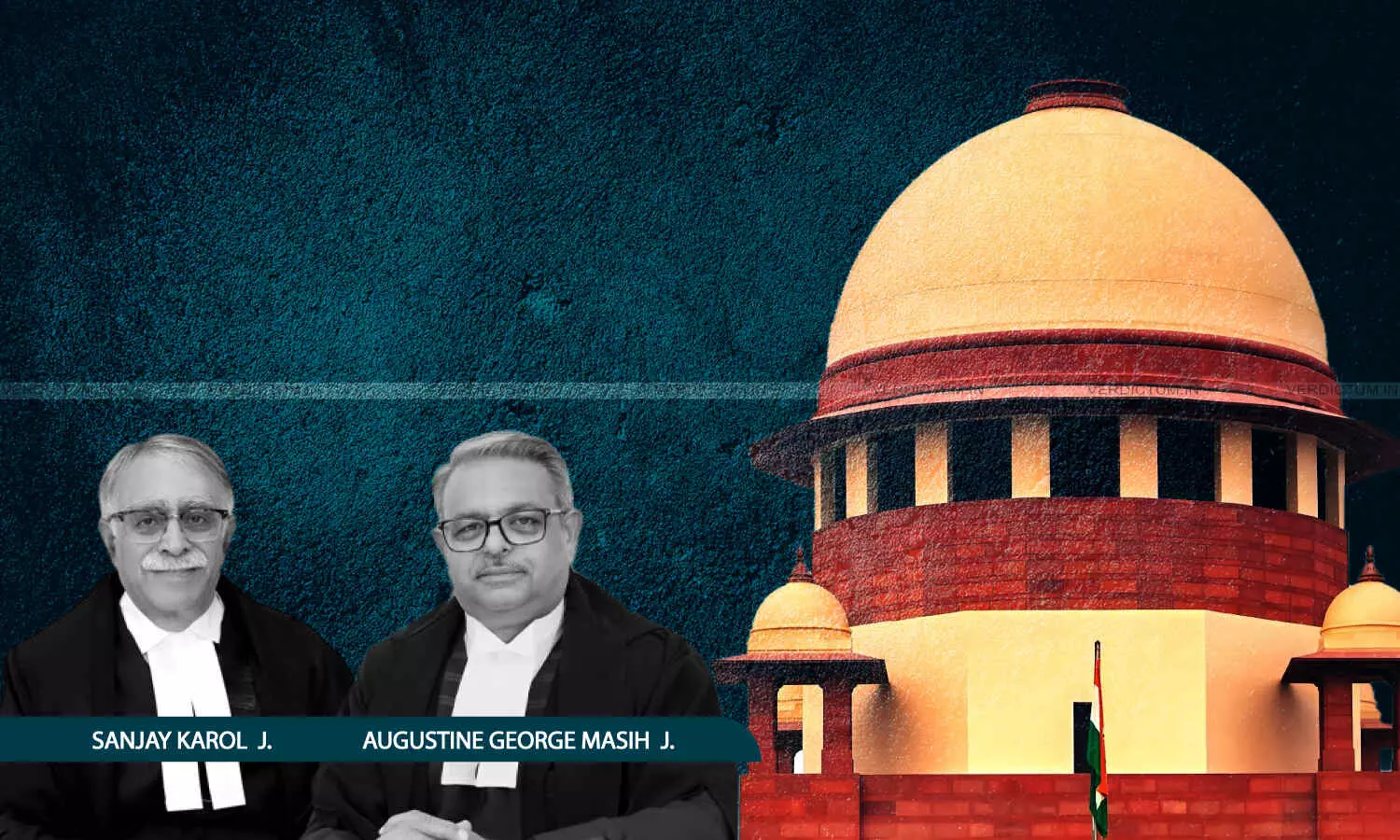
A Bench of Justice Sanjay Karol and Justice Augustine George Masih observed: “An Appellate Court, while carefully ensuring that a party does not profit from their own manifest wrong or unilateral desertion, may legitimately treat a prolonged period of separation as an indicator of mental cruelty within the meaning of Section 13(1)(ia) of the HMA.”
Advocate Neeraj Shekhar appeared for the appellant-wife. Advocate Mithilesh Jha appeared for the respondent-husband.
Background
The marriage between the parties was solemnised in December 2007 according to Hindu rites in Gujarat. No child was born out of wedlock. At the time of marriage, the appellant-wife was serving as a Gynaecologist in a government hospital in Gujarat, whereas the respondent-husband, who was also a doctor, was in State service in Rajasthan.
According to the respondent-husband, big sociocultural differences arose between the parties after marriage and cruelty was meted out to him during the matrimonial relationship. It was alleged that the appellant-wife resided with him at the matrimonial home only for about two to three months during the entire subsistence of the marriage.
The respondent-husband thereafter instituted a divorce petition before the Family Court under Section 13(1)(ia) of the Hindu Marriage Act, 1955, seeking dissolution of marriage on the ground of cruelty. The Family Court dismissed the petition after holding that cruelty had not been established.
Aggrieved thereby, the respondent-husband preferred an appeal before the Rajasthan High Court. The High Court allowed the appeal and granted a decree of divorce after holding that the appellant-wife had denied sexual relations on several occasions, insulted the respondent-husband publicly and that the parties had remained separated for over fifteen years.
Before the Supreme Court, the appellant-wife contended that she had never abandoned the respondent-husband and had always remained willing to continue the matrimonial relationship. It was further contended that the grounds of desertion and irretrievable breakdown of marriage had not been pleaded in the divorce petition and that the respondent-husband could not be permitted to take advantage of his own wrong.
The respondent-husband, on the other hand, contended that the parties had remained separated for more than fifteen years, had cohabited only for a brief period and that there existed no possibility of reconciliation.
Court’s Observation
The Supreme Court noted at the outset that the appellant-wife had consistently maintained throughout the proceedings that she did not want dissolution of the marriage and desired continuation of matrimonial life with the respondent-husband.
The Court further noted that the parties had remained separated for nearly fifteen years and that mediation efforts undertaken during the pendency of the proceedings before the Supreme Court had failed.
While examining the findings recorded by the High Court, the Supreme Court observed that the Family Court had rightly rejected the allegation relating to an incident involving a shopkeeper during a visit to the Taj Mahal.
However, on the issue of cruelty, the Court observed that the evidence on record disclosed that even during the brief period of cohabitation, the appellant-wife used to sleep separately and lock the room from inside, compelling the respondent-husband to sleep in another room.
Referring to Samar Ghosh v. Jaya Ghosh (2007), the Court reiterated that denial of conjugal rights and persistent refusal of sexual intercourse without reasonable cause constituted mental cruelty under Section 13(1)(ia) of the Hindu Marriage Act.
The Court observed: “The courts in India have repeatedly established that withholding sexual intimacy inflicts severe emotional distress and undermines the bedrock of marriage.”
The Court further observed that although desertion as a statutory ground had not been specifically pleaded, matrimonial disputes could not be confined to isolated legal labels and the Court was required to examine the overall conduct of the parties and the manner in which they discharged matrimonial obligations.
The Court observed: “Marriage, in its legal and constitutional dimension, can never be reduced to a mere contractual intersection of individual rights, nor can it be viewed strictly through the narrow lens of a petition for conjugal rights.”
Referring to the conduct of the parties, the Court observed that they had failed to perform their conjugal responsibilities even during the short period of cohabitation and had continued to maintain strongly held and irreconcilable views regarding matrimonial life.
Relying upon Nayan Bhowmick v. Aparna Chakraborty (2025), the Court observed that refusal of spouses to accommodate each other over a prolonged period could itself amount to cruelty.
The Court further observed that where parties have remained separated for a considerable duration without any genuine effort towards reconciliation, compelling them to continue the matrimonial relationship would itself amount to cruelty to both parties.
Referring to the powers of an Appellate Court while considering subsequent developments during pendency of proceedings, the Court observed: “Appeal is the continuation of a suit, and therefore, the Appellate Court would be entitled and justified to consider the conduct of the parties during the pendency of litigation.”
The Court further held that prolonged separation extending over several years, coupled with complete cessation of cohabitation and emotional alienation, may legitimately be treated as indicators of mental cruelty while adjudicating a matrimonial dispute under Section 13(1)(ia) of the Hindu Marriage Act.
The Court also examined the concept of irretrievable breakdown of marriage and referred to Vikas Kanaujia v. Sarita (2025), Shilpa Sailesh v. Varun Sreenivasan (2023) and R. Srinivas Kumar v. R. Shametha (2019).
Referring to the prolonged continuation of matrimonial litigation, the Court observed: “Prolongation of a matrimonial relationship would further lead not only to escalation of frustration in a dead relationship, which has already decayed and is decomposing day by day, creating foul sociological, psychological and mental hollowness in life.”
Conclusion
The Supreme Court held that the parties had admittedly remained separated for more than fifteen years and that all efforts at reconciliation had failed. The Court further noted that both parties were doctors serving in government service in different States and were financially independent.
The Court upheld the decree of divorce granted by the Rajasthan High Court on the ground of cruelty under Section 13(1)(ia) of the Hindu Marriage Act, 1955.
The Court further held that the present case was also fit for the exercise of powers under Article 142 of the Constitution of India on the ground of irretrievable breakdown of marriage.
Accordingly, the appeal filed by the appellant-wife was dismissed, and the marriage between the parties was dissolved.
Cause Title: ST v. VS (Neutral Citation: 2026 INSC 620)
Appearances
Appellant: Advocates Neeraj Shekhar, Kshama Sharma, Ritwik Prasad, Rajat Singh Chandel, Ujjwal Ashutosh, Avi Sahai, Rajesh Maurya
Respondent: Advocates Mithilesh Jha, Rishika Chahar, Sanskriti Mishra, Tarun Chauhan