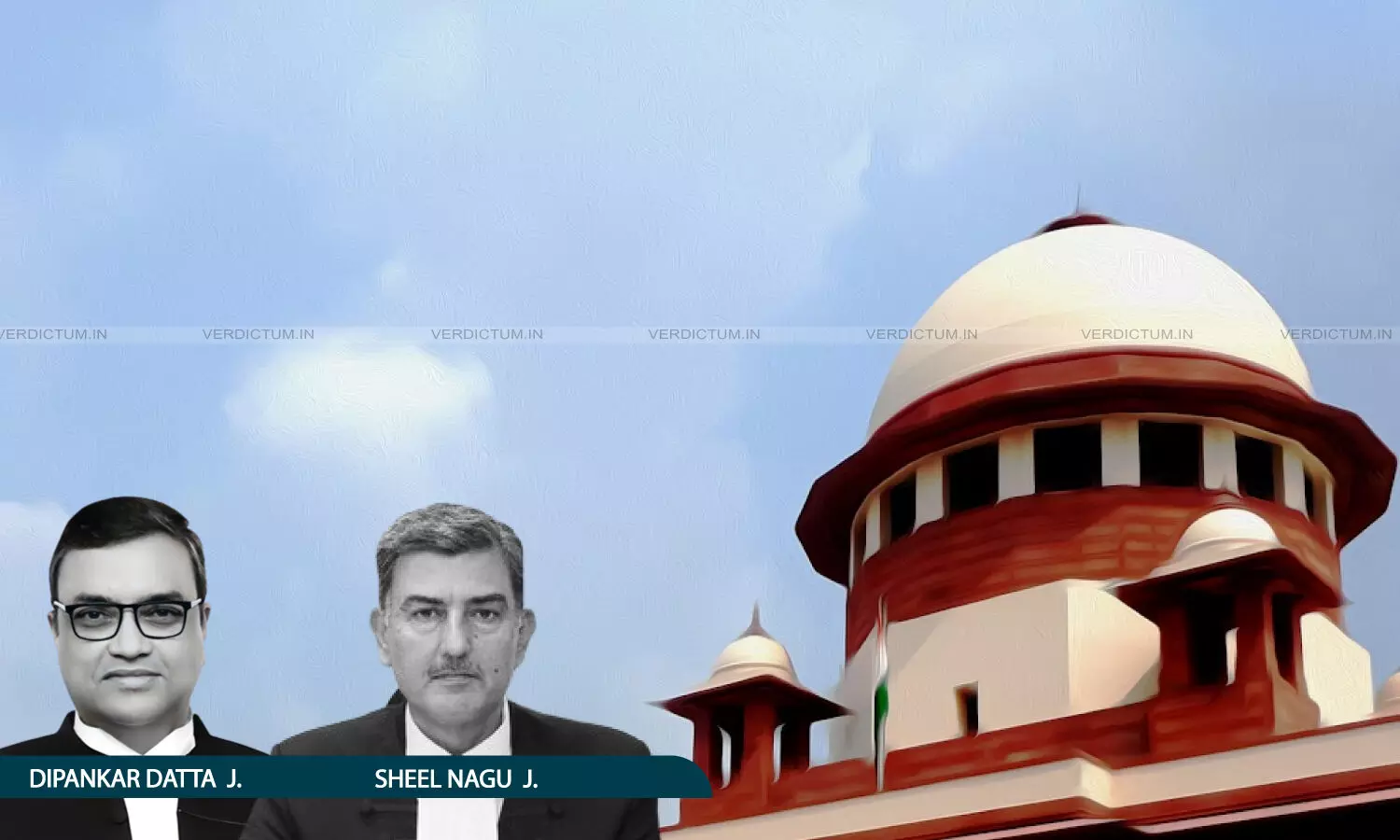
Justice Dipankar Datta, Justice Sheel Nagu, Supreme Court
Compulsory Retirement Order Partaking Character Of Backdoor Disciplinary Proceeding Is Indefensible: Supreme Court Orders ₹15L Compensation To Ex-ITS Officer
 |
|The Supreme Court was considering an appeal by special leave filed by a former Indian Trade Service (ITS) officer challenging the judgment of the Delhi High Court.
The Supreme Court has granted relief to a former Indian Trade Service (ITS) Officer by setting aside his compulsory retirement and asking the Centre to pay ₹15 lakh to him as compensation. The Apex Court further observed that any order of compulsory retirement partaking the character of a backdoor disciplinary proceeding, clandestinely avoiding the safeguards embodied in Article 311 of the Constitution, would be indefensible.
The Apex Court was considering an appeal by special leave filed by a former Indian Trade Service (ITS) officer challenging the judgment of a Division Bench of the Delhi High Court declining to interfere with the judgment of the Central Administrative Tribunal upholding the order compulsorily retiring the appellant from service a little less than 5 (five) years before his date of superannuation.
The Division Bench of Justice Sheel Nagu and Justice Dipankar Datta held, “...a promotion earned on merits, and not by dint of seniority alone, immediately prior to such order of compulsory retirement being made would, by itself, render the order susceptible to invalidity. This is for the reason that the merit-based promotion, not long ago, would stand as proof of a recent and objective assessment of the entire service record and a finding that the servant is fit for shouldering higher responsibilities, which is irreconcilable with the finding and thus negates the very foundation of the order, namely, that the servant has become dead wood, or is of doubtful integrity, and has outlived his utility. Any order of compulsory retirement partaking the character of a backdoor disciplinary proceeding, clandestinely avoiding the safeguards embodied in Article 311 of the Constitution, would be indefensible”, it added.
“The appeal, thus, stands allowed, with costs assessed at ₹ 6 (six) lakh to be paid by the respondent to the appellant. For the loss of reputation suffered by the appellant, we order the respondent to compensate him in a further sum of ₹ 9 (nine) lakh”, it directed.
Factual Background
The appellant was appointed to the Indian Trade Service in the year 1989. He was eventually promoted as Joint Director General of Foreign Trade in 2001. In 2017, he was placed in the Senior Administrative Grade of the ITS at the level of Joint Secretary and was promoted thereto regularly. The appellant claimed that the order dated May 10, 2018 of compulsory retirement came without any forewarning. The competent authority directed his premature retirement from service in exercise of the power under FR 56(j), before he attained the age of superannuation, without any complaint of worth. A detailed representation challenging the order partially succeeded, and the matter was remanded by the Representation Committee to the Review Committee, which maintained the earlier order and rejected the appellant’s challenge.
The Appellant challenged the order compulsorily retiring him as well as the order of rejection of the representation by instituting an original application before the CAT. The same came to be dismissed. His appeal before the High Court also failed, leading to the filing of the appeal before the Apex Court.
Reasoning
Delving into the law relating to compulsory retirement, the Bench explained that the proposition that an order of compulsory retirement in public interest is non-punitive does not elevate itself into a mantra which, by its mere invocation, can validate such order and repel all challenges laid to it.
On a perusal of the facts of the case, the Bench found that the appellant was found fit for promotion by none other than the UPSC and granted promotion to the post of Joint Secretary barely two months prior to the order of retirement with the approval of the ACC. The Bench stated that such grant of promotion was an unequivocal recognition by the department concerned that the appellant’s service was not only highly satisfactory and meritorious but that he was an officer who should be entrusted higher responsibilities. “Having promoted the appellant, barely a couple of months later, the superior officers in the department could not have branded him, so to say, ‘dead wood’ to justify weeding him out in purported public interest”, it mentioned.
As per the Bench, a selective bureaucratic reliance only on a particular subset of precedents favouring the department, divorced from the qualifications and balancing principles which accompany the propositions relied upon, could not furnish a rational basis for the exercise of power under FR 56(j). “The vice, therefore, is not in the propositions canvassed by the Review Committee, but rather, in their selective invocation and application, to justify, ex post facto, a decision already taken”, it added.
The Bench was of the view that the respondent-department was certainly entitled to review the services of the appellant, notwithstanding his promotion. “But where the very same departmental machinery had, after consideration of his record, found him fit for a higher post of Joint Secretary, the subsequent conclusion that his continuance was no longer in public interest required more than a general invocation of the expression “questionable integrity”, it added.
The Bench thus held that the order retiring the appellant compulsorily taking the aid of FR 56(j) suffered from a manifest contradiction and was not sustainable, being thoroughly vitiated by malice in law. Considering the fact of the appellant’s promotion as Joint Secretary roughly a few months before the impugned order, the Bench held, “To brand an officer like the appellant – who dedicated the best years of his life to the service of the nation – as dead wood and to weed him out from service by invoking the specious ground that it is necessary to do so in public interest smacks of a high degree of malice and colourable exercise of power. One would strain the eyes in vain to find out anything to show that the impugned order of compulsory retirement is, indeed, passed in public interest!”
Thus, allowing the appeal, the Bench directed that the appellant be entitled to all such service benefits as per law had he not been fastened with the impugned order of compulsory retirement dated May 10, 2018. “This would include promotion on notional basis if any of the appellant’s juniors, during the period he remained out of service, was granted promotion”, it clarified while further ordering that the respondent be compensated with an amount of ₹15 lakh.
Cause Title: S.S. Das v. Union Of India (Neutral Citation: 2026 INSC 980)
Appearance
Appellant: AOR Anurag Ojha, Advocates Mrinal Singh, Vipul Kumar, Tathagat Thakur
Respondent: Additional Solicitor General Anil Kaushik, AOR Gurmeet Singh Makker