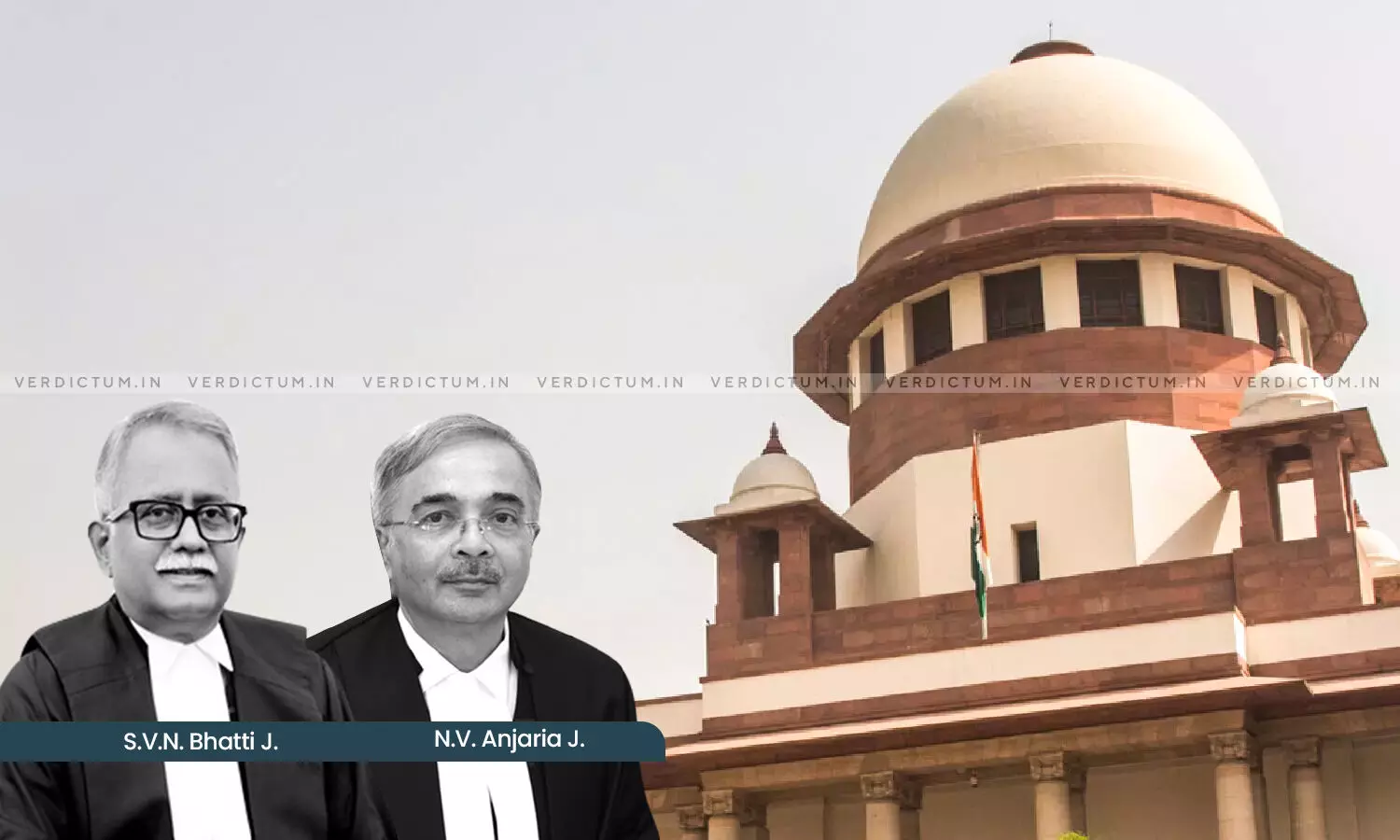
Justice S.V.N. Bhatti, Justice N.V. Anjaria, Supreme Court
“Bharat Is Now A Rich Country But Has Poor Sanitation Performance”: Supreme Court
 |
The Court flagged gaps in implementation of the Solid Waste Management Rules, 2026.
The Supreme Court, while examining the Short-Term Report filed by the Supreme Court Monitoring Committee (SCMC) on the implementation of the Solid Waste Management Rules, 2026, has observed that Bharat is now a rich country but has poor sanitation performance, and that the growth achieved in other fields is completely negated by the negative impact of this manageable dereliction by all the stakeholders.
The Court noted that the monitoring and implementation of the SWM Rules, 2026, as per the calendar set out by it, are nearing the halfway mark.
It said that while the administrative mechanism is in place and its directions have percolated through the SCMC to the Chief Secretaries, District Collectors and Local Bodies, the milestones are still far from realisation.
The Bench of Justice S.V.N. Bhatti and Justice N.V. Anjaria observed, “The Court notes that Bharat is now a rich country but has poor sanitation performance. The growth achieved in other fields is completely negated by the negative impact from this manageable dereliction by all the stakeholders. There is a need to emphasise that poor sanitation and solid waste management affect the outlook of our society and country. There are instances where similar economies, within India and outside India, have succeeded in their sanitation and hygiene objectives. Our existing resources make it possible, albeit through unwavering implementation by the statutory enforcing authorities and adherence by the citizens.”
Advocate-on-Record Vanshaja Shukla appeared for the Appellant, while Additional Solicitor General Aishwarya Bhati appeared for the Union of India.
The Secretaries of the Ministry of Environment, Forest and Climate Change, the Ministry of Panchayati Raj, the Department of Drinking Water and Sanitation (Ministry of Jal Shakti), the Department of Urban Development (Ministry of Housing and Urban Affairs) and the Ministry of Rural Development, along with the Member Secretary of the Central Pollution Control Board, were present as members of the SCMC. They assisted the Court in appreciating the report and its annexures.
The SCMC had filed a Short-Term Report along with annexures. The Court acknowledged that the first two phases, namely kickstarting and putting in place the administrative mechanism for monitoring, were in place, and that the SCMC was fully compliant with the stipulated timelines.
Among the milestones placed on record, the Court noted that the SCMC had convened four meetings with the stakeholders. Its letter dated 10.09.2026, addressed to the Chief Secretaries of the States and to the Railways, Defence, Information and Broadcasting and Education Departments, was followed up with reminders on four occasions.
The Court also recorded that 755 of 784 District Collectors are on the CPCB Portal, that Special Cells exist in 59% of Districts, and that 4958 out of 5049 ULBs and 699 of 701 District Panchayats have been onboarded. Special Gram Sabhas were convened in 89102 Gram Panchayats. The report further noted the installation of 4592 interception systems and the removal of 21324.69 metric tonnes of waste from the banks and water bodies, with the restoration of 778 river stretches either underway or substantially complete. In the “Swachhta Hi Seva 2026” programme, about 2.1 crore citizens, out of a total population of 140 crore, were claimed to have participated.
The Court, however, noted that approximately 400 Districts have yet to put in place Special Cells to assist the District Collectors, that only 9 out of 28 States comply with the Urban Bylaw target, that 16 States do not report on the incorporation of Rural Bylaws, and that 18 States do not report on rural four-way segregation of solid waste.
Referring to its 1980 decision in Municipal Council, Ratlam v. Shri Vardhichand and others, the Court recalled that Local Bodies cannot shirk their principal duty of health, hygiene and habitable conditions by pleading financial inability. It said, “In the last few decades, Bharat has seen substantial and perceptible economic growth. Therefore, a plea that failed in 1980 will definitely not work in the third decade of the 21st Century.”
The Court observed that, despite the Environment (Protection) Act, 1986 and the SWM Rules being in existence, the performance of the SWM Rules, 2016 and 2026, falls short of the objective set by Parliament.
It said, “This effort of the Supreme Court through the SCMC is not the fifth wheel trying to drive the other four wheels. As already noted in our earlier Orders, it is now or never. The SCMC’s efforts will sunset into self-regulation by the contributors.”
Stating that it had relied only on the District Collectors to achieve the objective of the Court and the Rules, the Bench observed, “The present Order is not an inspirational quote to the District Collectors but a reminder of the Apex Court’s expectations in them and their capacity, inasmuch as failure in the on going affairs will make the situation worse and remediless.”
The Court noted that the report was silent on several aspects. These included the notices served and the additional areas identified for temporary disconnection of water and electricity for compliance with the Rules; public-private participation; the statutory framework for CSR initiatives; biogas and waste-to-energy plants; and the initiatives undertaken by the State Governments to educate children and make them volunteers for implementing the SWM Rules.
The Court said that industries cannot be heard to say that the pollution is generated at one place and the CSR contribution is made elsewhere, and that the SCMC, through a proper framework, mandates industrial houses to spend CSR funds on solid waste management infrastructure at the place where the industry is located.
It found the Railways’ response neither positive nor encouraging, noting that the Railways had mapped only 630 out of 8809 stations to Local Bodies and that only 510 premises followed four-way waste handling. The SCMC was to issue further directions to the Railways for complete compliance within eight weeks.
The Court also noted that the report did not include a reply from the Ministry of Defence.
On the High Courts, the Court noted that neither a status report nor a reply had been received from the Registrars General of the High Courts, the only exception being the Lucknow Bench of the Central Administrative Tribunal.
It observed, “As the Judiciary, we should be first and foremost in implementing the Fundamental Duty enshrined in Article 51A(g) of the Constitution of India and the moral ground is added to constitutional jurisdiction conferred on the Judiciary.”
The Court directed the Chief Secretaries to instruct all District Collectors to upload geotagged and timestamped photographs showing the status of the facilities in ULBs and RLBs. The SCMC is to collate this information and place a District-wise status report on verifiable parameters in its next report.
The District Collectors were called upon to report category-wise, including private establishments and bulk waste generator (BWG) establishments, on the deficiencies noted and the steps taken, including notices issued for non-compliance. They are to ascertain the performance on the ground through drone surveys, video-call inspections and the staff of the Local Bodies. The Education Departments of the States were called upon to comply with the earlier orders without further delay.
The Court further directed that paragraph 8 of its previous order be implemented in letter and spirit. That paragraph had directed the Secretaries to explore including CSR contributions by industries for Compressed Biogas plants or other waste-to-energy technology in the extant scheme, with such funds to be used exclusively for improving the local bodies within whose jurisdictions the contributing industries are located.
Reminders were directed to be sent to the Railways and Defence, and the SCMC was asked to give further inputs on deficiencies in the monitoring mechanism.
Accordingly, the matter was listed for a further date.
Cause Title: Bhopal Municipal Corporation v. Dr Subhash C. Pandey & Ors. [Civil Appeal No. 6174/2023]
Appearances:
Appellant: AOR Vanshaja Shukla, Adv. Gunjan Chowksey, Adv. Ankeeta Appanna and Adv. Siddhant Yadav
Respondents: ASG Aishwarya Bhati, Sr. Adv. Shirin Khajuria, Sr. Adv. Arvind Nayar, AAG Shiv Mangal Sharma, AOR Raghavendra Pratap Singh, AOR Arpit Gupta, AOR Pashupathi Nath Razdan, AOR Salvador Santosh Rebello, AOR Saurabh Balwani, AOR Gurmeet Singh Makker, AOR Madhulika Upadhyay, AOR Vikramaditya Singh, AOR Pragati Neekhra, AOR Ranu Purohit, AOR Kedar Nath Tripathy, AOR Kumar Mihir, AOR Deepanwita Priyanka, AOR Siddhant Sharma, AOR Saurabh Rajpal, AOR Dr. Abhishek Atrey, AOR C. K. Sasi, AOR Avijit Mani Tripathi, AOR Aaditya Aniruddha Pande, AOR Sameer Abhyankar, AOR Surjendu Sankar Das, AOR Jamesh P. Thomas, AOR Swati Ghildiyal and others.