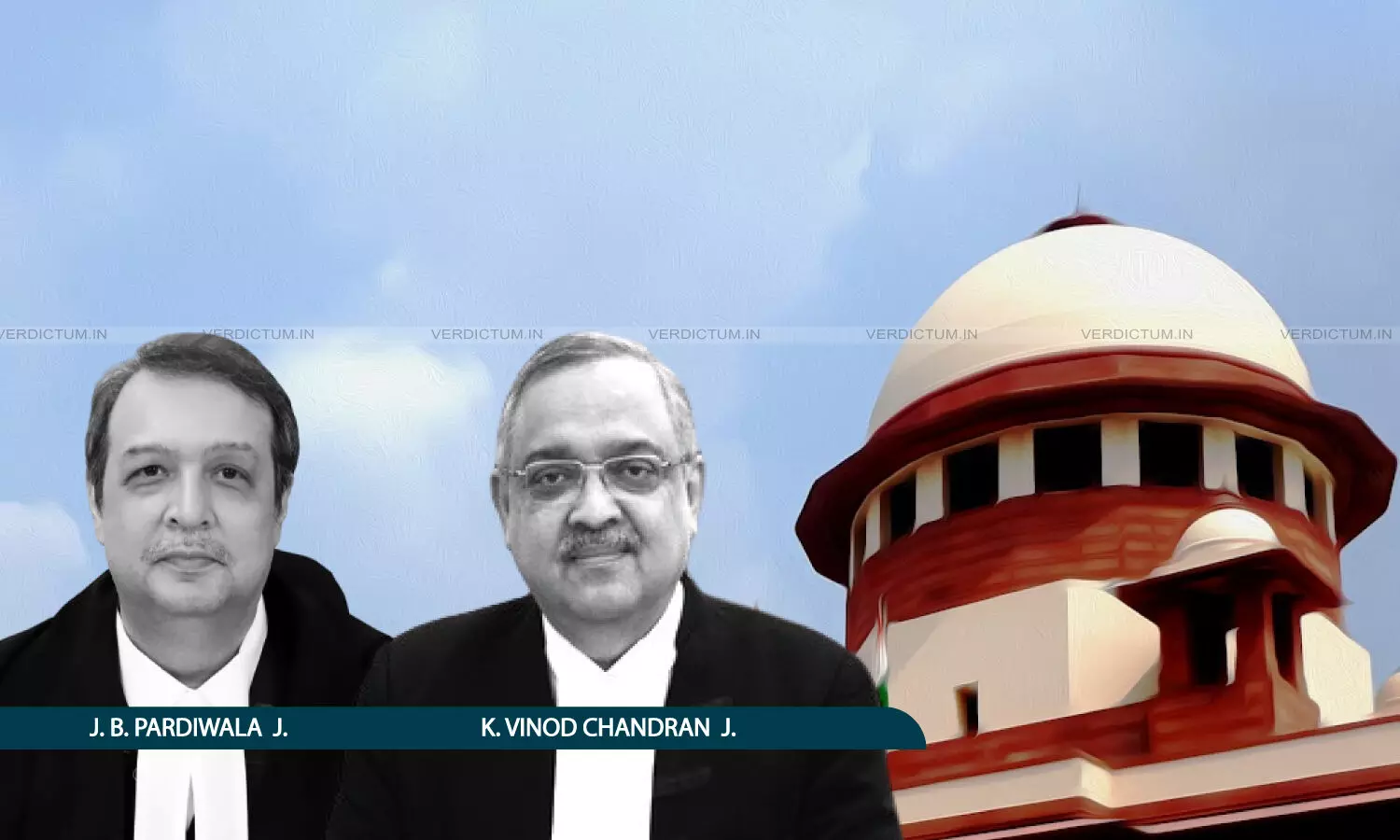
Justice J. B. Pardiwala, Justice K. Vinod Chandran, Supreme Court
UP Gangsters Act Is "Stillborn" As It Fails To Create An Offence: Supreme Court Quashes Proceedings Against Two Advocates
 |
|The Court noted that the U.P. Act merely lists offences punishable under other laws and re-punishes the offender under the guise of a "Gang Chart”.
The Supreme Court has categorically remarked that the Uttar Pradesh Gangsters and Anti-Social Activities (Prevention) Act, 1986 is "stillborn" because it prescribes penalties for a status without defining or creating a distinct, substantive offence. Accordingly, the Bench quashed gangster charges and charge sheets against two advocates, holding that punishing individuals based solely on executive-prepared "Gang Charts" violates fundamental tenets of criminal jurisprudence and Article 20(1) of the Constitution of India.
The Bench noted that the U.P. Act operates on the flawed premise that an offence exists under the statute when none was ever defined. Drawing a contrast with statutes like MCOCA (Maharashtra) and GCTOCA (Gujarat), which explicitly define and penalize acts of organized crime, the Court noted that the U.P. Act merely lists offences punishable under other laws and re-punishes the offender under the guise of a "Gang Chart”.
A Division Bench comprising Justice J.B. Pardiwala and Justice K. Vinod Chandran observed, “…what is obviously absent in the U.P. Act is a provision determining the offence as one created under the Act. After defining gang, which includes commission of the offences listed under sub-clauses (i) to (xxv) and defining gangster as a member or leader or organiser of a gang, the punishment is prescribed for a gangster without an offence being created by statute; which makes the penal act, stillborn”.
“…We have found the Act to be stillborn, since there is no crime created under the Act and this would not in any manner affect the charges levelled under the other penal laws, which has to proceed on the lines demarcated in the CrPC and the respective penal statute, which makes the objectionable act, an offence under law. We also make it clear that we have not upheld the Gujarat Act or the Maharashtra Act referred to by us and the attempt was only to draw a distinction from these; of the creation of an offence under those Acts being totally absent in the U.P. Act. We may also not be mistaken as having approved the Full Bench of the Allahabad High Court and or upheld the negation of all the contentions raised against the Act, which would be left open for consideration, especially since we have only held the Act to be stillborn on the provisions as existing now”, the Bench further noted.
In the matter, two separate criminal appeals were filed by practicing advocates, Shiv Pratap Singh alias Chinu and Himanshu Srivastava. In the first case, a dispute over Bar Association elections in Fatehgarh, Farrukhabad led to disciplinary action and an FIR was lodged. Based on this single underlying matter, police prepared a Gang Chart and registered an FIR under Section 2/3 of the U.P. Act. In the second case, an advocate challenged proceedings under the Act stemming from a single FIR registered under the IPC and the SC/ST Act. In both matters, the High Court had declined to quash the charge sheets under Section 482 CrPC.
-No Crime Created (Nulla Poena Sine Lege): The U.P. Act defines "gang" and "gangster" in its definition clause (Section 2) and prescribes punishment (Section 3), but it fails to define any specific act or omission as an "offence." In criminal law, a statute cannot impose punishment without first creating a distinct statutory offence.
-Status Cannot Be Punished: The court ruled that penalizing an individual merely for being labeled a "gangster" via an administrative Gang Chart, rather than for a specific actus reus, amounts to punishing a status determined by the executive's ipse dixit, which is impermissible.
-Subordinate Legislation Overreach: Rules framed under Section 23 of the U.P. Act cannot be utilized by police or executive authorities to effectively create criminal liability or supplant legislative functions.
-No Bar on Underlying Charges: The judgment solely invalidates proceedings under the U.P. Gangsters Act. It does not affect, discharge, or quash prosecutions for underlying/predicate offences under the Indian Penal Code or other penal statutes, which must proceed independently under standard criminal procedure.
Highlighting the constitutional safeguard against arbitrary state action, the Bench observed that the statute provides long pre-trial incarceration without the procedural safeguards mandated in preventive detention laws. The Bench starkly noted that under the current framework, once a status is assigned by the executive, the trial before a Special Court becomes a foregone conclusion with "a statutory imprimatur to punish". Borrowing a line from George Orwell's quote “Those who abjure violence can do so only because others are committing violence on their behalf”, the Bench remarked that the enactment, on the pretext of abjuring violence, was in fact perpetuating it on unsuspecting citizens.
Cause Title: Shiv Pratap Singh Alias Chinu v. State of U.P. & Ors. (Neutral Citation: 2026 INSC 894)