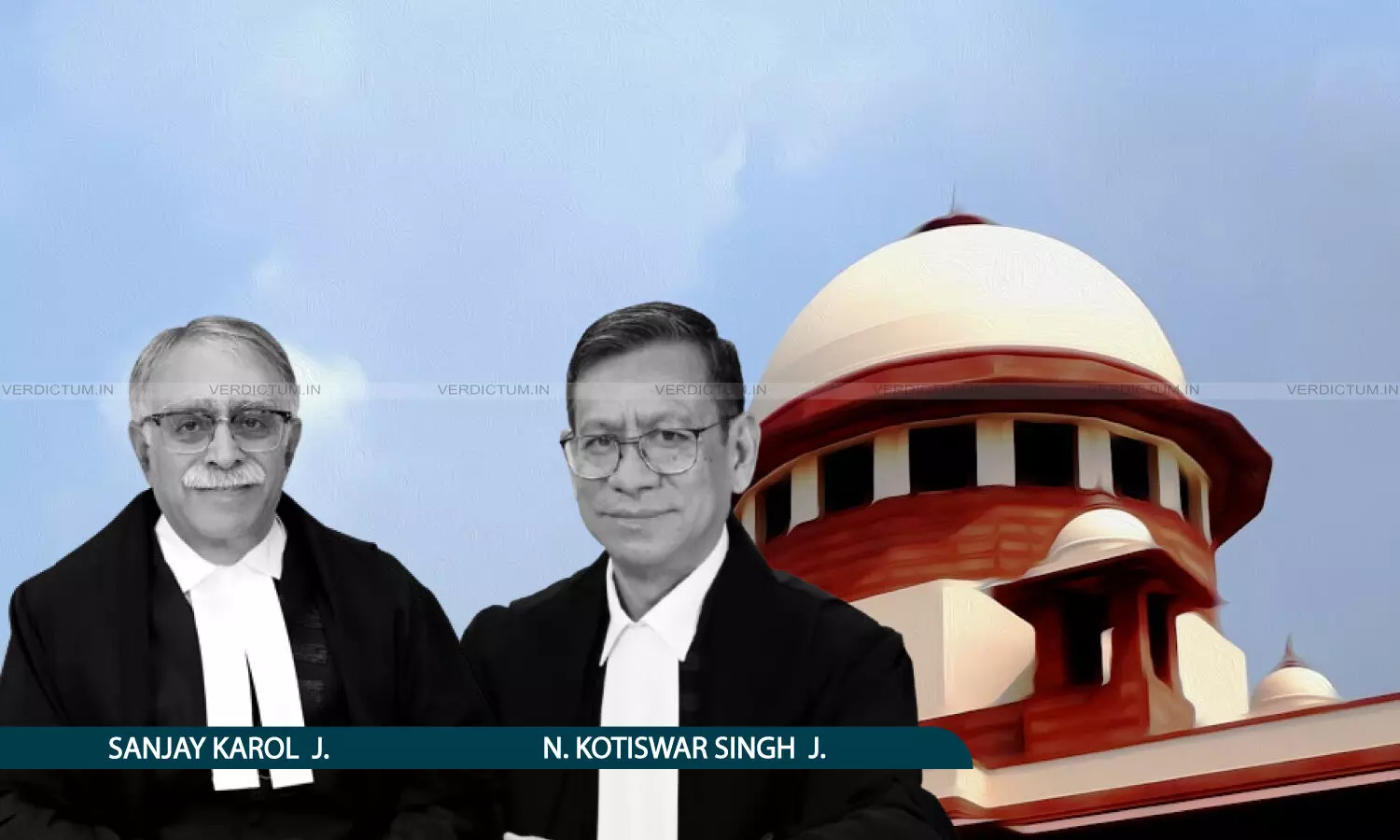
Justice Sanjay Karol, Justice N. Kotiswar Singh, Supreme Court
Homemakers Are “Nation Builders”; Invisible Contribution Should Be Made Visible: Supreme Court Adds "Loss Of Domestic Care" As Additional Head In Motor Accident Compensation Matters
 |
|Men too may don the role of a homemaker and deserve recognition, the Court observed while assessing value of domestic labour.
The Supreme Court has held that homemakers are the true "Nation Builders", whose often invisible and undervalued domestic labour forms the foundation upon which families, professionals, workers, and society at large function and contribute to the nation's progress. To standardise this recognition, the Court has observed that in motor accident claims involving the death of a homemaker, a separate, substantive head of "Loss of Domestic Care" must be mandatorily factored into the final computation of compensation.
The Bench categorically questioned that when Indian society calls a homemaker ‘grihaswamini’ (the owner of the house), then why are we still ‘groping in the dark’ by undervaluing her contribution as a mere dependent.
The Court expressed concern over the reality of third-generation litigation where accident victims' families are forced to wait decades for final adjudication, severely compounding their trauma. To dismantle this systemic failure, the Court issued a strict policy directive mandating all High Courts across India to remain vigilant and ensure that motor accident claim appeals are comprehensively decided within an absolute timeframe of four years.
A Division Bench comprising Justice Sanjay Karol and Justice Nongmeikapam Kotiswar Singh observed, “These are the people responsible for laying the foundation stones on which the edifices of the high flying business persons, successful politicians, headlining artists, sought after lawyers etc., on the one hand and on the other, the silent support behind the daily grind of an everyday worker who steps out of home in the hopes of making a decent living for the day in other words, they have a role either entirely invisible or just partially visible in the work of all those persons who are recognised to be contributing to the nation. It is high time now that the invisible is made visible or the veil is pierced to make what can be partially seen come out in the open. The ‘homemakers’, to put it directly, actually are the ‘nation builders’ and they ought to be recognised as such”.
“The claimant’s struggle for compensation is two-and-a-half decades old. In other words, delay is front and centre in this case. The other issue presented is the monetisation of a homemaker’s efforts since the deceased (wife of the claimant) was a homemaker. We may only ask ourselves when in Indian society, the ‘woman of the house’ is called the ‘grihaswamini’, then why n are we still groping in the dark about the questions such as the one present in this case”, the Bench observed at the outset.
Advocate Karan Dewan appeared for the appellant and Ranjan Kumar Pandey, AOR appeared or the respondent.
In a significant departure from the norm, the Bench even remarked that, “It may be a matter of deep seeded gender stereotypes that when we think of the word ‘homemaker’ the picture that emerges is that of a woman. This however may not be appropriate in all cases. As a result on one circumstance or another, sometimes unfortunate sometimes not, a man may too need to don the role of a homemaker. It is not to take away from the efforts of these men who also deserve recognition and acknowledgment, but for the purposes of the present case and more particularly the quantification of domestic efforts, we limit its application to the quintessential and traditional image, that of a woman”.
The brief facts arise from a fatal road accident that occurred on November 25, 2001. The deceased, a traditional homemaker and the wife of the first appellant, was traveling from Sirsa to Fatehabad when she succumbed to fatal injuries caused by the rash and negligent driving of a vehicle owned and driven by the respondents.
The MACT originally allowed the claim petition in December 2003, awarding a meagre sum of ₹ 2,42,000. Dissatisfied, the legal heirs filed an appeal for enhancement before the High Court of Punjab and Haryana in 2004.
Due to an unfortunate fire incident in the High Court registry in 2011, the case file was destroyed and tragically remained pending for reconstruction for fourteen years. The High Court finally decided the matter in December 2024, enhancing the compensation to ₹ 8,43,400 with a staggered interest rate. The claimants subsequently moved the Supreme Court seeking a fair quantification.
Pertinently, the Court enhanced the compensation from the High Court's award of ₹ 8,43,400 to a final sum of ₹ 18,34,510. To arrive at this figure, the Court assessed the homemaker's monthly notional income at ₹ 4,500, added 25% for future prospects, and applied a multiplier of 14 to fix the loss of dependency at ₹ 9,45,000. Crucially, it added a distinct head of ₹ 6,00,000 for "Loss of Domestic Care", alongside ₹ 2,40,000 for loss of consortium, ₹ 18,000 for loss of estate, ₹ 18,000 for funeral expenses and ₹ 13,510 for medical costs. The entire enhanced package carries 9% annual interest from the original 2001 claim petition until realization.
The Court placing reliance on economic paradigms and the National Statistical Office's 2019 Time Use Survey, observed that a homemaker's services cannot be equated to a hired housekeeper working fixed hours.
It extracted the ratio that a homemaker's domestic, psychological, and emotional labor results in real monetary savings, preserves human capital, and forms an economic entity that directly fuels the national economy. Consequently, the loss of personal care and attention must sound in substantial, separate damages.
“On the emotional and psychological plane, the inherent ability of a homemaker to juggle multiple aspects whether it is meals, properly ironed clothes, stocking up supplies, caring for the elderly in the house, ensuring that the children stay on top of their schoolwork and so many more things that enabled, to use a somewhat stereotypical expression, the ‘men of the house’, to have their undivided focus on earning a good living. They provide a sense of insulation from the pressures of the outside world, a bubble in which everything is taken care of and all that is needed for the people therein, is to relax and rejuvenate preparing themselves for what the next day might bring...”, the Bench observed.
“…In the majority of households, this is taken to be ‘normal’ but the truth is that those who do not have this luxury, truly understand what is missing in their lives. The family members in households where the homemaker is absent be it for whatever reason, are often required to come together and each individual therein will do a part of the work that would otherwise fall to the absent individual who would, in fact do it with a smile on their face”, the Bench further said.
It strictly mandated that the 10% triennial interest enhancement stipulated in the National Insurance Co. Ltd. v. Pranay Sethi (2017) 16 SCC 680 judgment must apply to all conventional heads. To curb future systemic delays, the Court directed all High Courts to ensure a four-year disposal cap for such appeals and encouraged Tribunals to actively adopt summary procedures for swift adjudication.
“The loss of a homemaker however is not limited to husband and children. It also directly impacts the women’s own parents who have been deprived of the love and company of their child, who have lost the support and comfort of this person and are left alone with this boundless grief. Still further, the loss is acutely felt by her in-laws who are more often than not members of the same household and therefore are dependent on the love, labour and dedication of this person, for food for medicines and doctor’s visit or for even the regular company over a morning tea. Strict arithmetic calculation does not lend its services to any of these scenarios”, the judgment further read.
Cause Title: Shishu Pal @ Shish Ram & Ors. v. Surjeet & Ors. (Neutral Citation: 2026 INSC 634)
Appellant: Karan Dewan, Kartik Yadav, Aanchal Jain, AOR, Advocates.
Respondent: Ranjan Kumar Pandey, AOR, K.K. Bhat, Amit Kumar Singh, AOR, K. Enatoli Sema, Chubalemla Chang, Prang Newma, Advocates.