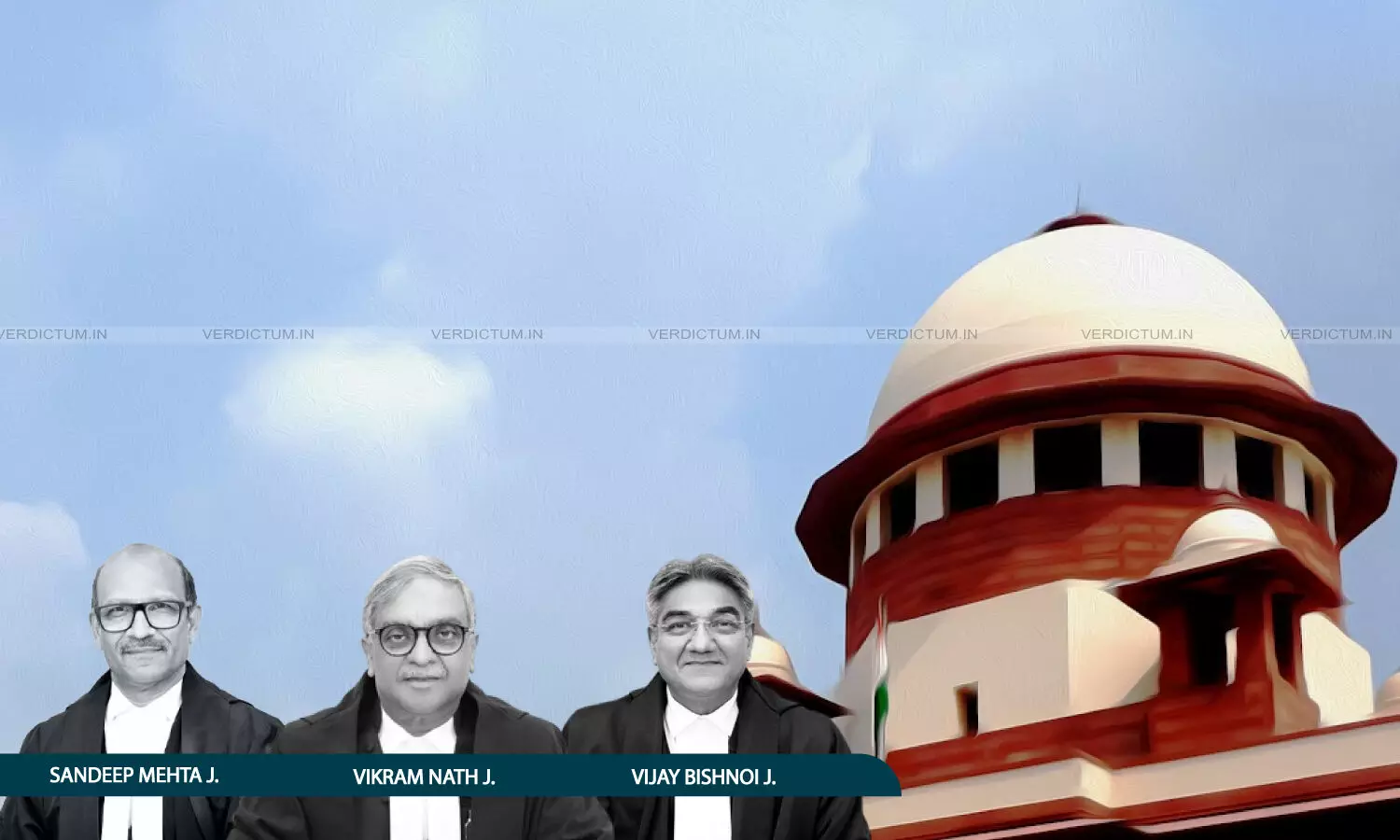
Double Murder By Terminated Employee Fueled By Frustration: Supreme Court Commutes Death Sentence To 25-Year Jail Term Without Remission
 |
|The Bench noted that the man belonged to lower echelon of society and was driven, in part, by the frustration of repeated rejection of his pleas for re-engagement.
The Supreme Court has commuted the death sentence awarded to a man (a terminated employee) convicted of brutally murdering his former employer and a co-worker in Dehradun in 2011, holding that while the crime was premeditated and heinous, it did not fall within the “rarest of rare” category warranting capital punishment.
The Court observed that the murders were traceable to the accused’s frustration following the loss of his livelihood and could not be equated with crimes exhibiting such extreme moral depravity or exceptional brutality as to foreclose the alternative of life imprisonment.
Therefore, the Bench upheld the conviction for offences under Sections 302, 392, 411, 436 and 506 IPC, along with Section 25/4 of the Arms Act, but modified the sentence from death to life imprisonment for a fixed term of twenty-five years without remission.
A three-judge Bench comprising Justice Vikram Nath, Justice Sandeep Mehta and Justice Vijay Bishnoi observed, “On a careful and holistic consideration of the aforesaid aggravating and mitigating circumstances, we are of the opinion that the offence committed by the appellant, howsoever, brutal and heinous, cannot be brought within the purview of the “rarest of rare” category… The double murder, though arising from a calculated premeditation, was fueled by the frustration of a man who had been deprived of his livelihood and whose repeated requests for revival of employment were rejected. It is thus, not a case exhibiting such extreme moral depravity or exceptional brutality as would shock the collective conscience of society so as to warrant the imposition of death penalty…”.
“…we cannot be unmindful of the mitigating circumstances. The appellant had no prior criminal antecedents. The motive for the commission of the crime, howsoever reprehensible, was traceable to a perceivable grievance arising from the termination of employment, his only source of livelihood and was not rooted in any communal, political, gratuitous, or preying motivation. The appellant belongs to the lower echelon of society and was driven, in part, by the frustration of repeated rejection of his pleas for re-engagement. There is no material on record establishing that the appellant poses a continuing threat to society or is incapable of reformation and rehabilitation”, the Bench categorically noted.
Sanjay Kumar Dubey, AOR appeared for the appellant and Sudarshan Singh Rawat, AOR appeared for the respondent.
The prosecution case arose out of a gruesome incident at Hariom Automobile in Selakui, Dehradun, where the appellant had earlier worked as head mechanic. He was removed from service after a complaint by Lalita, a supervisor at the showroom.
The prosecution alleged that on February10, 2011, the appellant arrived at the premises armed with a concealed knife, slit the throat of showroom owner Sanjay Guleria, chased Lalita into an adjoining vacant plot and repeatedly stabbed her to death. He then allegedly threatened bystanders, set the showroom ablaze and fled on a customer’s motorcycle.
Affirming the conviction, the Bench found the testimonies of four eyewitnesses to be unimpeachable and beyond the pale of doubt. The Court noted that the witnesses consistently described the sequence of attack and were fully corroborated by medical evidence, forensic material and recoveries made from the accused on the same day. Rejecting the defence challenge based on inconsistencies in timing and alleged lapses in investigation, the Court held that minor variations in witness accounts did not affect the substratum of the prosecution case.
On sentencing, however, the Court found fault with sustaining the death penalty. It reiterated that capital punishment may be imposed only where life imprisonment is “unquestionably foreclosed” and where the crime falls within the constitutional framework laid down in Bachan Singh v State of Punjab (1980) 2 SCC 684.
The Bench acknowledged several aggravating factors, the murders were premeditated, committed in broad daylight, involved two victims, and were followed by arson and public threats. Yet it held that important mitigating circumstances could not be ignored.
Placing reliance on Swamy Shraddananda v. State of Karnataka (2008) 13 SCC 767 and the Constitution Bench ruling in Union of India v V. Sriharan alias Murugan (2016) 7 SCC 1, the Court held that a fixed-term life sentence without remission was appropriate.
It further referred to Navas @ Mulanavas v State of Kerala 2024 INSC 215 to underline that courts may impose a long non-remittable sentence where death is unwarranted but ordinary life imprisonment would be inadequate.
Accordingly, the Court commuted the death sentence under Section 302 IPC to life imprisonment for a fixed term of twenty-five years without remission, while affirming all other sentences and directing payment of an additional fine of ₹25,000.
The appeals were partly allowed.
Cause Title: Shahjad Ali @ Ali Ur Rehman v. The State Of Uttarakhand (Neutral Citation: 2026 INSC 557)
Appearances:
Appellant: Sanjay Kumar Dubey, AOR, Shuchi Singh, Rakesh Kumar Tewari, Vivek Kumar Pandey, Krishna Kant Dubey, Aayush Kesharwani, Shivani Mishra, Ujjwal Kumar Dubey, Advocates.
Respondent: Sudarshan Singh Rawat, AOR, Rachna Gandhi, Sunny Sachin Rawat, Advocates.