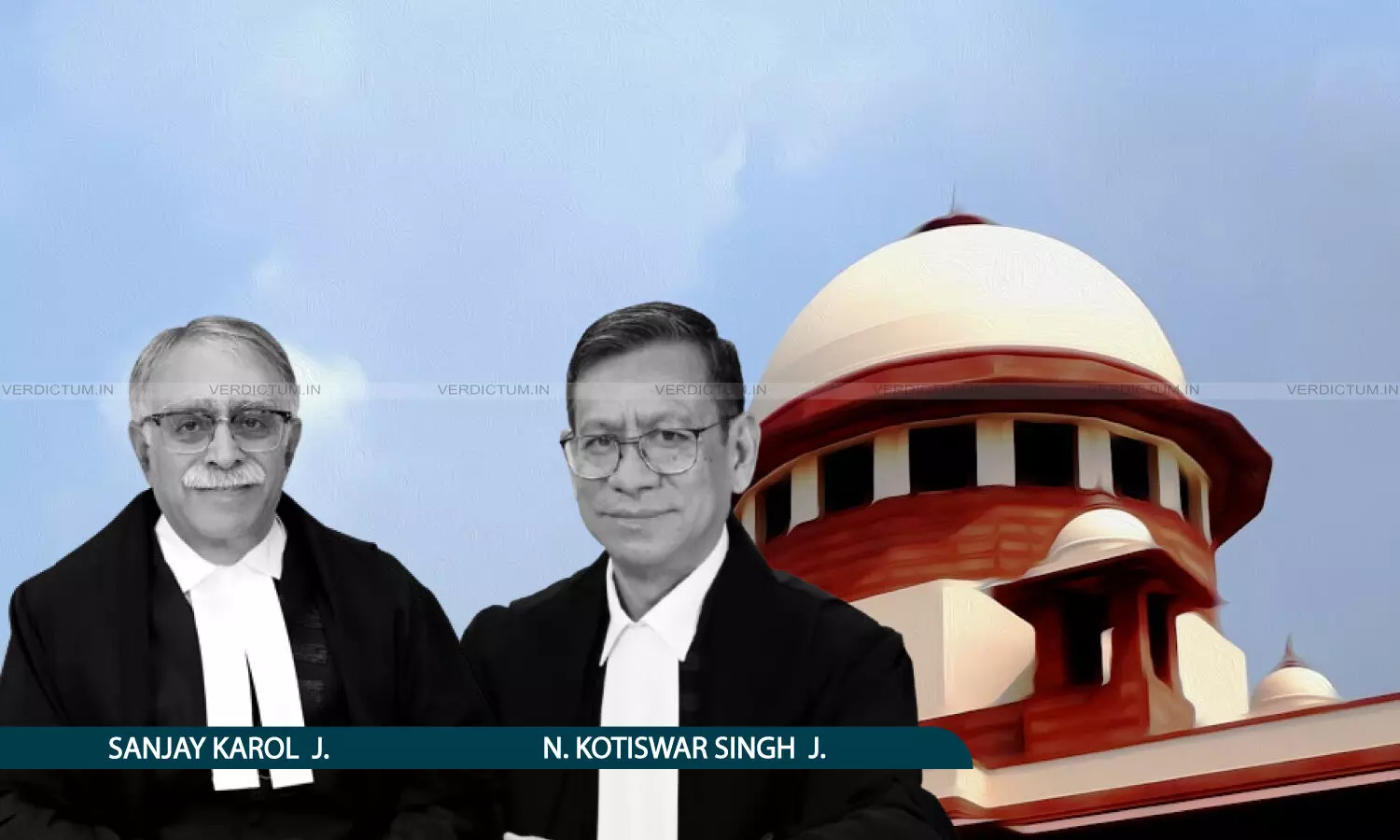
Justice Sanjay Karol, Justice N. Kotiswar Singh, Supreme Court
Dealing In Company’s Securities After Being Informed By Confidential Information Amounts To Insider Trading; Less Or No Profit Is Of No Consequence: Supreme Court
 |
|The Supreme Court was considering an appeal filed under Section 15Z of the Securities and Exchange Board of India Act, 1992.
While upholding an order of the Whole Time Member, SEBI, wherein the Chairman and other promoters of a Company were held guilty of insider trading under the SEBI Act, the Supreme Court has observed that the fact that the accused persons had indulged in the trades at the relevant point in time would be sufficient to conclude that they had conducted insider trading and less or no profit would not be of any consequence.
The Apex Court explained that insider trading is dealing in a company’s securities having been informed by confidential information which is likely to affect the price of the securities in the market, once such information is made public.
The Apex Court was considering an appeal filed under Section 15Z of the Securities and Exchange Board of India Act, 1992, challenging the correctness of the final judgment passed by the Securities Appellate Tribunal, Mumbai, whereby the SAT quashed the order passed by the Whole Time Member SEBI, holding the Respondents guilty of insider trading under the SEBI Act.
The Division Bench of Justice Sanjay Karol and Justice Nongmeikapam Kotiswar Singh held,"Let us first understand the concept of Insider Trading. In essence, it is dealing in a company’s securities having been informed by confidential information which is likely to affect the price of the securities in the market, once such information is made public. It qualifies as a breach of fiduciary duty by the employees of the company who are, by virtue of being such employees, privy to such insider information. The genesis of this concept is found in the United States of America, and the same is regulated by the Securities Exchange Act of 1934."
“As such, in view of the note appended to Regulation 4 (1) reproduced supra, the purposes for which the proceeds are employed is an irrelevant consideration. The fact that the respondents had indulged in the trades at the relevant point in time is sufficient to conclude that they had conducted insider trading. In that view of the matter, less or no profit, is of no consequence”, it added.
Factual Background
The Respondents in this case were the Chairman, Managing Director, Promoters and Vice Presidents of Tara Jewels Limited, a company engaged in buying and selling of jewelery. The first Respondent traded on the Bombay Stock Exchange and National Stock Exchange. It had entered the liquidation process, and the Company suffered losses of Rs.166.80 crores during the quarter ending in September 2017, whereas in the previous quarter ending in June 2017, the net loss was of Rs.6.62 Crores. For the same period, net Sales of the Company fell by approximately 69%.
During the Unpublished Price Sensitive Information Period, the first Respondent sold 30,93,948 shares owned by him, which was about 12.56% of the total shareholding of the company, and a further 29,75,000 shares by subsequent transactions. The other respondents sold their entire holding - 1,14,440 each. Consequently, a cumulative loss of approximately Rs.1.38 crores was avoided.
SEBI issued Impounding Order-cum-Show Cause Notice seeking explanation as to why appropriate directions should not be issued against them, as also the penalty imposed. The SCN culminated in an order of the WTM whereby all the three respondents were found to have committed insider trading prohibited under the SEBI Act and the Securities and Exchange Board of India (Prohibition of Insider Trading) Regulations 2015. The Respondents’ appeal before SAT was allowed. SEBI thus approached the Apex Court taking xception to the setting aside of the liability imposed upon the respondents.
Reasoning
Referring to Regulation 4 of the Securities and Exchange Board of India (Prohibition of Insider Trading) Regulations, 2015, the Bench stated that the same prohibited trading when in possession of UPSI. The Bench explained that it incorporates a rebuttable presumption that the trades done by the person in possession of such UPSI are motivated by the information contained therein, and it provides for scenarios where the person accused of having traded while in possession of such UPSI can demonstrate their innocence by demonstrating certain defences/circumstances.
The Bench further explained that at the end of Regulation 4(1) there is a note that embeds a presumption of trades so made being motivated by such knowledge and information in his possession, when such a person has UPSI. The Bench held that the intentions and the purposes to which the proceeds of the transactions are applied are thereby made irrelevant.
On a perusal of the facts of the case, the Bench noted that the respondents were in possession of UPSI and had sold of large portions or the entirety of their shareholding while in possession of such UPSI. It was also noticed by the Bench that Regulation 3B appears to deal with defences, in similar terms to what is provided in Regulation 4(1) in the 2015 PIT Regulations. “The most obvious difference that appears plain to us, is that there is no such ‘note’ as there is in the latter. In other words, there was no specific bar against the consideration of the issue of where the proceeds of such insider trading transactions are used”, it stated.
Reference was made to the judgment in SEBI v. Abhijit Rajan (2024) where the persons accused of insider trading had sold of the shares while in possession of UPSI apparently for the purposes of funding the Corporate Debt Restructuring Package. It was observed therein that one of the companies involved stood to gain “hugely” from the cancellation of the shareholders' agreements but had still proceeded with the selling of the shares since if the restructuring had not gone through, the parent company could have gone into bankruptcy.
The Bench was of the view that apart from the fact that in Abhijit Rajan (Supra) the shares were sold before the increase in price of the shares, as opposed to a fall in the prices in the present case, there was scope available for the Tribunal and the Court to consider why a particular person undertook the transactions in question. “Had it been that there was a fall in the shares of the company in that case, their intent to scrounge up the money for the CDR process for the parent company could have been considered. If the same transactions were after the 2015 PIT Regulations, that could not have been considered”, it added.
The Bench thus came to the conclusion that the respondents had engaged in insider trading and had avoided approximately Rs 1.38 crore in losses. Allowing the appeal and restoring the order of the WTM, the Bench reduced the penalty imposed upon the Chairman from Rs 25 lakh to 10 lakh.
Cause Title: Securities and Exchange Board of India v. Rajeev Vasant Sheth (Neutral Citation: 2026 INSC 826)