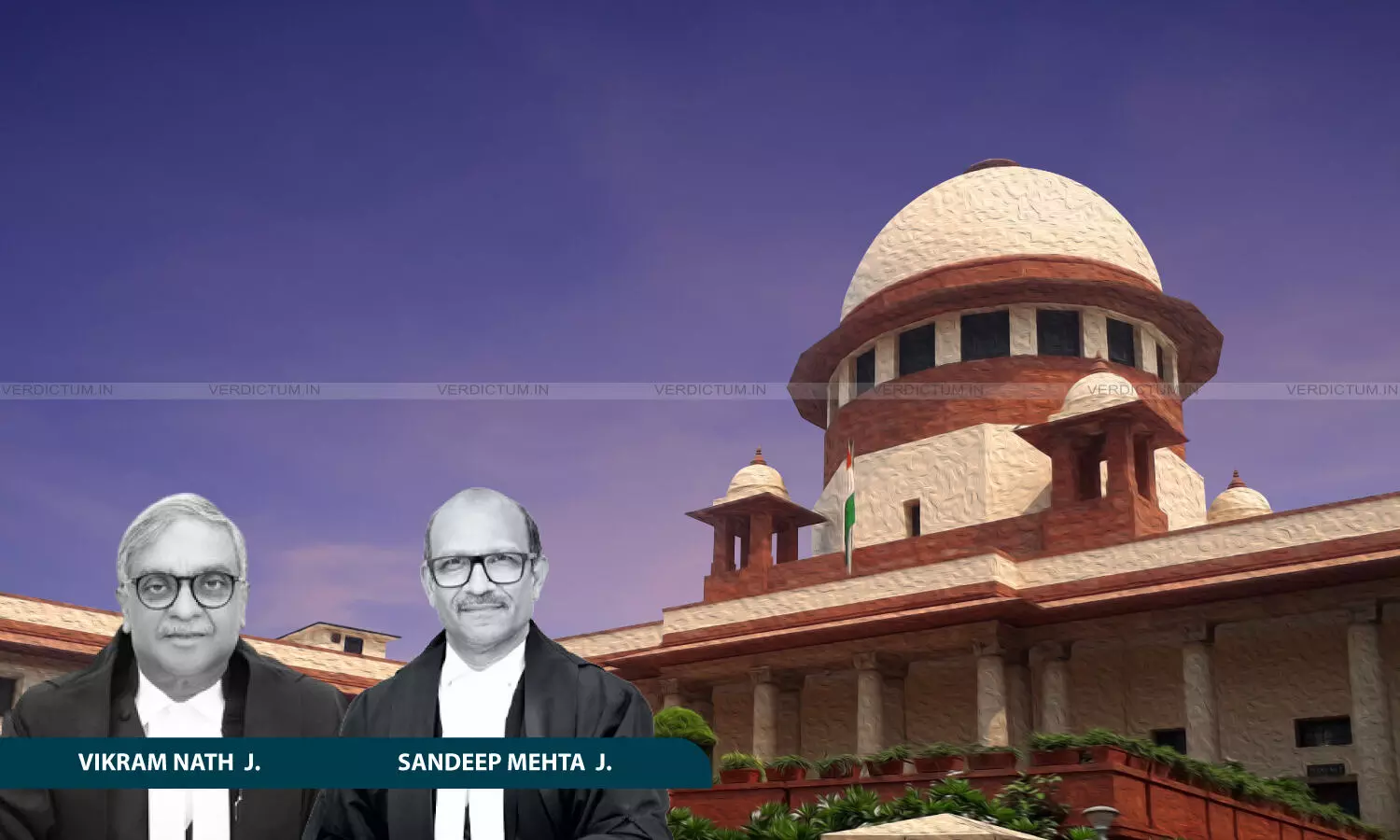
Justice Vikram Nath, Justice Sandeep Mehta, Supreme Court
Supreme Court Upholds Validity Of Rule 6 Of Karnataka State Human Rights Courts Rules Enabling Aggrieved Person To Directly Approach Human Rights Court
 |
|The Supreme Court was considering the appeals arising from the judgment striking down Rule 6 of the Karnataka State Human Rights Courts Rules, 2006.
The Supreme Court has upheld the validity of Rule 6 of the Karnataka State Human Rights Courts Rules, 2006 which enables an aggrieved person to directly approach the Human Rights Court. The Apex Court held that the said rule is not inconsistent with the provisions of the Protection of Human Rights Act, 1993.
The Apex Court was considering the appeals arising from the judgment passed by the Karnataka High Court striking down Rule 6 of the Karnataka State Human Rights Courts Rules, 2006 as unconstitutional, inconsistent with the provisions of the Protection of Human Rights Act, 1993 and ultra vires the rule-making power conferred upon the State Government under Section 41.
The Division Bench of Justice Vikram Nath and Justice Sandeep Mehta held, “The mere conferment of power upon the Commission to inquire into a complaint and, where appropriate, recommend initiation of prosecution cannot, in our view, be construed as making such an inquiry or recommendation an indispensable condition precedent to the initiation of criminal proceedings. Nothing in Sections 12 to 18 of the 1993 Act expressly provides that every prosecution concerning an offence arising out of a violation of human rights must originate from a recommendation of the Commission. Equally, Section 30 thereof does not make the jurisdiction of the Human Rights Court dependent upon the completion of any prior proceeding before the Commission. In our considered opinion, to read such a limitation into the statute would amount to supplying a condition which Parliament itself has not enacted.”
“In view of the foregoing discussion, we hold that Rule 6 of the 2006 Rules is not inconsistent with the 1993 Act and does not travel beyond the rule-making power conferred upon the State Government under Section 41 thereof. Rule 6 of the 2006 Rules is therefore intra vires the 1993 Act and is valid”, it added.
Additional Advocate General Avishkar Singhvi represented the Appellant while Senior Advocate Kiran Suri represented the Respondent.
Factual Background
The appellant arrayed as an accused in a criminal case instituted a private complaint before the Human Rights Court, Vijayapura, alleging violation of his human rights by certain police officials in connection with his custody. The Court referred the complaint to the Superintendent of Police, Vijayapura, for investigation under Section 156(3) of the Code of Criminal Procedure, 1973. Pursuant to the aforesaid order, a case came to be registered at Jalanagar Police Station, Vijayapura, against the concerned police officials.
The private respondents approached the High Court by filing a Writ Petition challenging the validity of Rule 6 of the 2006 Rules and also sought quashing of the proceedings. By the impugned judgment, the High Court allowed the writ petition and held Rule 6 of the 2006 Rules to be unconstitutional, inconsistent with the 1993 Act. Consequently, the case also came to be quashed. Aggrieved thereby, the appellant and the State of Karnataka preferred the proceedings before the Apex Court.
Issue
The principal question was whether Rule 6 of the 2006 Rules, insofar as it enables an aggrieved person to directly approach the Human Rights Court and prescribes the procedure to be followed on such a complaint, is inconsistent with the scheme of the 1993 Act or travels beyond the rulemaking power conferred upon the State Government under Section 41 of the said Act.
Reasoning
The Bench, at the outset, explained that Rule 6 of the 2006 Rules prescribes the procedure in respect of complaints before a Human Rights Court and it permits a victim of an offence arising out of violation of human rights, his legal representative or, subject to the prescribed authorization, a registered non-governmental organisation or public person to file a complaint against a public servant alleged to have committed or abetted such an offence while acting under colour of his office.
The Bench further explained, “A conjoint reading of the aforesaid provisions reveals that the 1993 Act contemplates two distinct institutional mechanisms for the protection and enforcement of human rights. On the one hand are the National and State Human Rights Commissions, which have been entrusted with powers of inquiry, investigation and recommendation under Sections 12 to 18 of the 1993 Act. On the other hand, Section 30 thereof expressly contemplates Human Rights Courts for the speedy trial of offences arising out of violations of human rights. The functions assigned to these two institutions are therefore not identical. The Commission primarily performs an inquisitorial and recommendatory role, whereas the Human Rights Court exercises judicial power in relation to offences arising out of violations of human rights.”
The Bench refused to accept the view that the rule-making power of the State Government under Section 41 of the 1993 Act is confined only to the matters enumerated in sub-section (2) thereof. “Section 41(1) thereof expressly empowers the State Government to make rules “to carry out the provisions of this Act”. More importantly, sub-section (2) begins with the words “in particular and without prejudice to the generality of the foregoing power”. The language employed by Parliament makes it clear that the matters specified in clauses (a) to (c) are illustrative and do not exhaust the amplitude of the general power conferred by sub-section (1)”, it stated while also adding, “Viewed in this light, Rule 6 of the 2006 Rules supplements Section 30 of the 1993 Act by prescribing the procedure through which a Human Rights Court may deal with offences arising out of violations of human rights. It does not supplant the 1993 Act.”
The Bench also refused to agree with the reasoning of the High Court. As per the Bench, the High Court proceeded on the premise that the mechanism contemplated under Sections 13, 14, 17 and 18 of the 1993 Act constituted the exclusive route through which an alleged violation of human rights must travel before prosecution can be initiated and in doing so, it read into the statute a limitation which the text does not contain and failed to give independent operation to Section 30 of the 1993 Act. “The High Court also treated Rule 6 as creating a parallel substantive regime, whereas, as noted above, the Rule merely provides the procedural machinery for a Human Rights Court already contemplated by Parliament”, it added.
Thus, upholding the validity of Rule 6 of the 2006 Rules, the Bench allowed the appeal, set aside the order of the Karnataka High Court and also ordered, “The proceedings arising therefrom shall continue from the stage at which they presently stand, in accordance with law.”
Cause Title: Sayad Asifulla v. State of Karnataka (Neutral Citation: 2026 INSC 964)
Appearance
Appellant: Additional Advocate General Avishkar Singhvi, Advocates Aujaswi Maken, AOR Rajesh Gulab Inamdar, Advocates B.L.N Sanjit, Rakshita Singh, Ritik Grover, Bhawna Piplani, Abhishek Kaushik, Sonal Priya, Nizam Pasha, Mushtaq Salim, AOR Lzafeer Ahmad B. F., Sidharth Kaushik, Advocates Awstika Das, Arif Ali
Respondent: Senior Advocate Kiran Suri, AOR Patil Rekha Chandra Gouda, Advocates Sheelavant Vijaykumar Maheswarappa, S.J. Amith, Aishwarya Kumar, Vishwanath Gururaj Joshi, AOR Vipin Gupta