Automatic Imposition Of Penalty And Exclusion Of Mens Rea Are Two Different Things: Supreme Court Quashes Penalty On Saudi Arabian Airlines For Late Deposit Of Foreign Travel Tax
 |
|The Court noted that the Airline cannot be worse off for having filed an appeal, invoking rule against "reformatio in peius" to strike down six-fold enhancement of penalty on remand.
The Supreme Court has set aside penalties imposed on Saudi Arabian Airlines for delayed deposit of Foreign Travel Tax, holding that even where a statutory provision does not require proof of mens rea for a breach, it does not follow that imposition of penalty becomes automatic, the two questions, the Court held, are entirely distinct, and whether penalty must follow depends on the scheme of the statute and the adjudicatory process it prescribes.
Applying this principle, the Court held that where the law requires a show cause notice, an opportunity to reply, and a hearing before penalty can be imposed, treating penalty as mandatory or a foregone conclusion would render that entire adjudicatory process meaningless, since the power to impose penalty necessarily includes the power not to impose it.
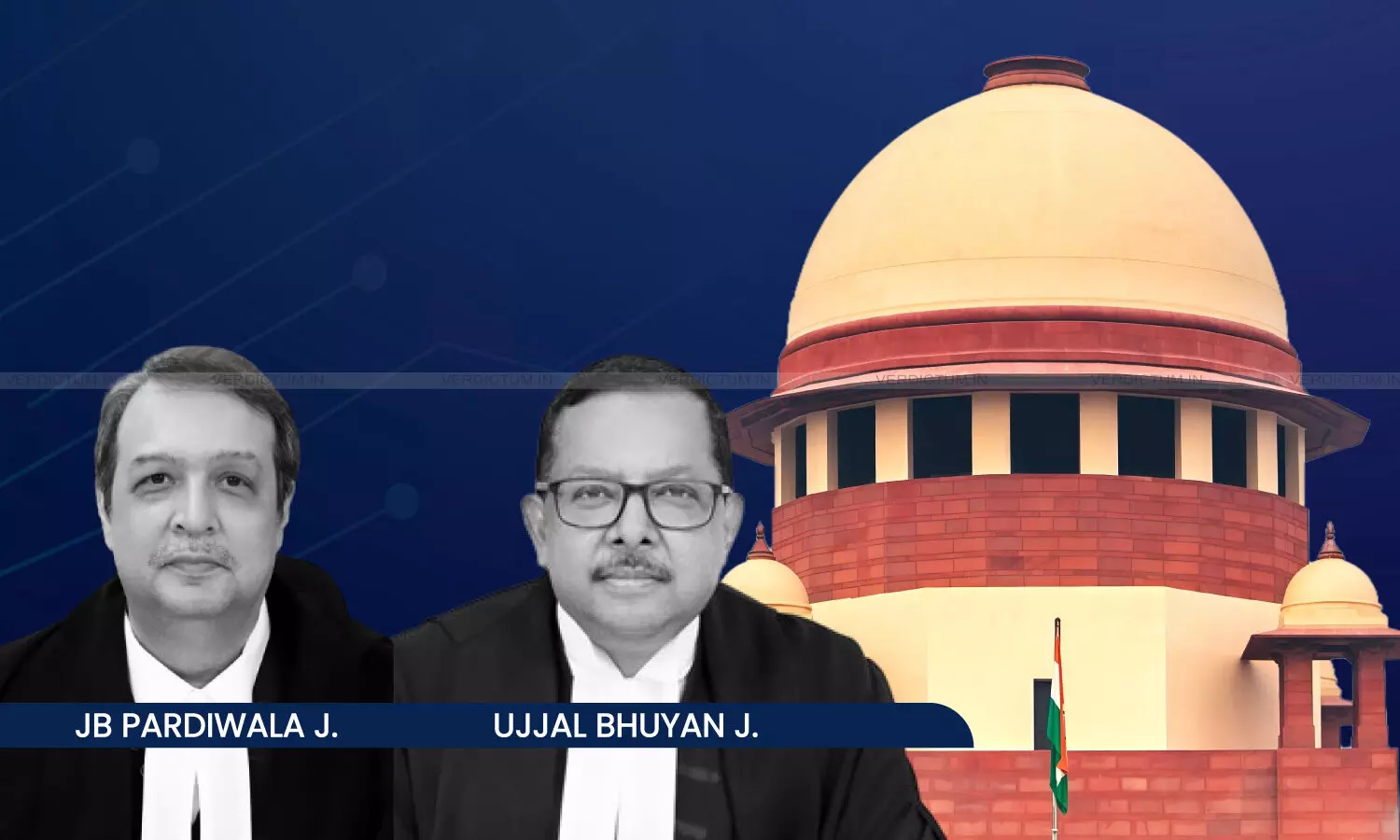
A Division Bench of Justice J.B. Pardiwala and Justice Ujjal Bhuyan observed, “From an analysis of the above decisions what can be culled out is that there are certain statutory provisions for violation or breach of which penalty is attracted for which proof of mens rea is not required. The question is whether in a given case, for such a statutory breach, imposition of penalty is automatic. Automatic imposition of penalty and exclusion of mens rea are two different things. According to us, it cannot be said as a general proposition that in all instances of violation of statutory provisions for which penalty is prescribed, imposition of penalty is automatic. It will all depend on the scheme of the statute and the adjudicatory process provided for imposition of penalty...”.
“…Where the adjudicatory process prior to imposition of penalty provides for show cause notice, filing of reply or representation against each of the grounds cited for imposition of penalty and hearing, to hold that imposition of penalty is mandatory or automatic or a foregone conclusion would be to render such a provision or adjudicatory process nugatory. After all, the power to impose penalty includes power not to impose penalty. As rightly held by the three-Judge Bench in Hindustan Steel Ltd, merely because the statute provides a minimum penalty it would not mean that penalty is automatic. Question of imposition of minimum penalty would arise only when the authority comes to the conclusion that penalty should be imposed”, it noted further.
Senior Advocate P.V. Dinesh appeared for the appellant and N. Venkataraman, A.S.G. appeared for the respondent.
Saudi Arabian Airlines, authorised to collect Foreign Travel Tax from outbound international passengers under the Finance Act, 1979, and the Foreign Travel Tax Rules, 1979, was found to have delayed depositing the collected tax into the Government treasury in six instances between 1994 and 1997, with delays ranging from one day to sixty-three days. In five of these cases, demand drafts had been purchased before the due date but deposited late; in the sixth, the delay was attributed to the employee responsible being on emergency leave. Show cause notices were issued proposing penalty and interest under Section 38 of the Finance Act.
The adjudicating authority's initial 1999 order imposed a modest penalty of Rs. 12,000 for the six delayed deposits, but on appeal the matter was remanded for de novo consideration. On remand, the adjudicating authority, invoking Section 38(3), enhanced the penalty for the identical six defaults to Rs. 71,29,140, reasoning that the earlier figure reflected an inadvertent failure to apply the statutory minimum. The appellate authority and the revisional authority under the Customs Act both upheld this enhancement, and the Bombay High Court dismissed the airline's writ petition challenging the orders, holding that delayed payment was equivalent to non-payment and that penalty under Section 38(3) was automatic once the timeline was breached.
Examining the 1994 amendment to Section 38, the Court found that the legislature had created a clear distinction: sub-section (3) penalises a carrier who "fails to pay" tax "to the credit of the Central Government," while sub-section (4) separately penalises breach of any rule made under the Act, a category into which delayed deposit under Rule 4 and delayed filing of returns under Rule 9 properly fall, since both provisions permit the Collector of Customs to condone delay on sufficient cause. Reading the two "fails to pay" and "amount of tax not so paid" expressions in sub-section (3) together, the Court held that non-payment, not delay, is what the provision addresses, and that any deposit made before issuance of a show cause notice is properly a case of delayed payment rather than non-payment.
The Court relied on its earlier judgment which held that belated remittance of TDS after deduction cannot attract penalty for "failure to deduct" under Section 271-C of the Income Tax Act, and on Hindustan Steel Ltd. v. State of Orissa (1972) 83 ITR 26 for the proposition that even a prescribed minimum penalty does not make imposition of penalty automatic, since the adjudicating authority retains discretion to decline penalty for a technical or bona fide breach.
On the enhancement itself, the Court invoked the principle of "no reformatio in peius," as recognised by the Bombay High Court in Jyoti Plastic Works Pvt. Ltd. v. Union of India 2020 SCC OnLine Bom 2276 and reaffirmed in Nagarajan v. State of Tamil Nadu (2025) 8 SCC 331, holding that a person cannot be left worse off for having availed a legal remedy, and that the six-fold escalation of penalty following the airline's own appeal could not be sustained.
Accordingly, it set aside the penalty imposed on the appellant for late deposit of FTT in all six instances, along with the corresponding portions of the High Court's judgment, the revisional order, the appellate order, and the de novo order-in-original. Any amount already paid by the appellant towards the penalty was directed to be refunded with interest at 9% per annum within three months, and the bank guarantee furnished by the appellant was directed to be discharged. The appeal was allowed with no order as to costs.
Cause Title: M/s. Saudi Arabian Airlines v. Union of India & Ors. (Neutral Citation: 2026 INSC 933)
Appearances:
Appellant: P.V. Dinesh, Sr. Adv., Shankh Sengupta, Samsuddha Majumdar, Kartikey Kulshrestha, Sujoy Sur, Soham Banerjee, Shreyash Sharma, Anna Oommen, Syed Jafar Alam, AOR, Advocates.
Respondent: N. Venkataraman, A.S.G., Gurmeet Singh Makker, AOR, B Sunita Rao, Arijit Prasad, Udai Khanna, Sarthak Karol, Neelakshi Bhaduria, Advocates.