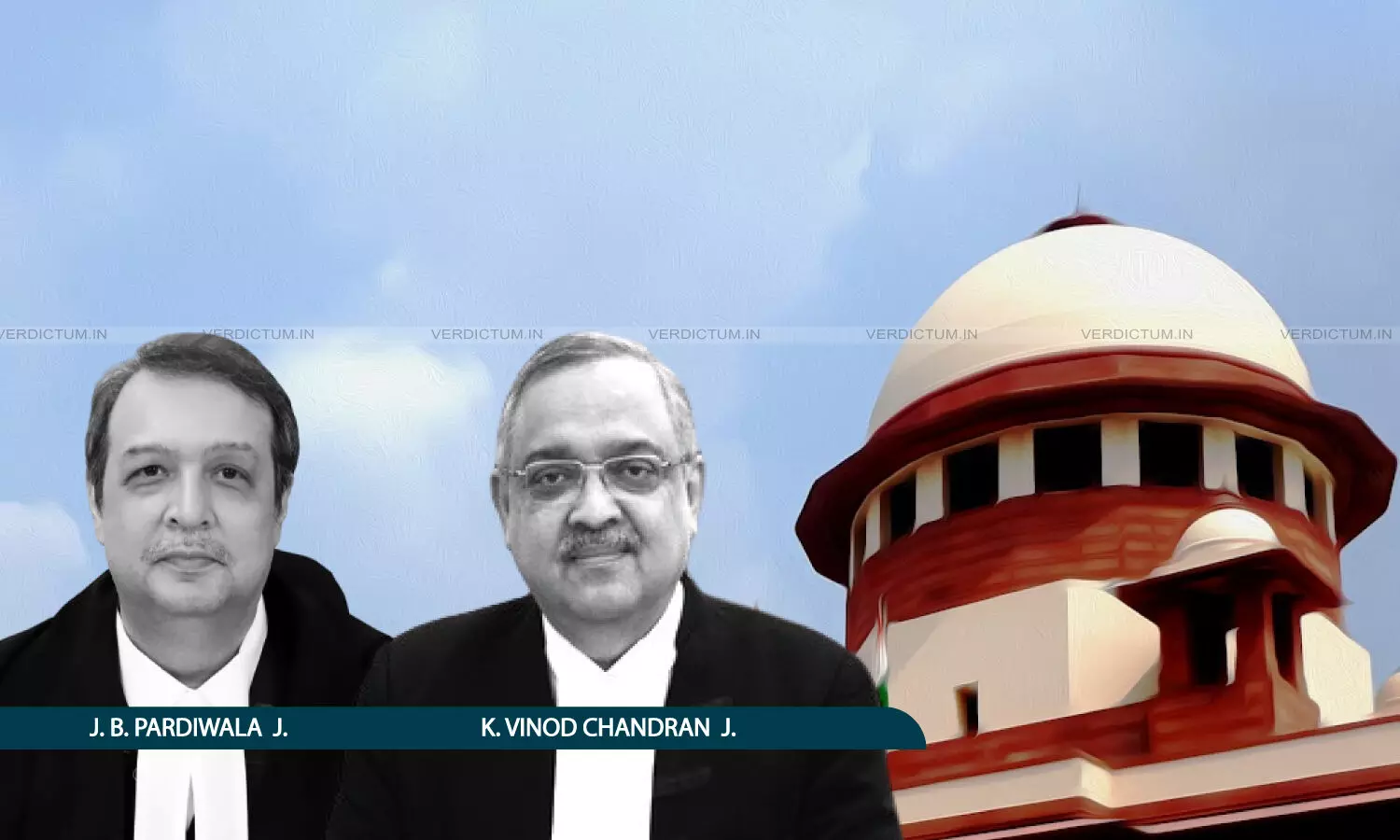
Justice J. B. Pardiwala, Justice K. Vinod Chandran, Supreme Court
Common Intention & Object Can Be Inferred Even If Accused Did Not Fire the Fatal Shot: Supreme Court Restores Murder Conviction
 |
|The Bench applied "separate the grain from the chaff" to eyewitness testimony, and held accused who held down and exhorted the assault on the victim are equally liable despite not having fired the weapon, but sustained acquittal of a third accused added later under Section 319 CrPC.
The Supreme Court has held that an accused who restrains a victim or exhorts a co-accused to fire, even without personally discharging the fatal shot, can be convicted with the aid of common intention or common object, reversing Madhya Pradesh High Court acquittal that had absolved two accused solely on the ground that no overt act of firing was attributed to them.
The Court arrived at this conclusion by applying the principle that "falsus in uno, falsus in omnibus" has no application in India, holding that a duty rests on courts to separate the grain from the chaff even where several eyewitnesses have named more accused than the evidence ultimately supports, and accordingly accepted the testimony implicating two accused while rejecting the case sought to be made out against a third.
A Bench comprising Justice J.B. Pardiwala and Justice K. Vinod Chandran, in appeals arising from a conviction under Sections 302, 148 and 149 of the IPC, observed, “The finding of the Trial Court was reversed by the High Court on the premise that his mere presence with a double barrel gun, without having shot at the victim does not implicate him with the crime even under Section 149 or Section 34 of the IPC. This finding according to us cannot be countenanced. His presence at the scene of occurrence along with some others with a double barrel gun if established, even if the fatal shot had not been fired by him; he can be roped in on common intention and object, if he is proved to be a part of the group of accused; constituting either an unlawful assembly under Section 149 or under Section 34 of the IPC”.
“The principle of ‘falsus in uno, falsus in omnibus’ is not applicable to India and as has been famously held, here, the Courts have a duty to separate the grain from the chaff in analyzing evidence. Carrying out such a measure, we are inclined to find the presence of A1, A6 and A13 as spoken of by PW1, PW10 and PW11 at the incident spot and the shooting having occurred as narrated by them…”, the Bench noted further.
Senior Advocates Siddharth Dave, Pramod Kumar Dubey appeared for the appellant and D. S. Parmar, A.A.G. appeared for the respondent.
In the matter, 17 persons were alleged to have ambushed three members of a family, resulting in the death of one victim and injuries to another. Of fourteen persons who stood trial, the Trial Court convicted four accused, including the appellant before this Court.
In appeal, the High Court confirmed the conviction of only one accused and acquitted the remaining three, including an accused who had been summoned to face trial at a later stage under Section 319 of the CrPC. The injured eyewitness, as the de facto complainant, challenged the acquittal of all accused before the Supreme Court.
The Trial Court had convicted the accused primarily on the strength of eyewitness testimony establishing specific roles: one accused was found to have fired the fatal shot, another to have held down the victim, a third to have exhorted the shooting, and a fourth, arraigned later under Section 319 of the CrPC, to have been present with a firearm. The High Court reversed the conviction of the latter three, holding that mere presence, without a specific overt act, could not sustain a conviction with the aid of Sections 34 or 149 of the IPC, leading to the present appeals.
The Court held that the High Court’s reasoning for acquitting the accused who restrained the victim was speculative and unsupported by expert evidence, particularly as the bullet remained lodged in the victim’s body. His exhortation to fire was consistent in the FIR and trial testimony and was sufficient to establish common intention under Section 34 IPC, though not Section 149 IPC. However, the Court upheld the acquittal of the third accused, noting that eyewitnesses had not named him until after he was summoned under Section 319 CrPC. It also held that discrepancies and the prosecution’s attempt to implicate several persons did not undermine the core testimony against the accused whose conviction was restored.
The Court allowed the appeal against the acquittal of the two accused, restoring their conviction and sentence as awarded by the Trial Court, while dismissing the appeal against the acquittal of the third accused added under Section 319 CrPC.
Further, the appeal challenging the acquittal of the remaining accused, in respect of whom only omnibus allegations of presence had been made without any specific role, was also dismissed. The two accused whose conviction stood restored were granted two weeks to surrender before the Sessions Court, failing which the Sessions Court was directed to take steps to apprehend them.
Cause Title: Santosh Singh v. The State of Madhya Pradesh & Ors. (Neutral Citation: 2026 INSC 972)
Appearances:
Appellant: Siddharth Dave, Sr. Adv., Pramod Kumar Dubey, Sr. Adv., Vivek Jain, AOR, Suchitra Kumbhat, Pinki Dubey, Sadiq Noor, Himanshu Tyagi, Nayan Dham, Satyam Sharma, Siddhartha B. Ramachandruni, Advocates.
Respondents: Sunny Choudhary, AOR, D. S. Parmar, A.A.G., Mrinal Gopal Elker, AOR, Saurabh Singh, Silpi S Swain, Srajan Yadav, Shantanu Sagar, AOR, Anil Kumar, Gunjesh Ranjan, Prakash Kumar Mangalam, Advocates.