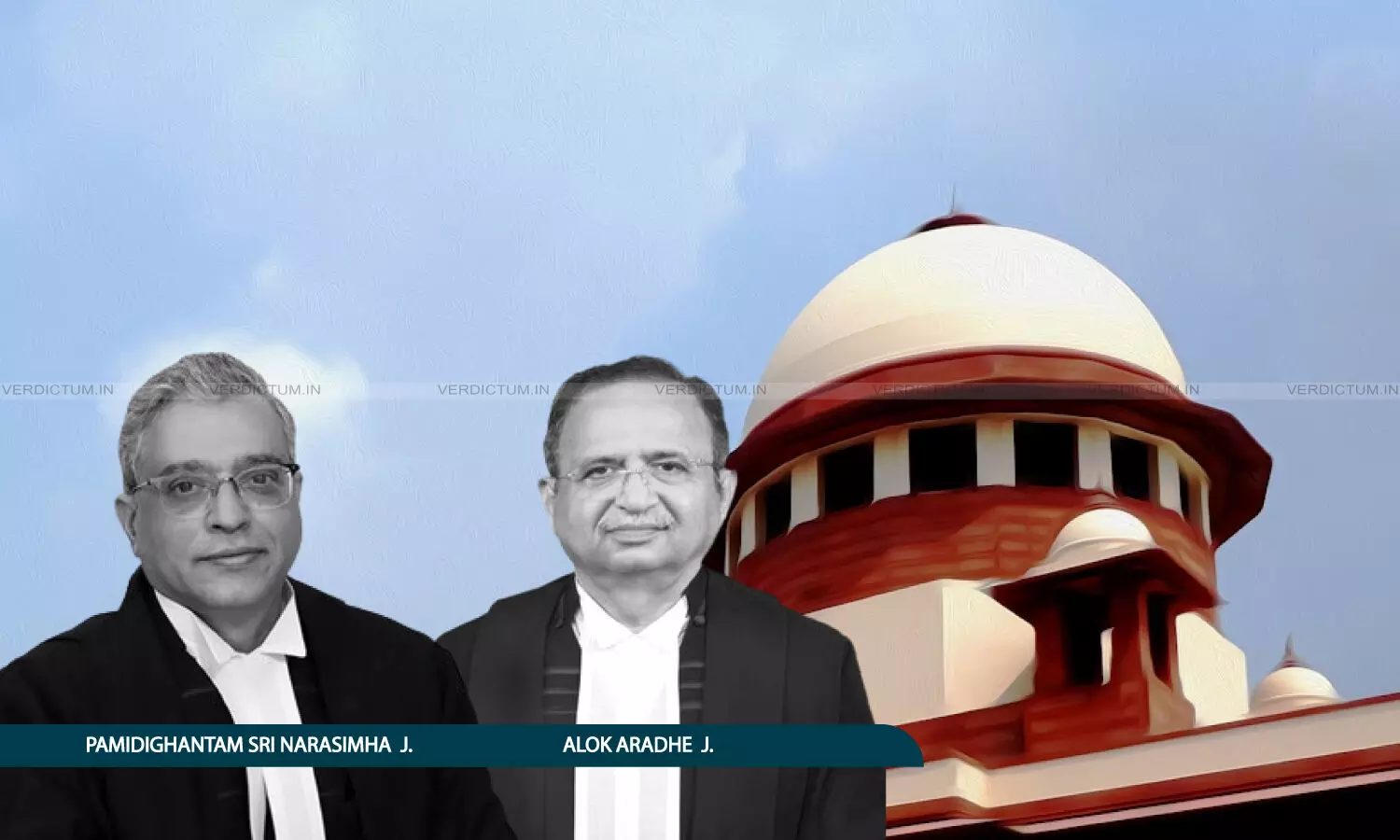
Justice Pamidighantam Sri Narasimha and Justice Alok Aradhe, Supreme Court
RBI's Power To Supersede Multi-State Co-Operative Bank Boards U/S 36AAA Banking Regulation Act Not Bound By Six-Month Limit Under Article 243ZL(1) Constitution: Supreme Court
 |
|The Court held that the Banking Regulation Act provisions prevail over Article 243ZL of the Constitution of India, and upheld successive supersession orders against Abhyudaya Co-operative Bank's Board.
The Supreme Court has held that the Reserve Bank of India's power to supersede the Board of Directors of a multi-State co-operative bank under Section 36AAA of the Banking Regulation Act, 1949 is not circumscribed by the six-month ceiling on supersession prescribed under Article 243ZL(1) of the Constitution of India. The Court held that the third proviso to Article 243ZL(1), which makes the Banking Regulation Act "also apply" to co-operative societies carrying on banking business, operates as an independent, additive provision rather than a restrictive exception, thereby preserving RBI's specialised regulatory authority over such banks.
The Bench further held that an order of supersession under Section 36AAA(1) can validly be extended beyond the original term of office for which the superseded Board had been elected, rejecting the appellants' contention that once their five-year statutory term expired, there remained no Board left to supersede and that successive extension orders were therefore unsustainable.
A Bench comprising Justice Pamidighantam Sri Narasimha and Justice Alok Aradhe observed, “…the power of RBI to supersede BoD of a multi-State co-operative bank under Section 36AAA(1) of BR Act is not circumscribed by the 6-month limit prescribed in Article 243ZL(1) of the Constitution”.
Senior Advocate Devadatt Kamat appeared for the appellants and Senior Advocate Jaideep Gupta appeared for the respondent.
Abhyudaya Co-operative Bank Limited, originally a Maharashtra co-operative society, became a Scheduled Bank in 1988 and, following an RBI-directed amalgamation with banks in Gujarat and Karnataka, acquired the status of a multi-State co-operative bank. The appellants were elected to the Bank's Board in May 2019 for a five-year term.
On November 24, 2023, RBI superseded the Board for one year, citing deteriorating financial health and the need to protect depositors, appointing an Administrator in its place. The appellants' statutory term expired during the pendency of their challenge, on May 24, 2024, after which RBI passed a Second Supersession Order on November 18, 2024 and a Third Supersession Order on November 07, 2025, each extending the supersession period.
The appellants challenged the First Supersession Order before the Bombay High Court, which by judgment dated November 18, 2024 held that Section 36AAA of the BR Act continues to operate independently of Articles 243ZL and 243ZT, that the consultation requirement under the proviso to Section 36AAA does not apply to multi-State co-operative banks, and that principles of natural justice could not be read into the provision. The writ petitions were dismissed, prompting the appeals before the Supreme Court.
Applying the doctrine of legislative incorporation, the Court held that the third proviso to Article 243ZL(1) uses the words "shall also apply... in an additive and non-restrictive sense," thereby incorporating the Banking Regulation Act into the constitutional scheme rather than qualifying or restricting it.
“…in case of incorporation, the provisions to which reference is made are bodily lifted in the enactment in which they are referred to and become part of it. The incorporated provisions operate on their own force. Tested on the analogy of the aforesaid well-settled legal principles, it is evident that the third proviso to Article 243ZL(1) employs the expression “shall also apply”. The said expression has been used in an additive and non-restrictive sense. Therefore, it is evident that the same incorporates BR Act into Part IXB of the Constitution insofar as it pertains to multiState co-operative bank”, the Bench said.
On the second issue, the Court held that "the tenure of the erstwhile BoD of a multi-State co-operative bank is of no consequence to the exercise of that power" since Section 36AAA(7) obliges the Administrator to convene elections only upon expiry of the period of supersession specified by RBI, subject to the statutory outer limit of five years.
“The Administrator is thus obliged to convene a general meeting for the election of new directors only upon expiration of the period of supersession specified by the RBI. Bearing in mind the object underlying the RBI’s power of supersession and the mandate of Section 36AAA(7), we are of the view that the tenure of the erstwhile BoD of a multi-State co-operative bank is of no consequence to the exercise of that power. At the same time, the provision safeguards the interests of the BoD of the multi-State co-operative bank by fixing an outer limit of five years, so that elections are not deferred indefinitely. In the instant case, the power of supersession was exercised while the statutory term of BoD subsisted, and the period of supersession has thereafter only been extended, within the permissible outer limit of five years”, the Bench said.
The appeals were dismissed, and the impugned judgment of the Bombay High Court upholding the supersession orders was affirmed. No order as to costs was made.
Cause Title: Sandeep S. Ghandat & Ors. v. Reserve Bank of India & Ors. (Neutral Citation: 2026 INSC 955)
Appearances:
Appellants: Devadatt Kamat, Senior Advocate.
Respondent: Jaideep Gupta, Senior Advocate, Ninad Laud, Advocate.