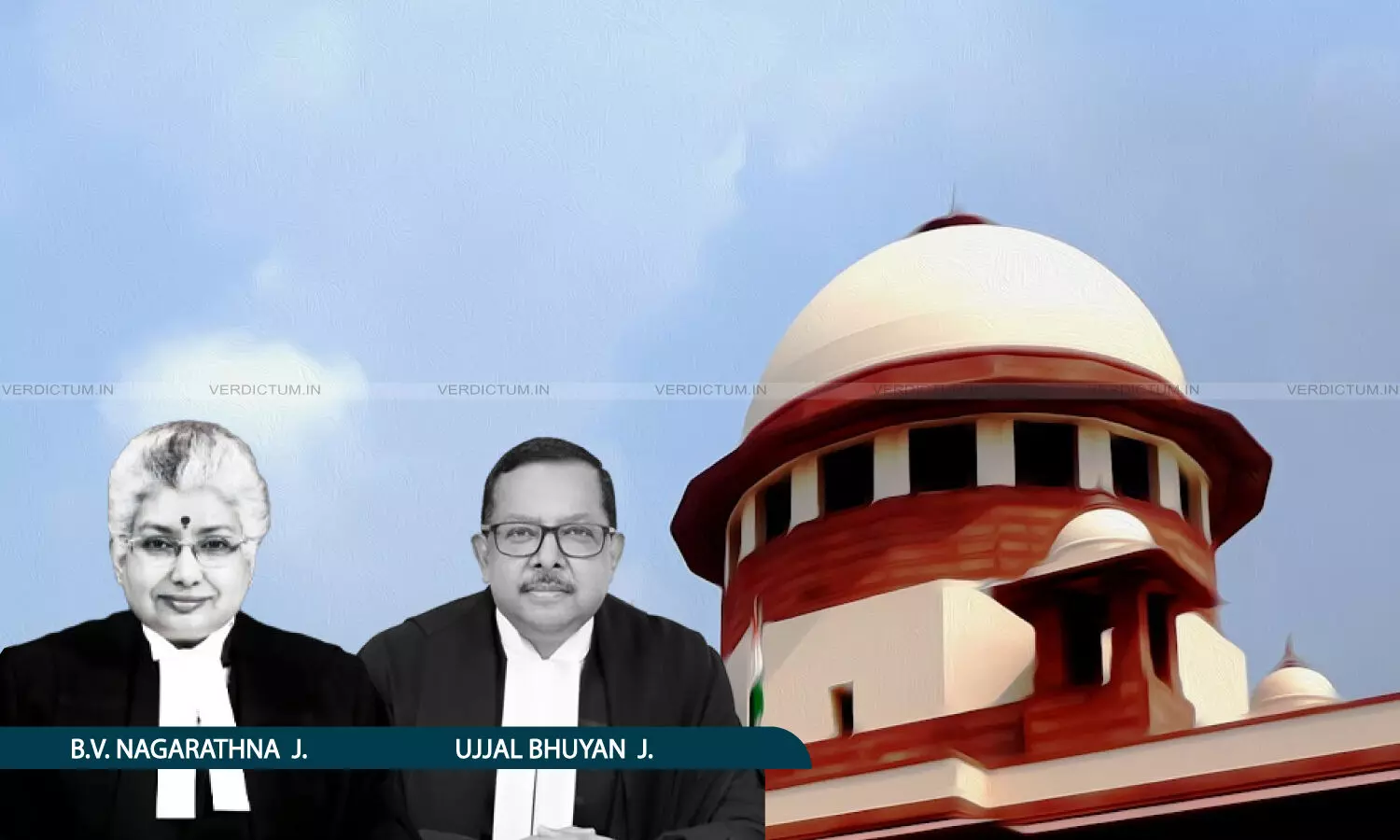
Justice B.V. Nagarathna, Justice Ujjal Bhuyan, Supreme Court
Supreme Court: Order II Rule 2 CPC Can't Be Invoked For Rejection Of Plaint Under Order VII Rule 11(d) CPC, Requires Evidence
 |
|The Court clarified that the bar requires a comparative analysis of the causes of action in both suits, which can only be determined after evidence is led.
The Supreme Court has held that a plea of bar under Order II Rule 2 of the Code of Civil Procedure, 1908 (CPC) cannot serve as a ground for the rejection of a plaint at the threshold. The Court noted that such a bar is not an absolute legal prohibition against filing a suit but rather a matter of evidence that must be established during trial.
The Bench noted the procedural distinction between a suit being "barred by law" and a plaintiff being precluded from seeking certain reliefs due to the omission of claims in a prior proceeding. While Order VII Rule 11(d) mandates the rejection of a plaint that appears from its own statements to be barred by law, the Court clarified that the Order II Rule 2 bar requires a comparative analysis of the causes of action in both suits, which can only be determined after evidence is led.
Justice B.V. Nagarathna and Justice Ujjal Bhuyan while setting aside a Madras High Court order that had rejected a plaint on the grounds of a purported procedural bar, observed, “…the bar created by any law to the filing of a suit is different from a plaintiff suing for certain claims or reliefs which he could not have claimed or sued having regard to Order II Rule 2 of the Code. Therefore, in our view, the application of Order II Rule 2 cannot be construed to be a ground for rejection of the plaint under Order VII Rule 11(d) of the Code”.
“On a conjoint reading of Order II Rule 2 with Order VII Rule 11(d) of the Code, it emerges that the plea under Order II Rule 2 of the Code cannot be a basis or a ground for rejection of the plaint. In other words, it is for the defendant to establish by way of evidence, the bar of the subsequent suit under Order II Rule 2 of the Code filed by the very same plaintiff…”, the Bench further noted.
Advocate Amarjit Singh Bedi appeared for the appellant and Senior Advocate Jayanth Muth Raj appeared for the respondent.
The dispute originated within a family over properties in Chennai, Ooty, and Pudukottai. In 2012, the original owner, M. Sokkalingam, and his wife filed a suit ('first suit') seeking a permanent injunction against their son (Respondent No. 1) to prevent interference with their Chennai residence and bank accounts. They alleged the son had used intimidating tactics to force the execution of certain documents, and following Sokkalingam’s death in 2013, his widow and daughters filed a 'second suit' seeking to declare a 2011 Power of Attorney in favor of the son’s friend as null and void, alleging it was obtained through fraud and coercion.
The Respondents moved an application under Order VII Rule 11 of the CPC in the second suit, arguing it was barred under Order II Rule 2 because the cause of action was identical to the first suit and the relief should have been claimed then.
The Trial Court dismissed this application, finding the causes of action and properties were distinct. However, the Madras High Court reversed this, holding the plaintiffs were aware of the Power of Attorney during the first suit and thus the second suit was barred, leading to the rejection of the plaint.
The Supreme Court held that the High Court erred in its approach by treating the bar under Order II Rule 2 as a ground for rejection of the plaint. It observed that for Order VII Rule 11(d) to apply, the bar must be apparent from the face of the plaint. Conversely, a plea under Order II Rule 2 is a defense that requires the defendant to prove the identity of the cause of action by producing the previous plaint and establishing that the plaintiff omitted the claim without the court's leave. The Bench further noted that the High Court improperly analysed the averments of the second suit as if they were evidence rather than taking them at face value for the purpose of a Rule 11 application.
“…In such an event, on a comparative analysis of the plaint filed in the first suit and the plaint filed in the second suit, if the Court comes to the conclusion that the second suit was filed on an identical cause of action which led to the filing of the first suit and there was an omission to make the claim or to reserve the reliefs to be claimed in the first suit in a subsequent suit, then the bar under Order II Rule 2 of the Code would apply to the subsequent suit or the second suit. Then the claims or reliefs not maintainable would be rejected as the plaintiff could not have sued for those reliefs by filing a second suit, although technically, the filing of such a suit was not barred by any law…”, the Bench noted.
“…On the other hand, if the cause of action for filing the second suit is totally distinct from the cause of action from filing the first suit and the reliefs claimed are distinct, subject-matter of the suits are different and if the parties to the suit are also different then in such a case, the plea under Order II Rule 2 of the Code would not arise at all. The above are, inter alia, the heads of distinction to be analysed while analysing the plaints in the first/former suit and a subsequent suit.”, the Bench further noted.
The Court, accordingly, allowed the appeal and set aside the High Court’s judgment. The order of the Trial Court was restored, effectively reviving the second suit for trial on its merits. The Court clarified that its observations were limited to the maintainability of the suit and would not influence the final outcome of the trial.
Cause Title: S. Valliammai & Others v. S. Ramanathan & Another (Neutral Citation: 2026 INSC 372)
Appearances:
Appellants: M/S.K.J.John And Co., AOR, Surekha Raman, Amarjit Singh Bedi, B.S.Jhothiraman, Shreyash Kumar, Yashwant Sanjenbam, Sidharth Nair, Harshit Singh, Advocates.
Respondents: Jayanth Muth Raj, Sr. Adv., Malavika Jayanth, AOR, A. Swetha, C. K. Sasi, AOR, Meena K Poulose, Advocates.