Alienee Acquiring Interest In Deceased’s Estate Before Probate Proceedings An Interested Party: Supreme Court
 |
|The Court held that persons having even a slight interest in the estate must be cited in probate proceedings, and suppression of such parties constitutes just cause for revocation.
The Supreme Court has held that an alienee who has acquired an interest in the estate of the deceased before the institution of probate proceedings is an interested party and is entitled to be cited in such proceedings under the Indian Succession Act, failing which the grant of probate is liable to be revoked.
The Court was hearing an appeal challenging the order of the High Court, which had set aside the revocation of probate granted in respect of a Will, despite findings of suppression of material facts and non-impleadment of necessary parties.
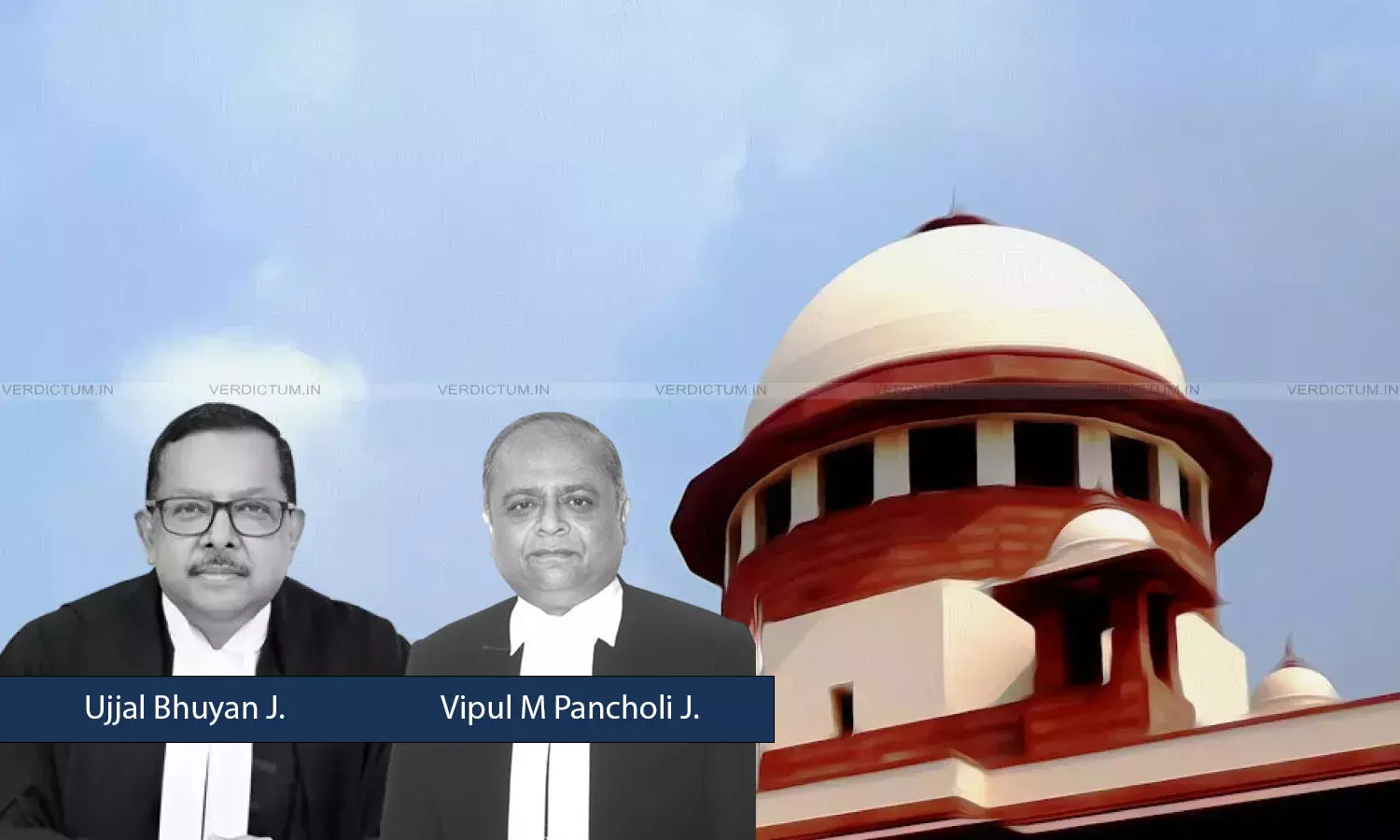
A Bench of Justice Ujjal Bhuyan and Justice Vipul M. Pancholi observed: “an alienee who has acquired an interest in the estate of the deceased, prior to the filing of the probate proceedings, is an interested party.”
Senior Advocate Anandh Padmanabhan appeared for the appellants; Advocate M.A. Chinnasamy, AOR, appeared for the respondents.
Background
The dispute arose out of probate proceedings initiated by a legal heir claiming rights under an unregistered Will allegedly executed in her favour by her father.
The testator had executed the Will in 1976. However, shortly thereafter, the same property was sold by the testator through a registered sale deed in favour of third parties. Subsequently, the appellants acquired title over the property through subsequent sale transactions.
After a considerable lapse of time, probate proceedings were instituted by the respondent without impleading the appellants or other legal heirs, and probate came to be granted.
Upon gaining knowledge of the grant of probate, the appellants filed an application under Section 263 of the Indian Succession Act seeking revocation, which was allowed by the District Court. The High Court, however, set aside the revocation, leading to the present appeal.
Court’s Observation
The Court undertook a comprehensive examination of the statutory scheme under the Indian Succession Act, 1925, particularly Sections 263 and 283, and the principles governing probate proceedings.
At the outset, the Court reiterated the nature of probate proceedings and observed that “the grant of probate is a judgment in rem and conclusive and binds not only the parties but also the entire world and therefore, a person who is aggrieved thereby and had no knowledge about the proceedings and proper citations having not been made, is entitled to file an application for revocation of probate on such grounds as may be available to him”.
The Court noted that Section 263 permits revocation of probate for “just cause”, including where material facts are suppressed or where parties who ought to have been cited were not impleaded.
Referring to the statutory framework, the Court observed that “just cause shall be deemed to exist under certain circumstances mentioned in the said explanation. Clause (b) of the explanation specifically provides that the grant was obtained fraudulently by making a false suggestion or by concealing from the Court something material to the case”.
The Court further emphasised the requirement under Section 283 that citations must be issued to all persons having an interest in the estate before the grant of probate.
It reiterated the settled position that even a slight or possible interest in the estate is sufficient to confer a right to participate in probate proceedings. In this context, the Court observed that “any interest, however slight, and even the bare possibility of an interest, is sufficient to entitle a party to oppose a testamentary document.”
The Court further added that “no citation needs to be issued to any person who had no interest in the property, prior to the commencement of the probate proceeding”.
The Court then addressed the central issue of whether alienees acquiring an interest in the property before initiation of probate proceedings are entitled to be treated as interested parties. Answering the issue, the Court held that an alienee who has acquired an interest in the estate of the deceased, before the filing of the probate proceedings, is an interested party.
Applying the aforesaid principles to the facts of the case, the Court found that the respondent had failed to implead the appellants and other necessary parties despite being aware of the prior transactions relating to the property.
It noted that the respondent had suppressed material facts regarding the execution of sale deeds by the testator and subsequent transfers, which were directly relevant to the probate proceedings. The Court further observed that the pleadings in the civil suit filed shortly after the probate petition indicated clear knowledge of such transactions, thereby establishing suppression.
It held that the failure to implead necessary parties and to disclose material facts amounted to a substantive defect in the proceedings and constituted just cause for revocation of probate.
The Court also noted that the District Court had undertaken a detailed examination of these aspects and had rightly revoked the grant of probate. On the other hand, the High Court had failed to consider the statutory provisions and the material findings recorded by the District Court.
The Court observed that the High Court erred in interfering with the well-reasoned order of revocation without addressing the foundational defects in the probate proceedings. On a cumulative assessment, the Court held that the grant of probate was obtained by suppression of material facts and without issuing citations to interested parties, thereby vitiating the proceedings.
Conclusion
The Supreme Court held that persons who have acquired an interest in the estate before initiation of probate proceedings are entitled to be treated as interested parties and must be cited in such proceedings.
The Court set aside the order of the High Court and restored the order of the District Court revoking the grant of probate, while clarifying that the pending civil proceedings shall be decided independently in accordance with the law.
Cause Title: S. Leorex Sebastian & Anr. v. Sarojini & Ors. (Neutral Citation: 2026 INSC 400)
Appearances
Appellants: Senior Advocate Anandh Padmanabhan; Advocate T. Harish Kumar, Aiyushi Daga
Respondents: Advocate M.A. Chinnasamy; Advocates C. Raghavendren, C. Rubavathi, P. Raja Ram