Supreme Court Expands Definition Of ‘Acid Attack Victims’ In Rights Of Persons With Disabilities Act To Include Forced Ingestion
 |
|The Court has observed that persons forced to consume acid are entitled to the same disability benefits as those who suffer external attacks.
The Supreme Court has expanded the legal protections for acid attack survivors by ruling that the definition of "acid attack victims" under the Rights of Persons with Disabilities Act (RPwD), 2016, must include those subjected to forced ingestion.
It was observed that the existing statutory definition was narrowly restricted to external disfigurement caused by the "throwing" of acid, thereby inadvertently excluding victims who suffer devastating internal injuries from administered acid.
Exercising its authority to bridge this legislative gap, the Court directed that, pending a formal amendment to the Act’s Schedule, the term shall encompass victims of forced administration regardless of whether outer disfigurement is present.
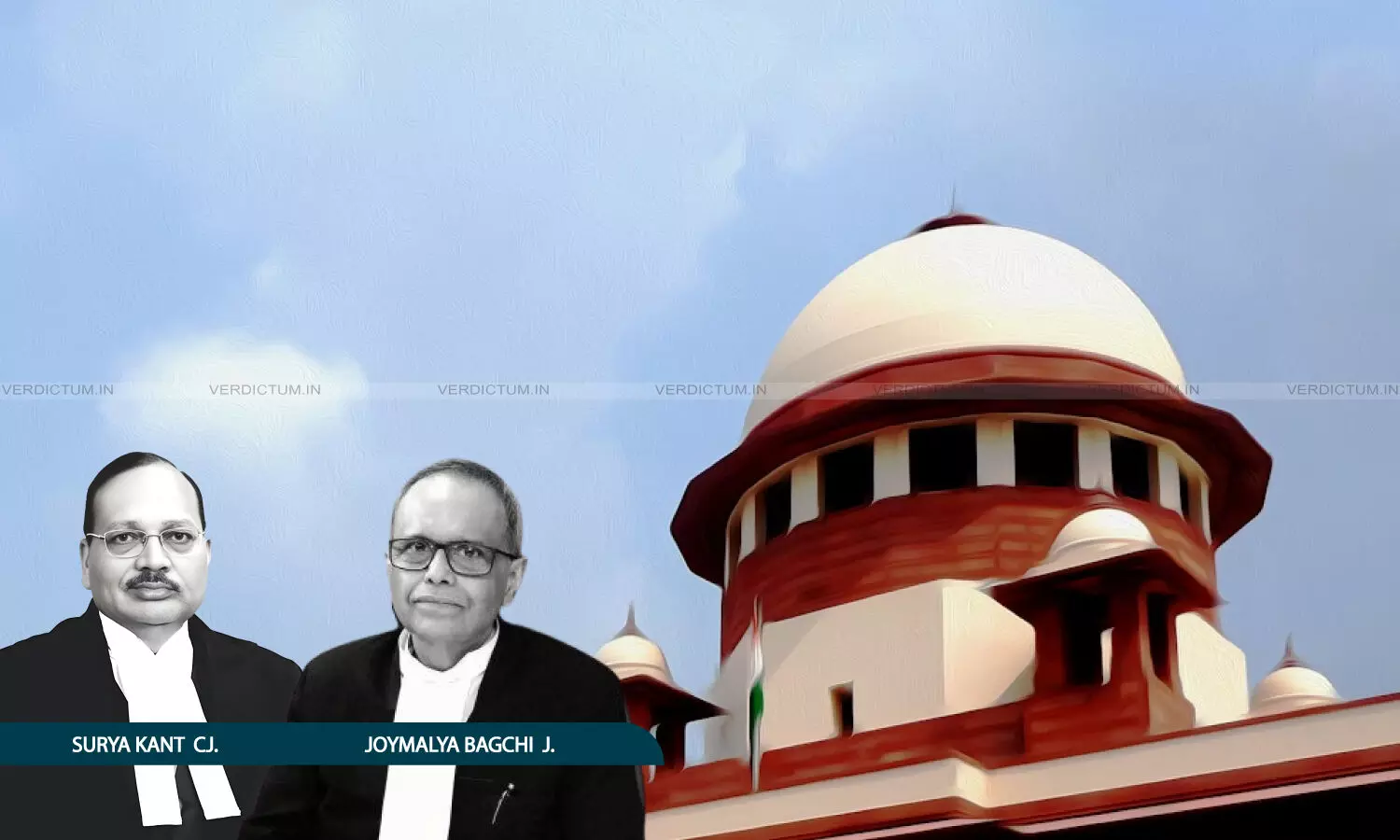
The Bench of Chief Justice Surya Kant and Justice Joymalya Bagchi ordered, "We find that if a victim has been administered acid, such a victim is not included within the expression "acid attack victims. Furthermore, the word "disfigured" suggests external disfigurement of the body and not the internal scars or injuries due to the administration of acid...The Solicitor General of India at this stage submits that the federal ministry has already proposed to amend the Schedule appended to the 2016 Act...We have considered the submissions. Pending the suitable amendment to the Schedule of the 2016 Act, it is directed that for all intents and purposes, and to give effect to the legislative scheme of the Act, "acid attack victims" shall also include victims to whom acid has been administered, and shall further include those who have suffered internal injury, even if there is no outer disfigurement of the body."
Senior Advocate Mukul Rohatgi and Siddharth Luthra appeared for the Petitioners, while Solicitor General Tushar Mehta appeared for the Union of India.
During the proceedings, Senior Counsel Mukul Rohatgi emphasized the urgency of the situation, noting that victims who suffer internal injuries often face even greater survival challenges than those with external scars. Chief Justice Kant and Justice Bagchi scrutinized the technicality, observing that "disfigurement" should not be limited to the exterior of the body. To rectify this, the Court exercised its authority to provide an interim solution while the government processes a formal amendment to the Act’s Schedule.
Rohatgi submitted, "This is the case regarding acid victims. The Court has been kind enough to take up this issue and ask the government to look at it; they want to frame a policy. But I have one pressing requirement."
SG Tushar Mehta submitted, "On the last occasion, the Court’s very right concern was the petitioner's impression that while throwing acid is an offence, forcing someone to drink acid is not. Under the Rights of Persons with Disabilities Act, it seemed excluded. I called the officers, and we found that it is indeed an offence now under the Bharatiya Nyaya Sanhita. It is Section 124: voluntarily causing grievous hurt by use of acid, etc."
Rohatgi added, "It is an offence. The problem is that while it is an offence under criminal law—whether you throw acid or force somebody to drink it—the Rights of Persons with Disabilities Act restricts "acid attack victims" to those where acid is thrown."
CJI Kant remarked, "It might be an offence, but the victims are entitled to certain benefits."
Rohatgi then added, "Only if they are victims of acid being "thrown" on them. As victims of forced ingestion, they are denied those benefits. A victim who is forced to drink acid—which is an offence—is declined the benefits of this beneficial legislation. Our request is urgent, as these are events happening every day."
CJI Kant said, "Why shouldn't the assets of the attacker also be attached, including their share in the coparcenary or Joint Hindu Family property? We talk about self-dignity, etc.; why should the accused not suffer?"
Rohatgi said, "This is a salutary suggestion by the Court."
CJI Kant suggested, "Also, please think about how to entangle these shopkeepers in the criminal investigation. This is very important; they should also face consequences."
SG Tushar Mehta clarified, "We will have to amend the Schedule, not the Act itself."
Senior Counsel Mukul Rohatgi urged the Court to pass an interim order under Article 142, similar to the Vishaka guidelines, to ensure victims receive immediate relief. He argued that victims of forced acid ingestion are currently denied benefits because the Rights of Persons with Disabilities Act narrowly defines victims only as those disfigured by the "throwing" of acid. "How will they survive?" he asked, noting that this technicality prevents them from accessing disability cards and monthly stipends of up to 8,000 rupees.
Rohatgi pointed out that while the Bharatiya Nyaya Sanhita (BNS) recognizes both throwing and administering acid as offenses, the Disabilities Act remains incomplete. He contended that the law must include internal injuries caused by administration to align with criminal statutes. In response, Solicitor General Tushar Mehta informed the Court that an amendment to the Schedule is already being processed by the Ministry of Law and Justice and promised to expedite it to provide the necessary relief.
Justice Bagchi said, "Solicitor, what are the exact words being introduced in the proposed amendment? If you forward that, we can direct that, subject to the passing of the amendment or notification, the proposal be implemented in the interim."
Rohatgi replied, "The Solicitor may show the proposed amendment to the Schedule. The Court can have a look, and then we can work it out."
The Court noted that under Section 326B of the Indian Penal Code (IPC), and subsequently under Section 124(2) of the Bharatiya Nyaya Sanhita (BNS), 2023, the law penalized both the throwing and the administration of acid. However, the Schedule to the 2016 Act defined "acid attack victims" narrowly, referring only to persons disfigured by the "throwing" of acid. This definition failed to account for victims who suffered internal injuries due to ingestion.
It was further observed that the term "disfigured" typically suggested external bodily damage, thereby excluding those with internal scars caused by the administration of acid. The Solicitor General informed the Court that the relevant ministry had already proposed an amendment to the Schedule to rectify this discrepancy.
Taking these submissions into account, the Court directed that, pending the formal amendment, the term "acid attack victims" shall include those to whom acid was administered. This inclusion extended to victims suffering from internal injuries, regardless of whether there was any external disfigurement.
The Court ruled that this clarificatory explanation would be deemed effective from the date the Rights of Persons with Disabilities Act, 2016, originally came into force.
Previously, the Court issued a "show-cause" notice to all State Governments and Union Territories seeking an explanation as to why specialized schemes for rehabilitation through public employment—specifically within government or government-controlled sectors—should not be established.
The Court had also asked all states and Union territories to provide a slew of information, including the year-wise details of the number of such cases and their status in courts, besides the rehabilitation measures to support the victims. it also asked states and UTs to provide information about the number of cases in which charge sheets are filed in trial courts.
Previously, the bench sought a response from all the States and Union Territories regarding the legislative gap that prevents victims of forceful acid ingestion from being recognised under the Rights of Persons with Disabilities Act, 2016 (RPwD Act). The Court had issued notice in the PIL and directed the Registrar General of all the High Courts to furnish details of pending trials in the cases of acid attack victims in their respective jurisdiction.
In July 2023, the Delhi High Court had refused to impose a complete ban on the sale of acid. The Court had further directed the GNCTD to conduct a comprehensive study and evaluate the effects of a complete prohibition on the sales of acid. The Court had instructed the GNCTD to implement necessary measures to address the shortcomings in the current regulatory system, as per the findings of the empirical study.
The PIL, filed by AOR Anuj Kapoor, highlighted a legal disparity arising from the definition of “acid attack victims” in the Schedule to the RPwD Act. The Act commendably includes acid attack survivors as persons with disabilities, but limits the definition to individuals “disfigured due to violent assaults by the throwing of acid”.
Cause Title: Shaheen Malik v. Union of India [Writ Petition(s)(Civil) No(s).1112/2025]