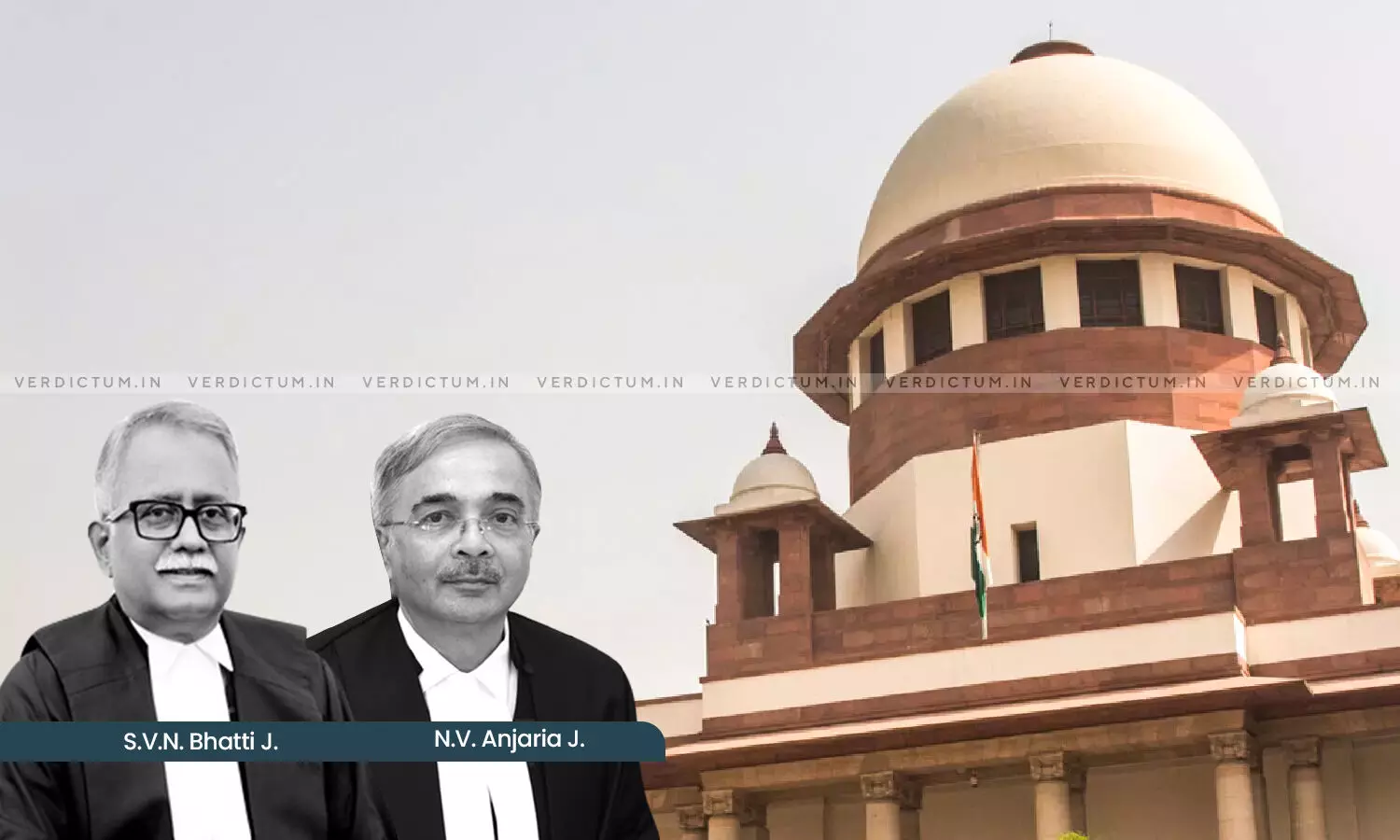
Justice S.V.N. Bhatti, Justice N.V. Anjaria, Supreme Court
Earning Capacity Must Be Assessed In Open Labour Market: Supreme Court Enhances Compensation For IBM Manager Who Suffered 100% Disability In Motor Accident
 |
|The Apex Court rejected the insurer’s reliance on continued employment, noting that the claimant’s work was possible only through special software, flexible hours and exceptional employer accommodations.
The Supreme Court has held that functional disability in a motor accident compensation claim must be assessed with reference to the victim’s earning capacity in the open and competitive market, not merely by looking at retention in an accommodated employment role.
The Court shifted the assessment from 80% to 100% functional disability and enhanced compensation to Rs. 3,77,84,297, with 7.5% interest, for an IBM Group Manager who suffered 100% permanent physical impairment due to post-traumatic head injury with cortical blindness, pelvic fracture and permanent colostomy.
The Court was hearing connected civil appeals filed by the insurer and the injured claimant challenging a Punjab and Haryana High Court order in motor accident compensation proceedings, where the High Court had enhanced the Tribunal’s assessment of functional disability from 60% to 80% and awarded Rs. 2,94,82,617.
A Bench of Justice S.V.N. Bhatti and Justice N.V. Anjaria observed: “The calculation of functional disability depends on assessing the victim’s earning capacity in the open, competitive market, rather than on retention in a specific, highly accommodated role. Evidence before the High Court, specifically the Career Growth Letter dated 06.02.2018 from her employer, confirmed that the Claimant lost out on her normal career growth and promotional progression, including advancement to the positions of General Manager, Director, or Vice President, as a result of the accident. The record further indicates that she is able to perform her current duties only through specially created software, flexible working hours, and extreme accommodations provided by her employer as an act of corporate compassion.”
The Bench further observed: “Based on the official Medical Board Report issued by Vardhman Mahavir Medical College & Safdarjung Hospital, which evaluated the Claimant and certified a 100% PPI of the whole body due to post-traumatic head injury with cortical blindness, pelvic fracture, and a permanent colostomy, the compensation calculation shifts from the High Court’s 80% assessment to a 100% functional disability because the Claimant’s capacity to independently secure, sustain, or advance employment in the open labour market has been entirely extinguished.”
Advocates Syed Jafar Alam, Prerna Mehta and Shantanu Sagar appeared for the parties.
Background
The case arose from a road accident involving a motorcycle and a truck. The claimant, who was riding pillion, suffered grievous injuries to several parts of her body, while the rider of the motorcycle died on the spot. The truck was insured by Reliance General Insurance Company Limited.
The claimant was admitted with pelvic fractures and blindness, underwent pelvic reconstruction, and later underwent rectal and colostomy surgeries. She was assessed with 100% visual disability due to post-traumatic bilateral cortical blindness, and AIIMS later certified that she required a permanent colostomy stoma for life. At the time of the accident, she was 35 years old and working as Deputy Group Manager with IBM Daksh, Concentrix Daksh Services India Pvt. Ltd.
The Motor Accident Claims Tribunal assessed functional disability at 60%, noted that the claimant continued in employment with an increased cost-to-company package, and awarded Rs. 1,35,53,298. The Tribunal also held the driver, owner and insurer jointly and severally liable, rejecting the insurer’s defence regarding absence of a valid fitness certificate.
Before the High Court, the insurer challenged the award, while the claimant sought enhancement. The High Court dismissed the insurer’s appeal and partly allowed the claimant’s cross-appeal, enhancing functional disability to 80%, granting 50% future prospects, and awarding Rs. 2,94,82,617. Before the Supreme Court, the insurer maintained that there was no loss of earning capacity as the claimant continued to work, while the claimant sought compensation on the basis of 100% functional disability.
Court’s Observations
The Supreme Court noted that it had directed the claimant to appear before a Medical Board of Vardhman Mahavir Medical College & Safdarjung Hospital for re-examination of her functional and physical disability. The Board, comprising specialists from Neurology, Neurosurgery, Ophthalmology, General Surgery, CIO and Physical Medicine and Rehabilitation, concluded that she had suffered 100% permanent physical impairment of the whole body.
Rejecting the insurer’s objection to enhancement, the Court observed: “The contention is merely noted and rejected. The Medical Board’s opinion will now be the guiding factor in determining the compensation for injuries suffered by the Claimants in the accident dated 10.04.2011.”
The Court further held: “Having invited the Medical Board’s opinion, for which no objection could be taken by either of the parties, and considering the number of surgeries the Claimant had undergone, the compensation has to be accordingly re-determined.”
The Court recorded that the claimant had been examined by a multi-disciplinary Medical Board, which certified 100% Permanent Physical Impairment affecting the whole body.
The Bench observed: “The Medical Board concluded that the Claimant suffers from a 100% Permanent Physical Impairment (PPI) affecting her whole body.”
It also noted that the AIIMS ophthalmic evidence established 100% visual handicap due to post-traumatic bilateral cortical blindness, while the gastrointestinal surgery evidence showed that restoration of intestinal continuity had failed.
The Court recorded: “Exhibit P2, provided by Dr. Peush Sahni of the Department of Gastrointestinal Surgery at AIIMS, confirmed that the continuity of her large intestine could not be restored because of a complication due to a communication between the rectal stump and a wound in her lower back, thus necessitating a permanent stoma for the rest of her life.”
The Court did not accept the insurer’s submission that continued employment and salary increments defeated the claim of functional disability. It relied on the Career Growth Letter placed before the High Court, which showed loss of normal career growth and promotional progression due to the accident.
On this basis, the Court held that the claimant’s ability to perform current duties through special arrangements could not be treated as a measure of her earning capacity in the open labour market. It therefore accepted 100% functional disability for compensation calculation.
The Court recalculated loss of future earning capacity on the claimant’s monthly income of Rs. 84,057, annual income of Rs. 10,08,684, 50% future prospects, and multiplier of 16, arriving at Rs. 2,42,08,416 under that head.
The Court also awarded amounts under medical bills reimbursement, attendant charges calculated for three attendants, loss of income during treatment, future medical expenses, pain, suffering and mental agony, loss of marriage prospects, special diet, loss of amenities and disfiguration, and transportation charges.
While awarding Rs. 20,00,000 towards loss of marriage prospects, the Court expressly limited the ruling to the facts of the case.
The Bench observed: “The Court is exercising its discretion in the peculiar facts and circumstances of this case to arrive at just and fair compensation payable to the Claimant.”
It further clarified: “In the circumstances of the present case, which shall not be treated as a precedent, a reasonable sum for the loss of marriage prospects, i.e., Rs. 20,00,000/-, is considered.”
In the connected appeals arising from compensation for the death of the motorcycle rider, the Court found no reason to interfere with the High Court’s order. It held that the Tribunal and High Court had correctly applied the multiplier of 16 by relying on the age of the deceased, following Sarla Verma v. Delhi Transport Corporation (2009), Munna Lal Jain v. Vipin Kumar Sharma (2015), National Insurance Co. Ltd. v. Pranay Sethi & Ors. (2017), and Sube Singh v. Shyam Singh (2018).
The Court also declined to disturb the apportionment issue after noting that the Tribunal and High Court had considered the evidence on the claimant’s asserted marital status and had followed Manjuri Bera v. Oriental Insurance Co. Ltd. & Anr. (2007).
Conclusion
The Supreme Court dismissed the insurer’s appeals in the injury-compensation matter and partly allowed the claimant’s appeal. It awarded total compensation of Rs. 3,77,84,297 with interest at 7.5% per annum from the date of the claim petition until realisation. The connected appeals arising from the death-compensation claim were dismissed. Pending applications were disposed of, with no order as to costs.
Cause Title: Reliance General Insurance Company Limited v. Priyanka Das and Others (Neutral Citation: 2026 INSC 950)
Appearances
Advocate Syed Jafar Alam; Trilegal Advocates On Record; Advocate Prerna Mehta; Advocate Shantanu Sagar; Advocates Prabhat Ranjan Raj, Anil Kumar, Gunjesh Ranjan, Abhishek Kumar Gupta, Manoneet Dwivedi and Prakash Kumar Mangalam