Supreme Court Refuses To Order Removal Of Video Of Court Proceedings On Social Media; Asks Lawyer To Exhaust IT Act Remedies First
 |
|The Court remarked that the petition against digital portals is premature and directed the petitioner to issue formal legal notices under the IT Act before seeking judicial intervention.
The Supreme Court dismissed a petition as withdrawn, a plea seeking a direction to remove audio-video recordings, clips, and footage of judicial proceedings uploaded on social media platforms and digital networks, especially the one depicting the appearance of an advocate, namely Bhanu Pratap Singh.
It was pointed out that the petition was premature as the petitioner, who is an advocate, wanted deletion of video clips involving his own appearance, without first exhausting statutory remedies under Section 69A of the Information Technology Act and the Intermediary Rules.
The writ petition was filed against the Bar Bulletin, Instagram, Facebook, LinkedIn, Google, YouTube and X.
The Court had, on July 24, 2026, barred any extraction, modification, dissemination, monetization, reposting, or uploading of judicial audio-video recordings on social media or digital platforms without the prior permission of the Secretary General of the Supreme Court or the Registrar General of the respective High Court.
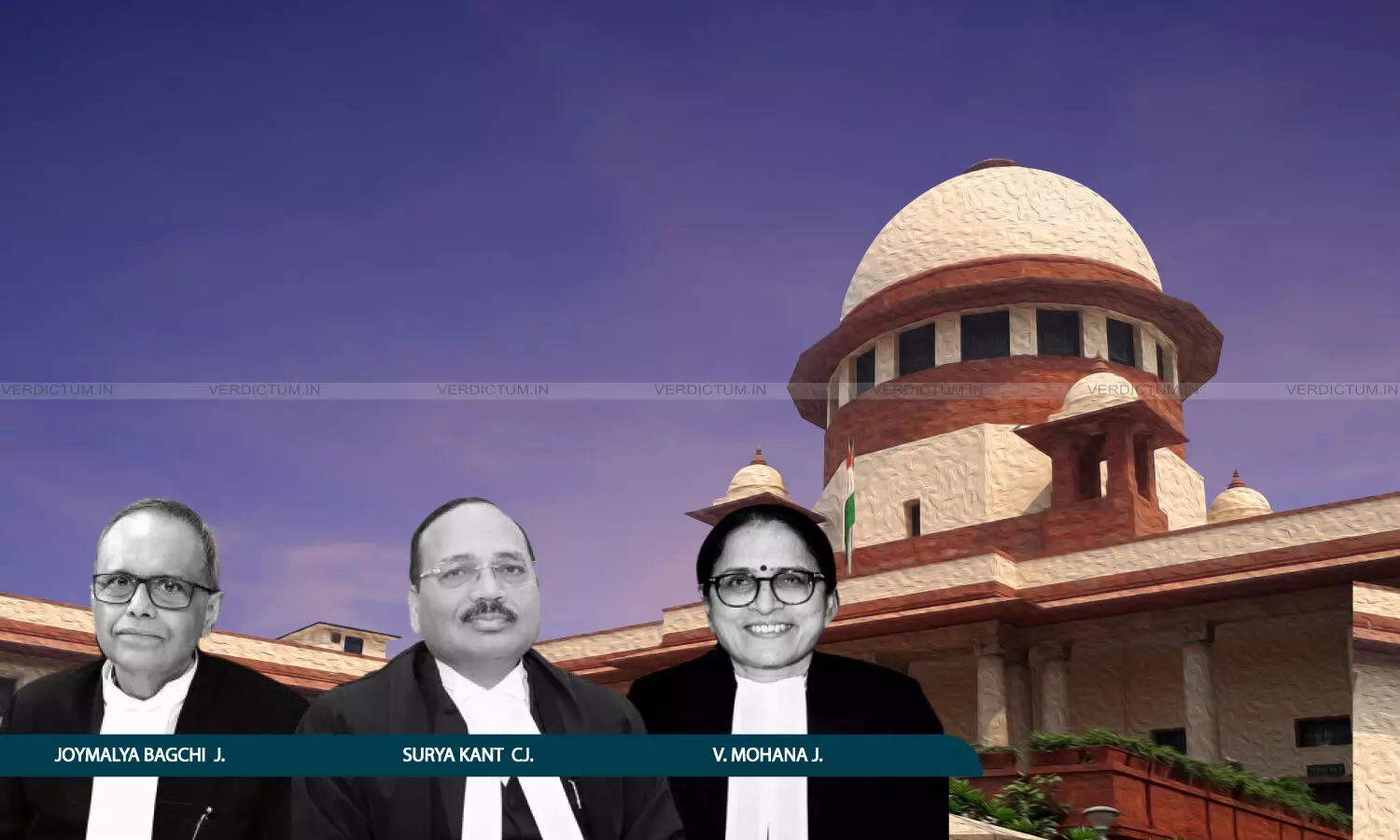
The Bench comprising Chief Justice Surya Kant, Justice Joymalya Bagchi and Justice V Mohana ordered, "Learned counsel for the petitioner seeks to withdraw this petition with liberty to initiate immediate action against the intermediaries or the platforms for taking down the video clip, in accordance with the provisions of the IT Act and Intermediary Rules framed thereunder, coupled with the order dated 24th July 2026 and 31st July 2026 passed by this Court in Writ Petition Civil Number 751/2026. We grant liberty that, in case the desired relief is not granted, the petitioner may again approach this Court."
The Petitioner alleged that despite orders passed by the Court prohibiting the circulation of video proceedings of all the courts, there are news portals that are still circulating them. He submitted that his profession will be hampered.
Chief Justice Kant said, "If you are so brave that in open court you can abuse... You can abuse, you can use all the chosen words, then why are you so shy of it now?"
Petitioner submitted, "These are people who are creating nuisance, My Lords. These are anti-social elements, My Lords. I don't have to do anything with that."
Chief Justice said, "You have invited them to create nuisance...Who has invited them to create nuisance? You are not saying that they have fabricated your video, right? You are not saying that they have used any AI or anything to harm your reputation or to damage you or cause anything..."
The Petitioner then submitted that he was just appearing in a bail matter when the portals started circulating the video.
To which Chief Justice Kant remarked, "Suppose now the live streaming is going on. You are arguing before us, we are hearing the matter. Assuming this proceeding is not supposed to be commercially encashed, right? So there can be an order by us...But assuming that some channel, they put it and they start utilizing it, they might be committing contempt. But unless they are adding some words which you have never spoken, or they are adding some attribution to the Bench which we have never spoken, that will be a more offending situation, isn't it? Because then they are indulging in a criminal act also. This will amount to a criminal act because they are adding something which you never spoke. They are adding something which we never observed. That will require a very serious view. The other thing will be in our domain that despite our orders, somebody is commercially exploiting..."
The Court further clarified that no explicit directions were issued to intermediaries in previous orders because the statutory framework under the IT Act inherently governs such impermissible publications once a declaration of law is made.
The Bench observed that the petition was premature, as the petitioner had directly approached the apex court without first exhausting the statutory legal remedies available to him.
The Court said that under the provisions of the Information Technology Act, including Section 69A and the Intermediary Rules, an aggrieved party is required to first issue formal legal notices or takedown requisitions to the respective platform intermediaries and news portals.
Justice Bagchi suggested, "Take appropriate steps before the service providers for takedown orders...Take in personam damage. Take necessary steps for getting takedown orders."
To which the Petitioner responded, "This is a news portal...A very reputed news portal, My Lords. I will not name. But My Lords, these news portals are also circulating the videos."
Justice Bagchi suggested that the Petitioner must first exhaust the legal remedies before coming to the Court. He added that the law itself gives remedies in respect of impermissible publications in the digital domain. These are in the nature of takedown orders or blocking orders. He said that if the takedown orders are not complied with then come to the Court.
Chief Justice Kant added, "Give them, give them a legal notice that now after at least 24th July 2026, or prior to, it amounts to contempt of court. You are also, you can write in your legal notice that this amounts to invading your privacy. They are liable to any penal action, and you call upon them to immediately..."
In response to the petitioner’s request for a generalized order directing intermediaries to remove video proceedings of all courts across India, the Bench refused to grant such blanket liberty.
The Plea prayed, "Issue an appropriate writ, order, or direction, including a writ in the nature of Mandamus, directing Respondent Nos. 5 to 12 to forthwith remove, take down, and delete all audio-video recordings, clips, and footage of judicial proceedings uploaded on social media platforms and digital networks till date, including the specific video clips depicting the Petitioner's appearance before a Division Bench of this Hon'ble Court on 01.07.2026;...Issue an appropriate writ, order, or direction to Respondent Nos. 1 to 4 to take appropriate regulatory, technical, and enforcement measures to ensure that audio-video recordings of judicial proceedings of this Hon'ble Court are not extracted, leaked, traded, or circulated on the dark web or illicit digital channels"
Consequently, upon the Bench pointing out the prematurity of the proceedings, the petitioner sought leave to withdraw the petition.
The Court accordingly dismissed the matter as withdrawn, granting the petitioner liberty to initiate appropriate legal recourse against the intermediaries under the IT Act and to approach the Court afresh only if the statutory remedies failed to yield the desired relief.
Cause Title: Bhanu Pratap Singh v. Union of India & Ors. [W.P.(C) No. 1137/2026]