Mere Suspicion Arising From Accused’s Explanation Can’t Substitute Cogent Proof In Case Based On Circumstantial Evidence: Supreme Court
 |
|The Court held that the High Court had not met the threshold for reversing an acquittal, since the Trial Court’s doubts about the child witness's testimony and lack of corroboration were supported by the record.
The Supreme Court has held that suspicion arising from an accused’s explanation cannot replace the prosecution’s duty to establish every circumstance in a chain of circumstantial evidence by cogent proof.
The Court set aside the Madhya Pradesh High Court’s judgment convicting the appellant for murder and causing disappearance of evidence under Sections 302 and 201 of the Indian Penal Code, and restored his acquittal.
The Court was hearing a criminal appeal against the Madhya Pradesh High Court’s judgment reversing the Trial Court’s acquittal and convicting the appellant in a case concerning the death of a woman and a child, and the alleged attempt to kill another child witness.
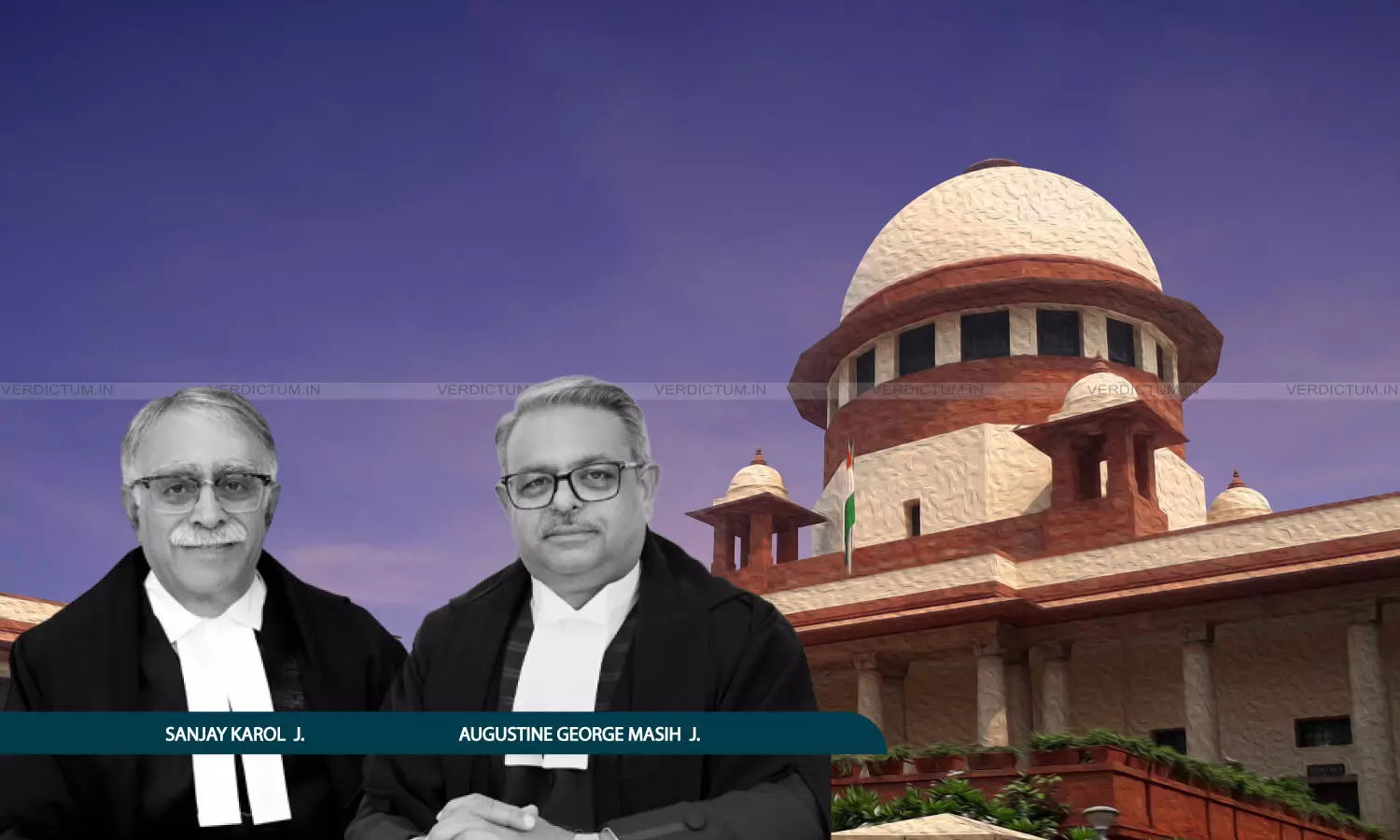
A Bench of Justice Sanjay Karol and Justice Augustine George Masih observed: “We are of the opinion that mere suspicion arising from the appellant's explanation cannot substitute for the requirement that each circumstance in the chain of events needs to be established by cogent evidence, such that the sequence so taken as a whole, points solely to the guilt of the accused.”
Senior Advocate Vibha Datta Makhija appeared for the appellant, while Advocate Abhimanyu Singh, G.A., appeared for the respondent-State.
Background
The prosecution case was that an injured male child was found near Bhero Ghat and taken for medical treatment, after which the dead bodies of a woman and another male child were recovered from the same area. The prosecution alleged that the appellant, who had been living separately from the deceased woman and their two sons, took them on a trip from Kanpur to Khajuraho and murdered the deceased persons by strangulation, while the surviving child managed to escape.
Two FIRs were registered, and the appellant was later arrested after the police received information that a person was enquiring about an unknown child at a hotel. The prosecution alleged that, after his arrest, the appellant confessed and led to the recovery of clothes and an empty bottle allegedly used to pour acid on the deceased persons.
The Trial Court acquitted the appellant, holding that the prosecution had failed to prove the case beyond reasonable doubt. It found the surviving child’s testimony unreliable due to contradictions, his young age, and the surrounding circumstances. The High Court reversed the acquittal, held the child witness reliable, and treated the appellant’s alleged abscondence and his explanation under Section 313 CrPC as circumstances pointing towards guilt.
Before the Supreme Court, the appellant argued that the case rested on uncorroborated and tutored testimony of the child witness, which was contradicted by medical evidence. He further argued that there was no evidence linking him to the crime, no established motive, no last-seen evidence, inconclusive forensic material, and unexplained delay in lodging the FIR. The State supported the High Court’s judgment and relied on the child witness, medical evidence, recoveries and the appellant’s subsequent conduct.
Court’s Observations
The Court first noted that the appeal arose from reversal of an acquittal and therefore the High Court was required to bear in mind the double presumption of innocence in favour of the accused.
Referring to Chandrappa v. State of Karnataka (2007), the Court observed: “At the very outset, it must be noted that this being an appeal against an order reversing an acquittal, the High Court, as per settled law, was bound to bear in mind the double presumption of innocence operating in favour of the appellant, and could interfere only upon a finding that the view taken by the Trial Court was not merely different from its own but was one no reasonable court could have taken on the material before it.”
The Court held that this threshold had not been met. It noted that the High Court’s finding of guilt principally rested on the testimony of the child witness, while the Trial Court had declined to give undue weight to that testimony for reasons supported by the material on record.
The Court reiterated that while there is no inflexible rule requiring corroboration of a child witness before conviction, corroboration is a rule of prudence ordinarily followed.
The Court noted that the child witness was only four and a half years old when the incident occurred and that his testimony was recorded four years later. It further observed: “Moreover, it is an admitted fact that the child lived with a constable Ramkishore. The said child witness in paragraphs 30 and 61 of his statement had also categorically stated that he was tutored.”
The Court also noted that the child had stated that the Station House Officer made him read his statement before going to Court and told him to give the same statement before the Magistrate. It further found that his statement that the appellant tried to strangulate him with a rope and threw acid on him stood falsified by medical evidence.
The Court recorded that the Trial Court had also found the child’s account unnatural, including his version that he woke up after hearing his mother cry, witnessed the killing, went back to sleep, and later again woke up and saw his brother being killed.
The Court relied on Karakkattu Muhammed Basheer v. State of Kerala (2024), where the principles governing circumstantial evidence were summarised.
The Court quoted the precedent to reiterate: “Mere suspicion alone, irrespective of the fact that it is very strong, cannot be a substitute for a proof. The chain of circumstances must be so complete that they lead to only one conclusion, that is, the guilt of the accused.”
Applying that test, the Court held that the prosecution failed to bring sufficient evidence to establish the appellant’s guilt or link him to the alleged offences.
The Court found that there was no medical or scientific evidence connecting the appellant to the crime.
It observed: “The post-mortem report of the deceased persons was of no assistance since as per the statements of the doctors, PW-1 and PW-20, the bodies were in an advanced stage of decomposition. Therefore, no definite opinion could be given regarding the cause of death.”
The Court also noted that the chemical examination report of the blood-stained soil was inconclusive since there was not enough blood for examination and it had decomposed.
The Court held that no forensic link was established between the recovered articles, the place of occurrence and the appellant. Although the prosecution alleged that clothes and a bottle were recovered at the appellant’s instance, there was no evidence connecting those clothes either to the deceased persons or to the appellant.
The Court noted that the independent witnesses to the alleged confession and recovery turned hostile. It also found the recovery doubtful because it was made from the place of occurrence six months after discovery of the bodies.
The Court further observed: “PW-11, the subsequent Investigating Officer, has also admitted in cross-examination that the recovered articles did not show any water, mud, or earth residue which is highly doubtful considering the fact that as per the prosecution case these articles were seized from under a rock, 6 feet deep in the ground after being hidden for several months.”
In these circumstances, the Court held that the possibility of the articles being planted could not be ruled out.
The Court held that the prosecution failed to establish last seen evidence and motive.
It noted that the neighbours had stated that the appellant had not been seen near the deceased woman’s house for several months. One witness stated that the deceased woman and her children left with a person he could not identify, while another witness stated that the person sitting in the car was not the appellant.
On motive, the Court observed: “On motive, none of the witnesses deposed regarding any enmity between the appellant and the deceased. In fact, PW-17 deposed that the relations between the deceased and the appellant were amicable.”
The Court therefore found motive absent and held that, in any case, there was lack of motive for the appellant to have committed the alleged act.
The Court noted that the prosecution case referred to travel in a truck and a car, and the surviving child had stated that the truck was driven by a driver. However, no effort was made to trace or examine that driver, though he would have been a witness according to the child’s version. The car and its driver were also not traced.
The Court held that this created “a significant gap in the chain of events.”
The Court also found unexplained delay in lodging the FIR. It observed: “Such unexplained delay in setting the criminal law into motion, particularly when the identity of the accused was purportedly known well before the FIR was recorded, seriously undermines the credibility of the prosecution version and lends credence to the possibility of embellishment in the investigation.”
Conclusion
The Supreme Court allowed the appeal and set aside the Madhya Pradesh High Court’s judgment convicting the appellant under Sections 302 and 201 of the IPC. It held that, in the absence of cogent evidence leading only to the conclusion of guilt beyond reasonable doubt, the conviction could not be sustained.
The appellant was acquitted of the charges. In view of the acquittal, his bail bonds were discharged. Pending applications were also disposed of.
Cause Title: Ravi Kumar Singh Malhotra v. The State of Madhya Pradesh (Neutral Citation: 2026 INSC 899)
Appearances
Appellant: Senior Advocate Vibha Datta Makhija with Advocate Raj Kishor Choudhary, AOR, Advocates Harsh Sethi, Aditya Wadhwa, Arunav Sharma, Priyanka Kashayap, Girish Tripathi, Rohini Narayanan, Vineet Jindal, Gulfeshan Javed, Vikram Patralekh and Sukhpreet Maan
Respondent: Advocate Abhimanyu Singh, G.A., with Advocate Mrinal Gopal Elker, AOR, Advocates Saurabh Singh, Silpi S Swain and Srajan Yadav