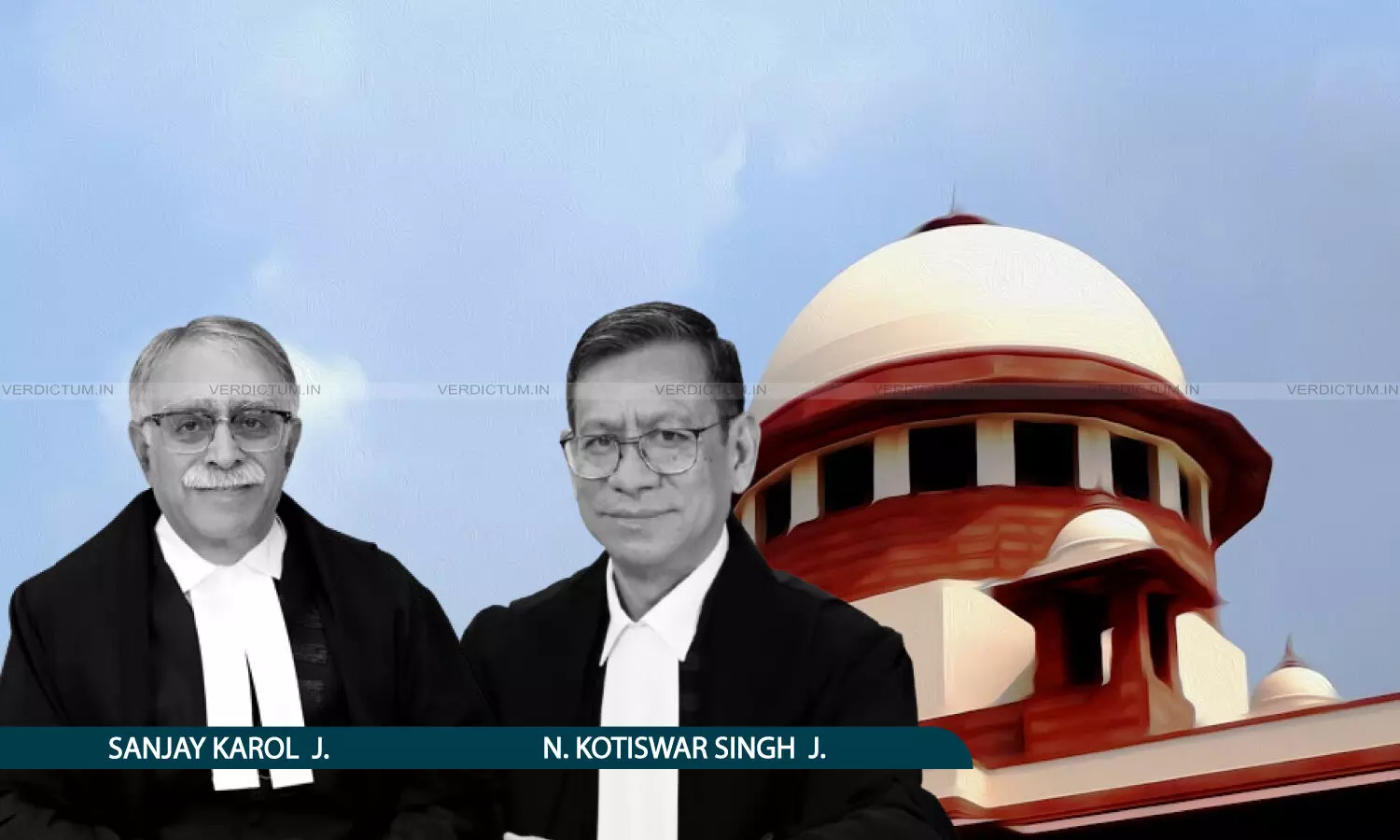
Justice Sanjay Karol, Justice N. Kotiswar Singh, Supreme Court
Last ITR Sufficient For Salaried; Average of Up To 3 ITRs For Self-Employed: Supreme Court Settles Deceased's Income Computation Formula For Motor Accident Compensation
 |
|The Court held that no hard and fast formula exists, and business nature, growth pattern, potential and negative income are also relevant for self-employed.
The Supreme Court has settled the formula for computing annual income of a deceased person for the purpose of motor accident compensation under the Motor Vehicles Act, 1988, holding that a bifurcation must be made between salaried individuals and self-employed individuals. For salaried individuals, only the Income Tax Return of the immediately preceding year is sufficient to establish annual income, since promotions significantly impact earnings and may be reflected only in that year's ITR.
Further, for self-employed individuals or those carrying on their own business, the average of the ITRs for up to the previous three years is to be taken as the reference point for assessing annual income, with surrounding business circumstances also being relevant.
The Court further held that ITRs filed after the deceased's death must be viewed with caution and ordinarily be supported by financial statements, noting the possibility of posthumous income inflation. For self-employed persons, it identified five relevant factors for income assessment: the nature and location of the business, its growth pattern and the impact of the death, future growth potential (particularly in capital-intensive businesses), initial years of negative income, and any other relevant business circumstance.
A Bench comprising Justice Sanjay Karol and Justice Nongmeikapam Kotiswar Singh observed, “…for salaried individuals, only the ITR of the previous year will be sufficient for showcasing the annual income from salary. The reason for considering only the preceding year is that the financial impact of promotions is significant and may be reflected in the ITR for only that year. A situation may also arise whereby the deceased/claimant might not have completed a year in the promoted position before the accident or might not have filed ITR for such period. In such cases the Court concerned shall take reference to the promotion letter and other corroboratory financial statements”.
The Bench, therefore, further observed, “When it comes to self-employed / individuals carrying out their own business, in our view, the average of the income specified in the ITRs of up to the previous three years is to be taken as a reference point for assessment of annual income from their business. There may also be a scenario where only one or two ITRs have been filed. Given such scenarios and the fluctuation of income in these professions, surrounding circumstances are also to be taken into consideration. These would include:
a) The nature of the business (including geographic location, category etc.);
b) Growth pattern of the business and impact of death on the business;
c) Potential growth of business (for instance certain businesses are capital intensive at the outset and are profitable at scale/in the future);
d) Negative income (certain businesses may require losses in the initial years, which may not reflect the true financial standing); and
e) Any other relevant factor relating to the business”.
Senior Advocate J.R. Midha and Advocate Salil Paul appeared as Amicus Curiae while Advocate Aditya Narayan Tripathy appeared for the appellant and Advocate Kshitij Mittal appeared for the respondent.
The lead matter in the batch, arose from a fatal road accident in Odisha in May 2018 in which the deceased, aged 39, was running his own construction business. The Tribunal had assessed his income at Rs. 15 lakhs per annum based on the immediately preceding year's ITR and awarded Rs. 2.27 crores.
The High Court reduced the award to Rs. 1.87 crores by taking the average of two ITRs showing annual incomes of Rs. 11.59 lakhs and Rs. 15.06 lakhs.
The Supreme Court, noting that the High Court made no reference to other factors relating to the nature of the construction business, fixed the annual income at Rs. 14 lakhs and enhanced the total compensation to Rs. 1.97 crores. The Court appointed Senior Advocate J.R. Midha and Advocate Salil Paul as Amicus Curiae to assist on the question of ITR-based income computation.
In the first connected appeal, the deceased was an insurance agent aged 49., where the High Court had taken the average of four ITRs.
Therefore, the Supreme Court held this was erroneous since performance-based income hikes in certain years do not warrant taking additional ITRs into consideration, and assessed the annual income on the average of the three previous years at Rs. 6.87 lakhs, enhancing compensation to Rs. 87.09 lakhs.
“…there can be no hard and fast formula for computing the annual income of a deceased person/claimant. ITRs being a statutory document are an important reference point when it comes to assessing one’s income, for the purposes of compensation under the Motor Vehicle Act”, the Bench said.
In the second connected appeal, the deceased was a wholesale grocery store owner aged 28. Two ITRs filed after his death were in question. The Court held that since surrounding financial statements were not available to verify whether those figures were unduly enhanced, it fixed the annual income at Rs. 3.25 lakhs, enhancing compensation to Rs. 60.79 lakhs.
Cause Title: Rashmirekha Tripathy and Another v. The Branch Manager (Legal Claims), Sriram General Insurance Company Limited and Others (Neutral Citation: 2026 INSC 661)
Appearances:
Appellant: Aditya Narayan Tripathy, Kedar Nath Tripathy, AOR, Chand Qureshi, AOR, Preeti Chauhan, Arpana Soni, Mohit Yadav, Aarti Pal, Md.imran Siddiqui, Saaket Jain, Shivangi Anand, Siddhartha Iyer, AOR, Advocates.
Respondent: Kshitij Mittal, Anand Sukumar, AOR, Salil Paul, Manjeet Chawla, AOR, Sahil Paul, Sandeep Dayal, Jyoti, Harmeet Singh Phillip, Raghav Nagar, Advocates.