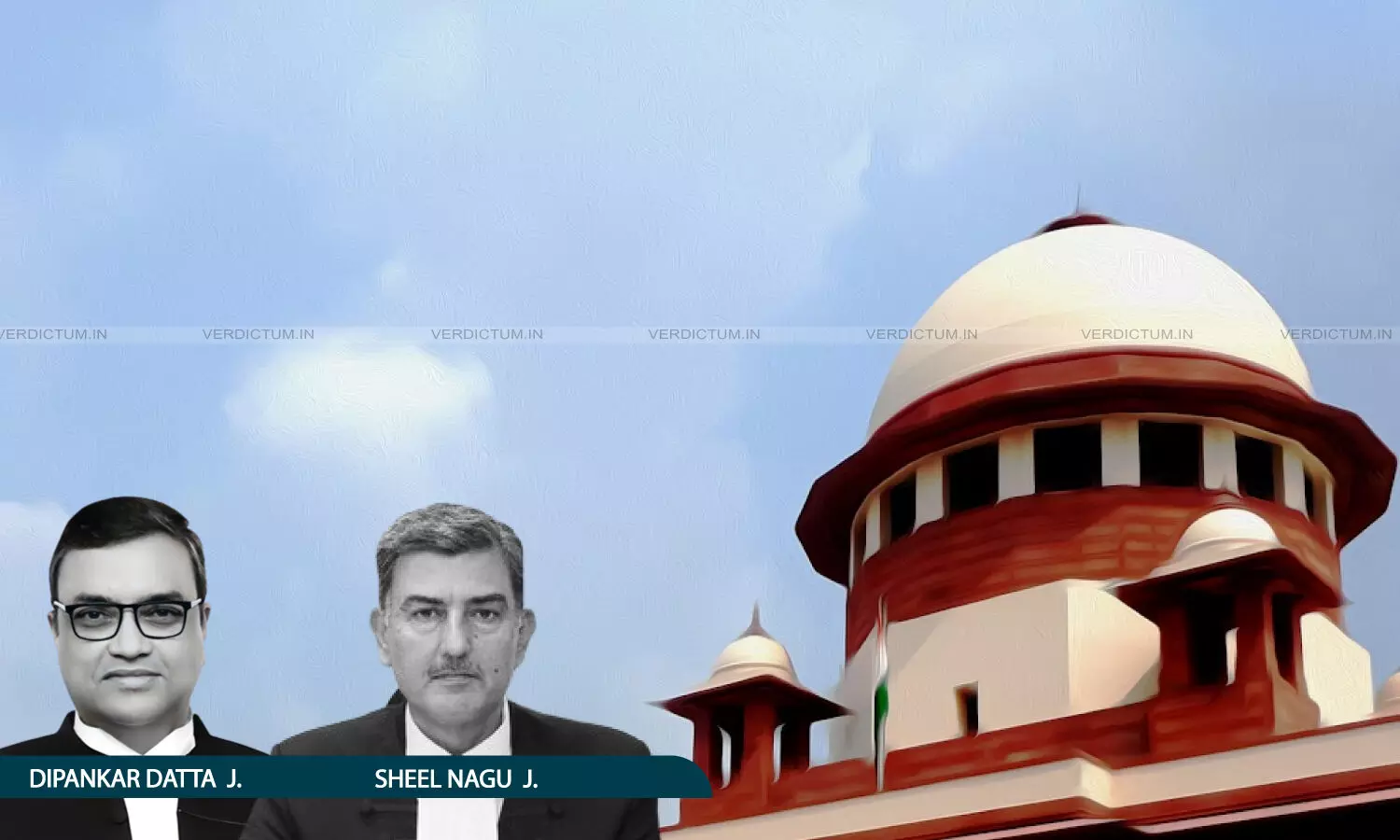
Justice Dipankar Datta, Justice Sheel Nagu, Supreme Court
Every Judicial Order Must Meet Basic Standard Required From High Court Judge: Supreme Court Laments Lack Of Reason
 |
|The Supreme Court was considering an appeal challenging the dismissal of an appeal under Section 14A(2) of the SC/ST Act.
While quashing an order passed by the Allahabad High Court in a case pertaining to the Scheduled Castes and the Scheduled Tribes (Prevention of Atrocities) Act, 1989, the Supreme Court has held that the lack of reasons is indicative of non-application of mind and it handicaps the higher Court from discerning the basis upon which the conclusion was arrived at and testing its legality and/or correctness.
The Apex Court was considering an appeal challenging a judgment of a Single Judge of the Allahabad High Court whereby, their appeal under Section 14A(2) of the Scheduled Castes and the Scheduled Tribes (Prevention of Atrocities) Act, 1989 was dismissed.
The Division Bench of Justice Dipankar Datta and Justice Sheel Nagu held, “The insistence on reasons for the decision is for the simple reason that it ensures application of mind by the adjudicator to the material on record and also enables the unsuccessful party to test the same before the higher forum. Lack of reasons, indicative of nonapplication of mind, handicaps the higher court from discerning the basis upon which the conclusion was arrived at and testing its legality and/or correctness.”
“Indeed, the impugned order does not meet the standards of a judgment/order, which is reasoned and speaking in the sense that the affected party is in a position to comprehend what weighed in the mind of the Judge to hold against him and in favour of the other”, it added.
Advocate Yogendra Kumar Verma represented the Appellant while AOR Srishti Singh represented the Respondent.
Factual Background
The Appellants figured as accused in an FIR registered under Sections 323,34, 324, 504, 506, 307,34, 336, 427 of the Indian Penal Code, 1860 and Sections 3(1)(d), 3(1)(r), 3(2)(va) of the SC/ST Act. They were not shown as accused in the chargesheet that was filed upon completion of investigation. After the trial commenced, an application under Section 319 of the Code of Criminal Procedure, 1973 was filed by the complainant(second respondent). The Special Judge, SC/ST Act, vide an order allowed the said application and summoned the appellants to face trial. This order of the Special Judge was upheld by the High Court vide the impugned order.
Reasoning
On a perusal of the impugned order, the Bench noted that the same spread over two pages. It had eight paragraphs and fifteen sentences. The first paragraph recorded presence of the counsel for the parties as well as perusal of the records by the Judge; the second paragraph recorded provision of law which was invoked and the particulars of the order under challenge; the third paragraph recorded the prosecution story; the fourth and fifth paragraphs recorded the submissions followed by the last three paragraphs whereby the impugned order, was dismissed but no reason was given for the same.
The Bench, thus, stated, “Although, we are conscious of the immense burden that Hon’ble Judges of the High Court are required to shoulder, a laconic order (such as the impugned order) can neither be appreciated nor countenanced. Writing brief orders, in the circumstances of the heavy burden being shouldered, could be a prudent approach but not at the cost of reasons. Every judicial order must meet the basic minimum standard required from a Judge of the High Court while disposing of any matter before him, more so in a criminal appeal of the present nature, where the appellants not found involved initially is forced to face trial.”
Reference was also made to the judgment in Asma Lateef and Another versus Shabbir Ahmad and Others (2024).
The Bench took note of the fact that the order did not refer to any evidence, far less cogent evidence, based on which the High Court could conclude the appellants’ prima facie involvement in the case.
Thus, allowing the appeal and quashing the impugned order, the Bench ordered a remand of the criminal appeal to the roster Bench of the High Court. “Such appeal shall now be disposed of expeditiously, in accordance with law, upon granting opportunity of hearing to the appellants, the State as well as the complainant”, it concluded.
Cause Title: Rajeev Singh and Ors. v. State of Uttar Pradesh and Anr. (Neutral Citation: 2026 INSC 938)
Appearance
Appellant: Advocates Yogendra Kumar Verma, Rajan Mishra, Dr. Jyoti Verma, Aditya Saurabh, Jayesh Kain, Arun Kumar Assija, Anmol Pandey, Vijendra Kumar Verma, Abhaya Nath Das, K Gopinath, AOR Satish Kumar
Respondent: AOR Srishti Singh, Advocate Charu Singhal, AOR Gaurav, Advocates Shaurya Krishna, Gaurav Srivastava, Shreya Saxena, Saurabh Singh, Marbiang Khongwir, Harsh Pratap Singh