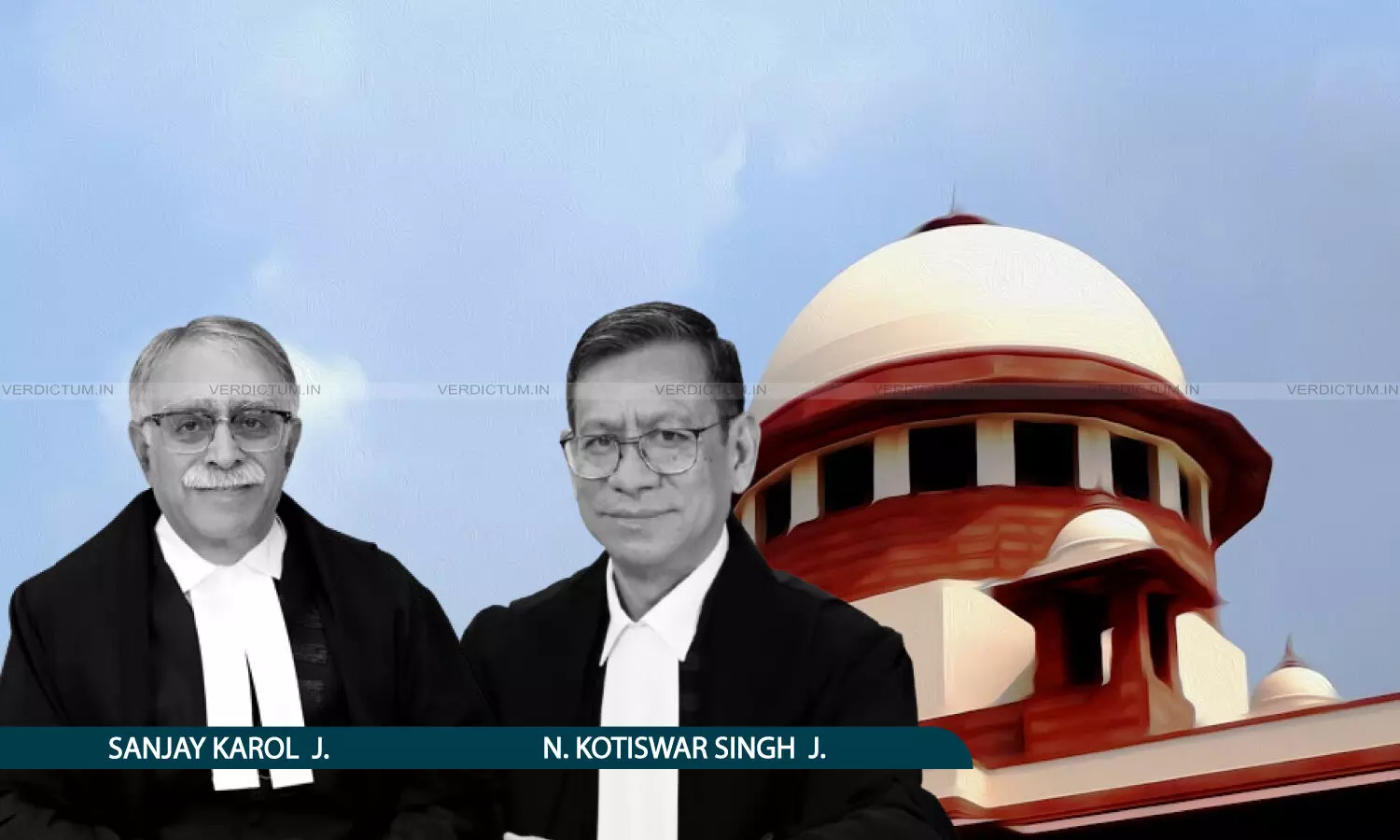
Justice Sanjay Karol, Justice N. Kotiswar Singh, Supreme Court
Could Not Remain Silent Till Employee Crossed 55 Years, Then Rely On Its Own Delay: Supreme Court Orders Insurance Company To Grant Compassionate Appointment
 |
|The Court held that an employer cannot interpret a compassionate appointment scheme in a manner that allows it to control an employee's eligibility through delayed processing of a time-sensitive application.
The Supreme Court has held that a public sector insurance company, New India Assurance Company Limited in the present matter, could not sit on an employee's voluntary retirement application filed before he attained the age of 55 years, communicate the requirement of a Medical Board certificate only after the age threshold had lapsed, and then rely on that very consequence to deny his dependent's claim for compassionate appointment.
The Court held that the eligibility clause of the Scheme for Compassionate Appointment could not be construed in a manner that allows the employer to control eligibility through delayed processing, and directed the insurance company to grant compassionate appointment to the appellant, with age relaxation where necessary, since the delay in finalising the claim could not operate to his prejudice.
A Bench of Justice Sanjay Karol and Justice Nongmeikapam Kotiswar Singh observed, “…The respondent-company was dealing with a time-sensitive application. Clause 1.1 of the Scheme made the age of 55 years a material threshold. Once the appellant No.2 applied for voluntary retirement on medical grounds before attaining 55 years of age and supported the application with a Government medical certificate, the respondent-company was required to scrutinise the application with reasonable promptitude. If the Civil Surgeon’s certificate was considered insufficient, the respondent-company had to inform the appellant No.2 so before the age threshold expired. It could not remain silent till the appellant No.2 crossed 55 years and thereafter, rely on the consequence of its own delayed action”.
“Clause 1.1 cannot be construed in a manner that enables the employer to control eligibility through delayed processing. The purpose of the age condition is to identify cases where an employee is medically incapacitated before the prescribed age. The purpose is not to enable the employer to defer scrutiny until the age condition expires and thereafter reject the dependent’s claim on that basis”, the Bench noted further.
Rajat Joseph, AOR appeared for the appellant and Abhisth Kumar, AOR appeared for the respondent.
The appellant's father, an employee of New India Assurance Company since 1984, suffered serious neurological problems and was certified by the Civil Surgeon, General Hospital, Gondia, as permanently incapacitated for further service on July 21, 2015, when he was about 54 years old.
He applied for voluntary retirement on medical grounds the very next day, before completing 55 years on December 10, 2015, enclosing the Civil Surgeon's certificate. He sent two reminders in November and December 2015, both before the age threshold expired, but the company neither accepted his application nor informed him that a Medical Board certificate was additionally required under Clause 1.1 of the Scheme.
The company sought such a certificate only by letter dated February 03, 2016, after the employee had already crossed 55 years. He obtained the Medical Board certificate within seven days, but his voluntary retirement was accepted only on May 31, 2016. His son's subsequent claim for compassionate appointment was rejected in 2019 on the ground that the father had retired after completing 55 years.
The Bombay High Court, Nagpur Bench, upheld the rejection, holding that the Civil Surgeon's certificate did not satisfy Clause 1.1 and that the Medical Board certificate was obtained only after the employee turned 55.
Examining the sequence of dates, the Court found that the employee had applied well within the age limit, supported his application with a government medical certificate, and pursued the matter diligently through reminders before the threshold expired, while the company remained silent throughout that period.
Placing reliance on Malaya Nanda Sethy v. State of Orissa 2022 SCC OnLine Page 13 of 23 SC 684 and Kusheshwar Prasad Singh v. State of Bihar(2007) 11 SCC 447, the Court held that an authority cannot take advantage of its own default, and that the company was obliged to communicate any deficiency in the certificate before the age threshold expired rather than after. The Court distinguished this from cases of genuine belated applications, noting that the employee here had not caused the delay, the company had.
Setting aside the High Court's judgment and the rejection order, the Court directed the company to grant compassionate appointment to the appellant within eight weeks, with necessary age relaxation, monetary benefits to run only from the date of actual appointment, and any admissible unpaid dues of the father to be released within the same period.
Cause Title: Rahul S/o. Ramnarayan Madankar & Anr. v. The New India Assurance Company Limited & Ors. (Neutral Citation: 2026 INSC 710)
Appearances:
Appellant: Rajat Joseph, AOR, Hrishikesh Chitaley, Kaustubh Kadasne, Sumit Kumar, Advocates.
Respondent: Abhisth Kumar, AOR.