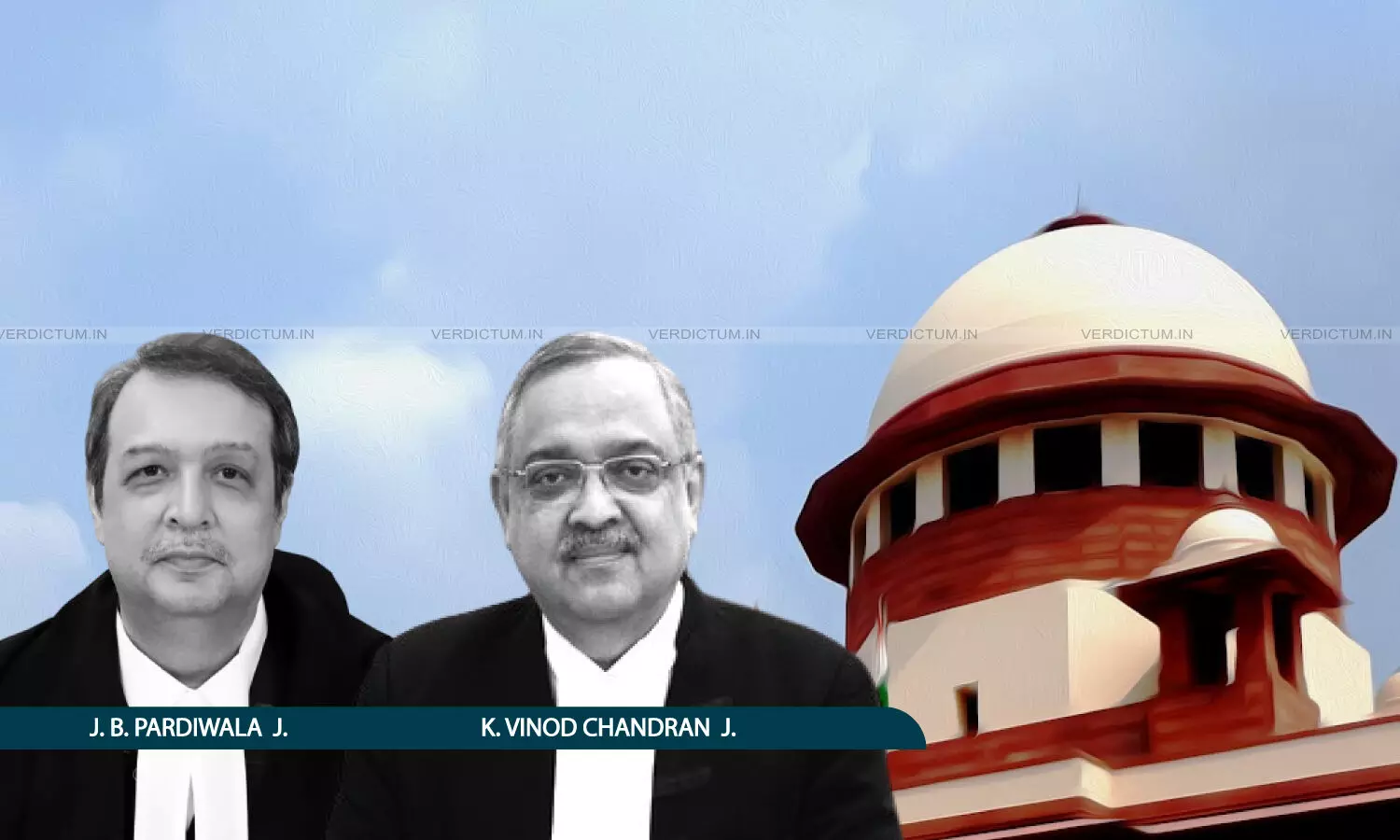
Justice J. B. Pardiwala, Justice K. Vinod Chandran, Supreme Court
Drug Disposal Committee Must Hear Vehicle Owner Before Auctioning NDPS-Seized Vehicle; Confiscation Power Lies With Trial Court: Supreme Court
 |
|The Court also clarified that acquittal in the criminal trial does not automatically result in release of the seized vehicle, since confiscation proceedings and criminal proceedings operate on different standards of proof.
The Supreme Court has held that the Drug Disposal Committee must hear the owner before the vehicle is sold in public auction, and that statutory confiscation remains within the power of the Court trying the NDPS offence under Section 63(1) of the Act.
The Court was hearing a criminal appeal challenging a Madras High Court judgment which had affirmed the order of the Additional District and Sessions Court for EC and NDPS Act Cases, Pudukottai, rejecting the appellant’s prayer for release of a lorry seized after alleged recovery of contraband under the NDPS Act.
A Bench of Justice J.B. Pardiwala and Justice K. Vinod Chandran observed: “However, if none appears to seek custody of the vehicle, then to avoid wastage of a valuable asset, the I.O may move the Court, if the owner does not approach the Court for interim custody, to refer it for disposal before the DDC. In that circumstance necessarily the Court has to issue notice to the owner of the vehicle and afford an opportunity of hearing before such reference is made. Even if the reference is made after giving an opportunity for hearing, the DDC also has to hear the owner before the asset, in the form of a vehicle, is sold in public auction. On such sale being carried out, the amount received shall be deposited before the Jurisdictional Court, since the procedure delineated for disposal does not include confiscation. Statutorily the power of confiscation is on the Court, trying the offence.”
Advocate A Velan appeared for the appellant, while Advocate S. Gowthaman appeared for the respondent-State.
Background
The case arose from the interception of a lorry and alleged recovery of 66 kg of ganja. Three persons travelling in the vehicle were booked under the NDPS Act, while another person who had allegedly fled was later arrested. The vehicle was also seized.
The trial ended in acquittal after the court found that the prosecution had failed to prove the accused persons’ complicity beyond reasonable doubt. The trial court recorded multiple defects, including issues relating to the arrest memo, safe custody of contraband, explanation for the vehicle’s movement during pandemic restrictions, and delay in sending samples. It also directed release of the lorry to its owner after the appeal period.
The vehicle owner later moved the trial court for release of the vehicle. That application was rejected, and the High Court affirmed the rejection on the ground that release of a vehicle detained in an NDPS case had to proceed through the Drug Disposal Committee under Section 52A of the NDPS Act, standing orders and the Narcotic Drugs and Psychotropic Substances (Seizure, Storage, Sampling and Disposal) Rules, 2022.
Court’s Observations
The Court held that the view taken by the Madras High Court in Nahoorkani v. State (2023) ran counter to the Supreme Court’s ruling in Biswajit Dey v. State of Assam (2025).
The Court observed: “On reading the NDPS Act, this Court was of the view that the vehicle in which the contraband is alleged to have been found carried, can be confiscated by the Trial Court only on conclusion of the trial, when the accused is convicted or acquitted or discharged.”
It further noted that if the court proposes confiscation, the vehicle owner must be heard, and confiscation cannot follow if the owner proves that the vehicle was used without his knowledge or connivance and that reasonable precautions were taken against such use.
The Court agreed with Biswajit Dey and held that Section 63(1) of the NDPS Act places the confiscation decision before the court trying the offence.
The Bench observed: “We are in full agreement with the view taken in Biswajit Dey2 since sub-section (1) of Section 63 provides that whether the accused is convicted or acquitted or discharged, the Court shall decide whether any article or thing seized under this Act is liable to confiscation under Section 60 or Section 61 or Section 62 and that if it decides that the article is so liable, order of confiscation may be passed.”
The Court clarified that although the 2022 Rules permit disposal of conveyances, the Drug Disposal Committee cannot independently sell or dispose of a vehicle pending criminal proceedings without orders from the court.
The Bench remarked: “We observe that a conveyance also can be disposed of under the Rules of 2022, but the power to confiscate being with the Court, it would not be proper for the DDC to independently proceed against the vehicle and dispose of that by sale or otherwise in auction, pending the criminal proceedings, without proper orders from the Court.”
The Court held that where no one seeks custody of the vehicle, the Investigating Officer may move the court to refer it for disposal before the Drug Disposal Committee. However, the court must issue notice to the owner and afford an opportunity of hearing before making such a reference.
The Bench further observed: “Even if the reference is made after giving an opportunity for hearing, the DDC also has to hear the owner before the asset, in the form of a vehicle, is sold in public auction.”
The Court added that any sale proceeds must be deposited before the jurisdictional court, since the disposal procedure does not include confiscation and the statutory power of confiscation remains with the court trying the offence.
The Court also reiterated that the general powers under Sections 451 and 457 of the Code of Criminal Procedure, 1973, or their analogous provisions under the Bharatiya Nagarik Suraksha Sanhita, 2023, can be invoked even in NDPS cases for return of seized vehicles pending trial.
The Court observed: “It cannot be forgotten that the vehicle kept in the custody of the Police or the Court, during the pendency of the trial, may deteriorate and become unusable in the long run.”
On the facts, the Court found that the earlier direction for release of the vehicle by the trial judge could not be treated as erroneous. It noted that the grounds which led to acquittal, read with other inconsistencies noticed in the case, made the interception itself doubtful.
The Bench observed: “The above grounds juxtaposed with the grounds relied on by the Trial Court to acquit the accused, according to us, makes the very interception suspect.”
It added: “The Trial Court exercising the power conferred under Section 63(1) has ordered release of the vehicle to its owner; according to us, perfectly justified in the facts of the case.”
Conclusion
The Supreme Court allowed the criminal appeal, set aside the order rejecting release of the vehicle and also set aside the judgment of the High Court. It directed that the lorry be released to the appellant. If the vehicle had already been transmitted to the Drug Disposal Committee, the Court directed the Committee to release it forthwith. Pending applications were disposed of.
Cause Title: R Manimaran v. State of Tamil Nadu (Neutral Citation: 2026 INSC 946)
Appearances
Appellant: Advocate A Velan, with Advocates Navpreet Kaur, Prince Singh, Nilay Rai, M. Rashik Hameed Mukilan, Vanya Sharma, Yashwardhan Chauhan and Anoopa Tiwari
Respondent: Advocate S. Gowthaman, with Advocates C. Chinnappa, Abhisar Thakral, Shivpa Taneja and Akash Verma