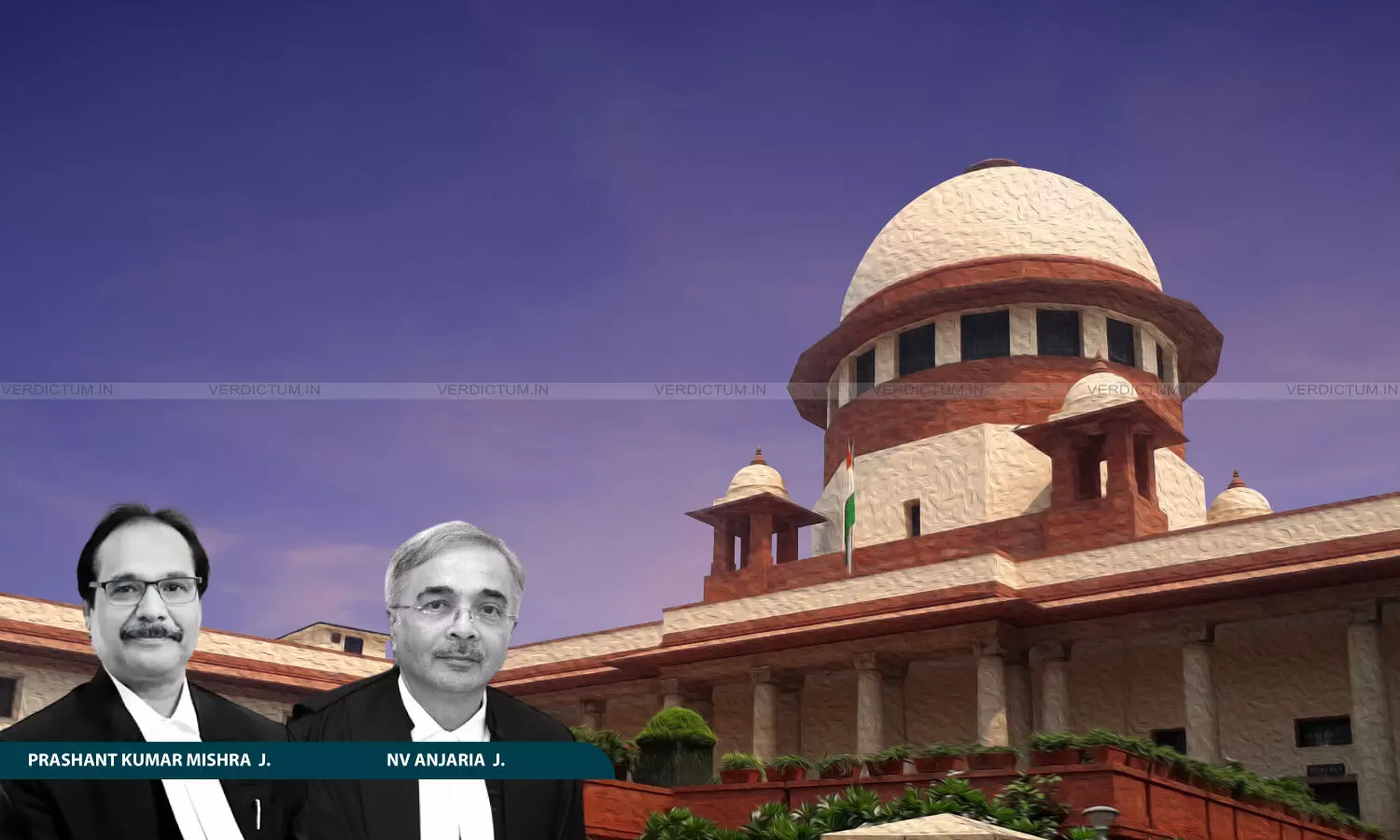
Supreme Court, Justice Prashant Kumar Mishra, Justice N.V. Anjaria
Baptismal Certificate Not A Prescribed Document U/S 94 JJ Act To Prove Minor’s Age: Supreme Court Converts POCSO Conviction Into Rape U/S 376 IPC
 |
|The Court noted that letting guilty escape is not doing justice to a rape victim, invoking Section 464 CrPC to sustain conviction despite no charge framed under Section 376 IPC.
The Supreme Court has held that a Baptismal Certificate, even where its contents are corroborated by the mother’s testimony, cannot by itself satisfy the mandatory hierarchy of proof of age prescribed under Section 94 of the Juvenile Justice (Care and Protection of Children) Act, 2015. In the absence of such proof, coupled with the prosecution’s failure to produce school or municipal records or conduct an ossification test, minority cannot be treated as proved for the purposes of the POCSO Act. Accordingly, the Court set aside the appellant’s conviction under Section 4 of the POCSO Act and instead convicted him for rape under Section 376(1) of the IPC.
Rejecting the plea for acquittal on the ground that age was not proved, the Court noted that letting a guilty person escape would not amount to justice for a rape victim. Invoking Section 464 CrPC, the Court further held that failure to frame an alternative charge under Section 376 IPC did not occasion any failure of justice, as penetrative sexual assault stood independently proved.
A Bench comprising Justice Prashant Kumar Mishra and Justice N.V. Anjaria observed, “…The only document available on the record for proving the age of the victim is the Baptismal Certificate issued by the Khasi Jaintia Presbyterian Assembly. Although the date of birth in the Baptismal Certificate finds corroboration in the deposition of P.W.-2, the mother of the victim girl, stating the girl was born on 05.03.2006, yet since the document itself is not the one prescribed under Section 94 of the JJ Act, we are of the considered view that the prosecution has failed to prove the age of the victim in the manner required under Section 94 of the JJ Act”.
“…the present is a case where this Court is dealing with the issue relating to proof of age of a POCSO victim for which a statutory prescription is put in place by the legislation in the form of Section 94 of the JJ Act which had been found applicable in the case of POCSO victims also as held by this Court in the judgments discussed by us in the preceding paragraphs. Thus, the case of Luis Caetano Viegas (supra) is not only distinguishable, but it does not apply in the background of the statutory mechanism for proving the age of the POCSO victim with which we are concerned in this case. The argument raised by the learned Advocate General for the respondent-State basing on Luis Caetano Viegas (supra) is, thus, rejected”, it noted further.
Advocate Shashank Bajpai appeared for the appellant and Amit Kumar, Advocate General appeared for the respondent.
The prosecution's case was that the appellant had committed penetrative sexual assault upon a thirteen-year-old girl at Sutnga village in East Jaintia Hills district of Meghalaya, following which an FIR was lodged by the victim's mother. The prosecution examined fourteen witnesses and relied, for proof of the victim's age, principally on a Baptismal Certificate issued by a church authority, without producing school records, municipal birth records, or subjecting the victim to an ossification test.
The Special Judge (POCSO) convicted the appellant under Section 4 of the POCSO Act and Section 506 IPC, sentencing him to twenty years' rigorous imprisonment. The Meghalaya High Court affirmed the conviction, prompting the present appeal.
Examining the scheme of Section 94 of the JJ Act and its own precedents, the Court held that the Baptismal Certificate did not answer the description of any document contemplated therein, and that the mandatory recourse to an ossification test in the absence of such documents had not been undertaken. The prosecution had, therefore, failed to prove minority as required by law.
However, since the factum of penetrative sexual assault stood established through consistent testimony, corroborative medical findings, and forensic evidence, the Court held that the omission by the Trial Court to frame an alternative charge under Section 376 IPC did not occasion any failure of justice, since the ingredients of both offences were identical save for the age of the victim, and the accused had full opportunity to defend himself.
Exercising its powers under Section 386 CrPC, the Court set aside the conviction under Section 4 of the POCSO Act and instead convicted the appellant under Section 376(1) IPC, sentencing him to ten years' rigorous imprisonment and a fine of Rs.10,000/-, while upholding the conviction and sentence under Section 506 IPC. The appeal was partly allowed accordingly.
Cause Title: Pynchemalangaki Bareh v. State of Meghalaya (Neutral Citation: 2026 INSC 984)
Appearances:
Appellant: Shashank Bajpai, Prachi Nirwan, Akshit Saxena, Shakun Sudha Shukla, Vaishnavstuti, Vidula Mehrotra, AOR, Advocates.
Respondent: Amit Kumar, Advocate General, Avijit Mani Tripathi, AOR, T.k.nayak, Aditya Kumar, Aditya S. Pandey, Advocates.