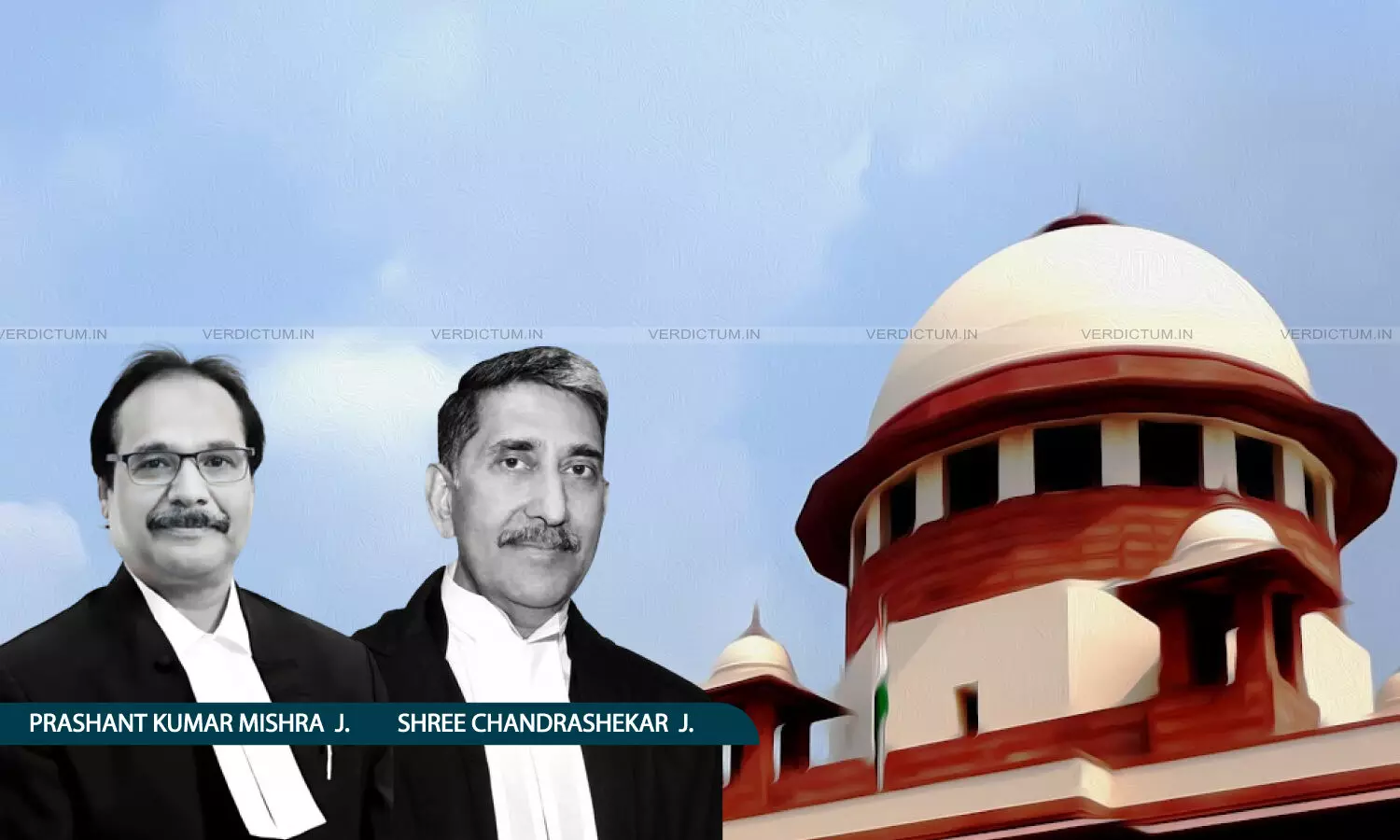
Justice Prashant Kumar Mishra, Justice Shree Chandrashekhar, Supreme Court
Services Rendered On Contract/Ad Hoc/Daily Wage Basis Before Regularization Must Be Computed As Qualifying Service For Retiral & Pension Benefits: Supreme Court
 |
|The Supreme Court was considering an appeal revolving around the entitlement of the employees of the Punjab School Education Board to have their pre-regularisation service counted as qualifying service for pension.
While dismissing an appeal of the Punjab School Education Board, the Supreme Court has affirmed the view that the services by the employees rendered on contract/ad hoc/daily wage basis prior to regularisation must be computed as qualifying service for the purpose of retiral and pension benefits.
The Apex Court was considering an appeal filed against the judgment passed by the Division Bench of the Punjab and Haryana High Court in a case revolving around the entitlement of the respondent-employees of the appellant, the Punjab School Education Board, to have their pre-regularisation service counted as qualifying service for pension, and be governed by the old pension scheme rather than the new Defined Contributory Pension Scheme, which was introduced in 2004.
The Division Bench of Justice Prashant Kumar Mishra and Justice Shree Chandrashekhar held, “Here, too, the Single Judge and Division Bench had rightly held that the services by respondent-employees rendered on contract/ad hoc/daily wage basis prior to regularization must be computed as qualifying service for the purpose of retiral and pension benefits. The breaks in service were either ‘notional’ or artificial/administrative breaks, or precipitated by Court orders. They must be ignored and the service should be treated as continuous.”
Advocate Rohit Sharma represented the Appellant while Additional Advocate General Shadan Farasat represented the Respondent.
Factual Background
The respondents and others similarly situated were first engaged by the appellant-Board, an autonomous body established under the Punjab School Education Board Act, 1969, as Clerks and Peons (later promoted to Junior and Senior Assistants) between 1993 and 1996 on a contract/ad-hoc/daily wage/work-charge basis, initially for periods of 89 days. In 1994, the High Court directed that contractual appointments would not continue beyond six months or until regular appointments to the posts were made, whichever was earlier. However, on account of exigencies of work and the commencement of examinations, 184 employees were again engaged on contract and their engagement was thereafter continued from time to time.In 1996, the Board advertised 134 posts of Clerks. This recruitment process was subsequently cancelled.
A fresh advertisement was issued but owing to a Government-imposed ban on recruitment, the process was kept in abeyance. In the meantime, several of those who had continued in service on a contractual basis approached the High Court by filing a batch of writ petitions, which were dismissed by the High Court, and they were permitted to continue in service for four months or until regularly selected candidates became available, whichever was earlier. In the meantime, the Government of Punjab issued a Notification in 2001 revising the extant policy pertaining to the regularisation of work-charged, daily wage, and other similar categories of employees. Based on this policy, four writ petitions were filed before the High Court seeking regularisation. The recruitment process for 134 Clerks was thereafter completed in December 2001 by way of direct recruitment. Their services, however, were subsequently dispensed with, and the termination was challenged. During the course of those proceedings, pursuant to a compromise, a High-Powered Committee was constituted which affirmed that the selection process was not proper. The dispute continued with the filing of the petition seeking reconsideration of the claim for regularization.
Following their regularization, the respondent-employees raised a claim for pension under the old pension scheme. The State Government, however, declined the request and took the view that the respondent-employees were not entitled to the benefit of the old pension scheme in view of the Defined Contributory Pension Scheme, which had come into force with effect from January 1, 2004. The writ petition came to be filed in such circumstances. Both the Single Judge and the Division Bench held that the respondent-employees were entitled to the benefits. Aggrieved thereby, the Baord’s appeal came to be filed before the Apex Court.
Reasoning
The Bench concurred with the view of the Courts below that the substance of the respondent employees’ engagement must prevail over its form. The Bench noted that though the term “appointment” was used in the letters issued to them, the intent of the appellant Board to regularize the respondent-employees was unmistakable from the language consistently used across the Government Policy, the deliberations and recommendation of the Committee to adopt said policy, the Board’s decision accepting this recommendation, and the consequent public notice, which referred to appointment “on regular basis.”
Referring to the letter of the appellant-Board to the State Government dated October 20, 2011,the Bench noted that the appellant-Board itself committed to this position in writing and there was no doubt that it did in fact regularise the employees.
The Bench further held that the Single Judge and Division Bench had rightly held that the services by respondent-employees rendered on contract/ad hoc/daily wage basis prior to regularization must be computed as qualifying service for the purpose of retiral and pension benefits. The Bench considered the fact that the High Court in the year 2001, had upheld that it was free to adopt or reject the Government Policy dated January 23,.2001, despite it being made expressly applicable to public sector undertakings, corporations, boards, local authorities and other autonomous bodies in the State of Punjab.
Taking note of the fact that the appellant Board had voluntarily adopted the policy mutatis mutandis, the Bench dismissed the appeal and held, “The respondent-employees were indeed regularized and are entitled to be treated as having entered Government service prior to 01.01.2004 and therefore fall under Tier II of the Defined Contributory Pension Scheme. They have the discretion to choose either the old GPF pension scheme or the new scheme, if they opt for it.”
Cause Title: Punjab School Education Board And Another v. Satnam Singh and Others (Neutral Citation: 2026 INSC 965)
Appearance
Appellant: Advocates Rohit Sharma, Jatin Lalwani, Nikhil Purohit, Giri Raj Singh, AOR Kumar Dushyant Singh
Respondent: Additional Advocate General Shadan Farasat, Senior Advocate P S. Patwalia, AOR Natasha Dalmia, Anisha Jain, Shambhavi Singh, Prerna Cheema, Deveshi Chand, AOR Karan Sharma, Advocate Arkaprava Das