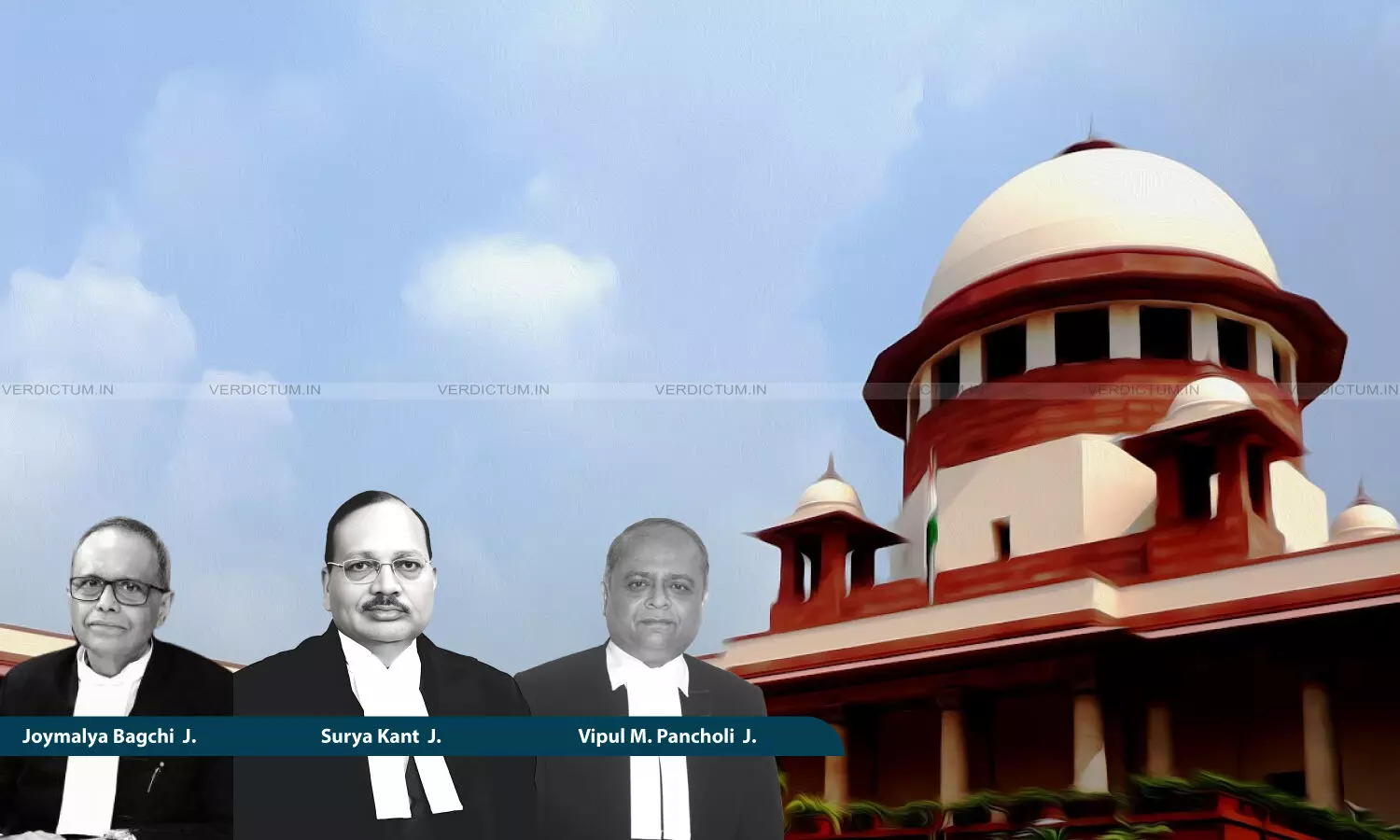
Supreme Court of India, Justice Surya Kant, Justice Joymalya Bagchi, Justice Vipul M. Panhcoli
Reverting To Ballot Papers A 'Regressive Step', But Can't Injunct Election: Supreme Court Refuses To Stay Punjab Municipal Polls
 |
|The Court declined to interdict the Punjab Municipal Elections scheduled for May 26, 2026, observing that while reverting to manual ballot papers is a regressive policy, courts must not disrupt an ongoing electoral process once it has commenced.
The Supreme Court, while refusing to pass an order in Punjab Municipal Elections, emphasised that reverting to paper ballots is undoubtedly a regressive step, but regardless of how regressive or unwise the measure may be, it is extremely inadvisable to injunct or regulate an election process once it has commenced.
A Special Leave Petition was filed by the Petitioner against the Impugned Judgment passed by the Punjab and Haryana High Court. Vide the said impugned judgment, the High Court dismissed the Writ Petition filed by the Petitioner seeking a Writ of Mandamus to direct that the forthcoming Municipal General Elections, 2026, in the State of Punjab, scheduled for 26.05.2026, be conducted utilizing Electronic Voting Machines (EVMs) equipped with Voter Verifiable Paper Audit Trail (VVPAT) systems.
The Bench of Chief Justice Surya Kant, Justice Joymalya Bagchi and Justice Vipul M Pancholi refused to pass any orders in the matter. During the hearing Justice Bagchi said, "The ECI does not conduct municipal elections. The specific authority responsible for conducting these local body elections, namely the State Election Commission, is not before us today. It is for the State Election Commission to take a definitive call on this matter...This Court would have certainly entertained the plea had you demonstrated a patent lack of jurisdiction. However, an unwise policy choice by an authority does not persuade us to destabilize an ongoing election process. The State Election Commission is the ultimate master of municipal elections..."
"Had the State Election Commission lacked the statutory power to choose, the position would be different; however, it is legally open to them to determine whether to use ballot papers or EVMs. We are in agreement with your submission that the State Election Commission ought to have factored in the observations made by this Court in the ADR judgment, and that reverting to paper ballots is undoubtedly a regressive step. Nevertheless, regardless of how regressive or unwise the measure may be, it is extremely inadvisable to injunct or regulate an election process once it has commenced. We may, however, make appropriate observations to safeguard future elections", Justice Bagchi added.
Senior Advocate Nachiketa Joshi appeared for the Petitioner.
Senior Advocate Nachiketa Joshi submitted, "The elections are now sought to be conducted via ballot papers. I place reliance upon your Lordships' own judgment, which mandates that the use of Electronic Voting Machines (EVMs) must be the norm. The statutory rules have been amended accordingly and they clearly provide—moreover, Milords, the election is scheduled for tomorrow."
Chief Justice Suryakant said, "There is no time left now. What can be done at this stage?"
Joshi replied, "No, Milords. Kindly appreciate the timeline from when the notification was issued. The petitions were filed immediately thereafter. The Hon’ble High Court has erroneously recorded that the writ petition was filed on the 18th of May. The Election Commission of India (ECI) even undertook to provide the necessary training facilities. Therefore, the question of delay does not arise. The State had set up a false premise that EVMs were unavailable. The ECI was served with advance notice and their counsel is present before your Lordships today. The ECI filed an affidavit categorically stating that all arrangements would be executed from their end. Since the ECI has explicitly stated that the machines are available, and in light of your Lordships’ own binding precedent—"
CJ Surya Kant said, "There was no necessity for the Petitioner to wait for the formal election notification to be issued. You were fully aware that the elections were due and imminent. This is not the first time this litigation has been generated; you have already engaged in several rounds of litigation earlier. You could have approached the Hon’ble High Court well in advance to seek a direction to the authorities to make all necessary arrangements."
Chief Justice Surya Kant expressed severe reservations regarding the timing of the litigation, noting that the election was imminent and that the Petitioner was well aware that local body elections were due. The Bench observed that this was not the first instance of litigation surrounding these elections, referencing prior rounds of disputes, and remarked that the Petitioner ought to have approached the High Court well in advance to seek prospective directions for electoral arrangements rather than waiting for the eleventh-hour formal notification.
Joshi countered by drawing a parallel to the pending case of Seema Sharma, where the Court had previously intervened to appoint a High-Powered Fact-Finding Commission to investigate massive electoral malpractices arising from manual voting, urging that the ready availability of EVMs at the state border warranted a similar judicial intervention to protect democratic integrity.
Justice Bagchi also clarified that the dispute did not present a fundamental jurisdictional error that would justify judicial interference at such a late stage.
The Bench observed that the Election Commission of India does not possess the mandate to conduct municipal elections; rather, the State Election Commission is the constitutional master of local body elections. In the absence of a patent lack of statutory power or a jurisdictional transgression by the State Election Commission, the Court emphasized that it would not interdict, halt, or regulate an ongoing electoral process once it had actively commenced.
While the Bench explicitly agreed with the Petitioner's submissions that reverting to physical ballot papers represents an unwise and highly regressive step—reaffirming that the guidelines laid down in the Association for Democratic Reforms (ADR) judgment ought to be strictly factored in by all electoral authorities—it concluded that a mere error in policy choice cannot persuade the Court to destabilize an election on its eve. Consequently, the Bench declined to grant immediate injunctive relief but indicated that it would remain open to formulating strict regulatory observations to safeguard the integrity and mechanism of future elections.
The SLP filed by AoR Alabhya Dhamija said, "It is submitted that the said decision of Respondent No. 2 is arbitrary, unreasonable, and amounts to an unnecessary return to the old ballot paper/ballot box system of voting, by replacing the EVM-VVPAT system. The EVM-VVPAT system has been widely adopted across India and upheld by this Hon’ble Court as a reliable, transparent, and effective method for conducting free and fair elections. The sudden departure from this established system, without any valid or reasonable justification, seriously affects the transparency, fairness, and credibility of the electoral process, and weakens public confidence in the conduct of elections."
While the High Court, in principle, affirmed the Petitioner’s contention that reverting to the orthodox method of ballot papers and ballot boxes would be inappropriate, it rejected the Writ Petition solely on the ground of laches, holding that the Petitioner had approached the Court belatedly.
Aggrieved by the said dismissal, the Petitioner has approached the Apex Court on the ground that the High Court failed to appreciate that the Petitioner had immediately filed the Writ Petition and mentioned the matter thrice for urgent listing, but the matter was taken up for the first time only on 19.05.2026, five days after filing and seven days after the election notification.
"It is submitted that consistency, predictability, and institutional continuity constitute integral components of free and fair electoral administration and an abrupt departure from an established electoral mechanism immediately preceding elections undermines public confidence and creates avoidable apprehensions concerning the integrity of the electoral process. The electorate and political stakeholders had a legitimate expectation that elections would continue to be conducted through the established EVM-VVPAT framework followed in previous elections", the petition said.
It is further submitted that the High Court erred in failing to appreciate the statutory mandate of Rule 48-A of the Punjab Municipal Election Rules, 1994, which prescribes EVMs as the exclusive mode for casting and counting votes.
Furthermore, the High Court failed to consider the Affidavit filed by the Election Commission of India (ECI), wherein the ECI explicitly undertook to provide the requisite number of EVMs on a loan basis from the neighboring State of Rajasthan within 2–3 days, and further committed to training the government officials within 20 to 30 minutes, thereby ensuring that logistical arrangements could have been seamlessly executed before the final conclusion of the election schedule on 01.06.2026.
The Petitioner has challenged the impugned notification issued by Respondent No. 2 (State Election Commission, Punjab), whereby it was abruptly and arbitrarily decided at the eleventh hour—merely days before the nomination process and without any gazette notification or public consultation—that the Municipal General Elections, 2026 would be conducted through manual voting and large-size ballot boxes.
It was submitted that this decision suffers from manifest arbitrariness, violates Article 243ZA of the Constitution of India, and flouts the legitimate expectations of the stakeholders. The Petitioner further highlighted administrative unpreparedness, pointing out that official communications evidenced a severe shortage and non-availability of ballot boxes in various districts, including Barnala, Fazilka, Pathankot, and Tarn Taran.
It also said, "That the past conduct of the present ruling government clearly raises serious apprehensions regarding the hurried decision to reintroduce ballot papers for the forthcoming elections. In the previous Municipal Corporation elections, there were grave allegations of large-scale harassment, interference, and electoral malpractice by members and supporters of the ruling party."
It was further submitted that severe irregularities and administrative compromises had plagued recent local body elections in the State, further underscoring the dangers of deviating from an automated and secure voting system. Specifically, during the recent Block Samiti elections held in Patiala, serious concerns were raised regarding the fairness, systemic integrity, and legality of the entire electoral process. A controversial audio recording had surfaced in the public domain, wherein the then Senior Superintendent of Police (SSP), Patiala, was purportedly heard stating that explicit directions had been issued to permit illegal activities outside the designated nomination centre.
The Petitioner contended that the contents of the said audio recording revealed a deeply disturbing misuse of the state administrative machinery and a deliberate compromise of free and fair electoral practices by high-ranking enforcement officials. In view of the gravity of the situation and the threat to democratic principles, the Hon’ble High Court had been approached, which was pleased to direct an independent forensic verification of the controversial audio recording through the Forensic Science Laboratory, Chandigarh.
The Petitioner has preferred the present application seeking ad-interim ex parte relief during the pendency of the instant Special Leave Petition, on the ground that if the scheduled elections are permitted to proceed under the discredited and regressive ballot paper system, it would cause irreparable injury to the democratic process and render the main petition infructuous.
Cause Title: Ruchita Garg v. State of Punjab & Ors. [SLP (C) No. 18893 of 2026]