Witnesses Complaining Of Police Detention Raise Doubt That They Were "Set Up" By Police: Supreme Court Acquits 2008 Murder Conspiracy Accused
 |
|The Bench noted that circumstances from which the conclusion of guilt is to be drawn must or should be, and not merely may be, fully established.
The Supreme Court has acquitted a man convicted for criminal conspiracy in a 2008 murder case, holding that when prosecution witnesses complain of illegal police detention and there is no convincing explanation for why they were summoned, a serious doubt arises as to whether such witnesses were “set up” by the Police. Reiterating that suspicion, however strong, cannot replace proof beyond reasonable doubt, the Court held that an incomplete chain of circumstances cannot sustain a conviction for conspiracy.
The Bench allowed the appeal filed by an accused and set aside the judgments of the trial court and the Madhya Pradesh High Court which had convicted him under Sections 302/120B IPC. The Court found that the testimonies of key witnesses, who alleged they had been detained by police before their statements were recorded, could not be safely relied upon, and the remaining circumstantial evidence was insufficient to establish any prior agreement or meeting of minds between the appellant and the assailants.
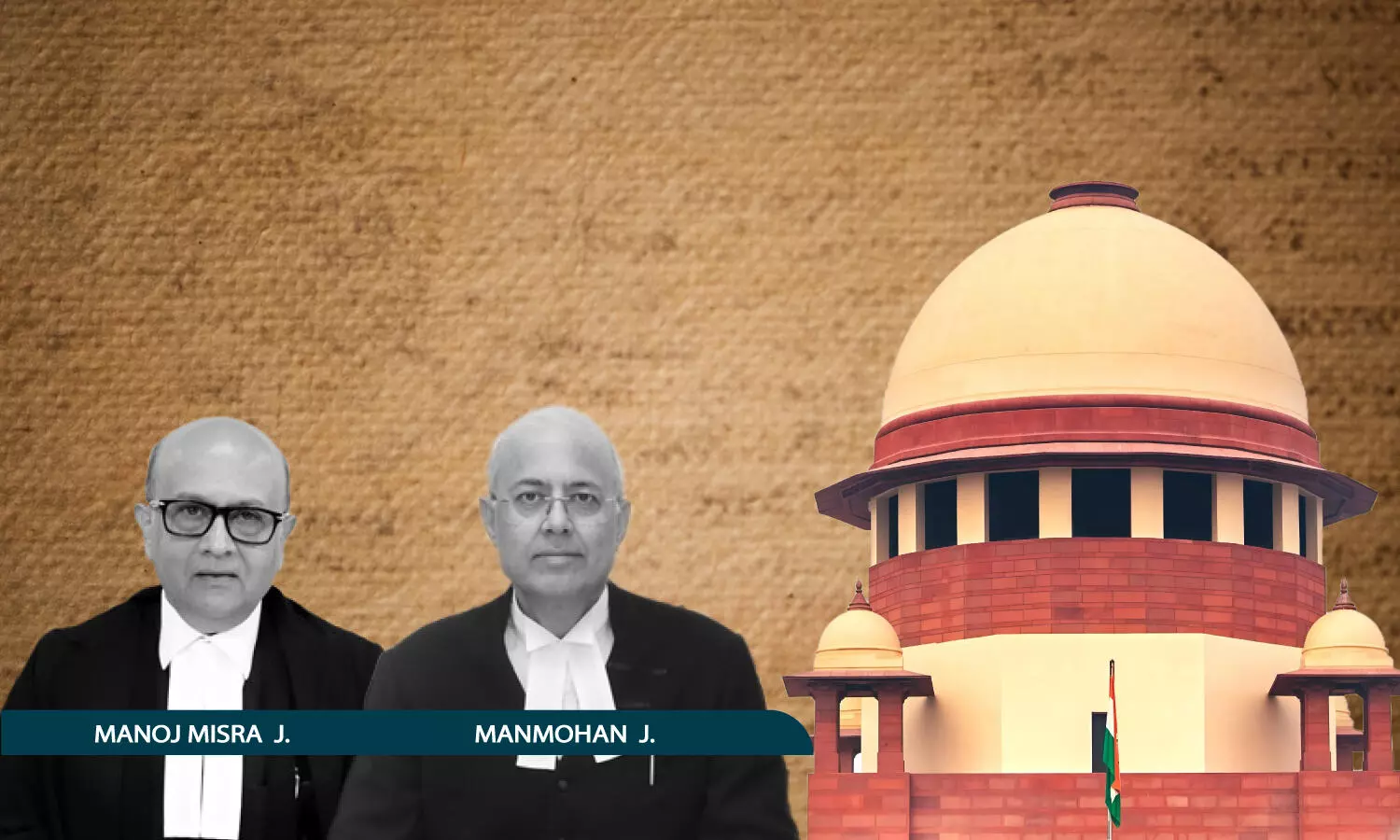
A Bench of Justice Manoj Misra and Justice Manmohan observed, “…No doubt the trial court observed that their statement about detention for 5-6 days may not be correct as their statement was recorded within 4 days of the incident, but once those witnesses complain of detention and there appears no good reason for the investigating agency to summon those witnesses, there arises a doubt whether those witnesses were set up by the police. In such circumstances, when the High Court had discarded testimony of those witnesses there is no reason for us to accept their testimony”.
Advocate Ganesh A. Khemka appeared for the appellant and Pashupathi Nath Razdan, AOR appeared for the respondent.
In the matter, the prosecution case was that four persons were tried for the murder of Ashok Bakdiya. While three accused were convicted for murder and offences under the Arms Act, Pulkit was convicted solely on the allegation that he had entered into a criminal conspiracy with the perpetrators.
The trial court relied on alleged prior hostility between the appellant and the deceased, testimony of witnesses claiming the appellant had sought a recce of the deceased’s movements, disclosure statements made during police custody, and mobile call records allegedly indicating contact with a co-accused after the incident.
Before the Supreme Court, the appellant argued that there was no direct or reliable circumstantial evidence to show any agreement or meeting of minds between him and the assailants prior to the incident. It was further contended that once the High Court had discarded the testimony of two material witnesses on the ground that they were illegally detained before their statements were recorded, the remaining evidence was insufficient to sustain the conviction.
Accepting the appellant’s case, reiterating Sharad Birdhichand Sarda v. State of Maharashtra, (1984) 4 SCC 116, the Bench observed, “We are conscious of the law that from circumstances also inference of conspiracy can be drawn. However, the law regarding proof of guilt by circumstantial evidence is settled. The circumstances from which the conclusion of guilt is to be drawn must or should be, and not merely may be, fully established; the facts established should be consistent only with the hypothesis of the guilt of the accused, that is to say, they should not be explainable on any other hypothesis except that the accused is guilty; these circumstances should be of a conclusive nature and tendency; they should exclude every possible hypothesis except the one to be proved; and there must be a chain of circumstances so complete as not to leave any reasonable ground for the conclusion consistent with the innocence of the accused and must show that in all human probability the act must have been done by the accused”.
The Court found the testimony of a “chance witness”, who claimed to have seen the appellant and another accused discussing the deceased at a public place a few days before the murder, to be inconclusive and lacking sufficient detail.
It also found the prosecution’s motive theory weak, where, while the deceased’s wife initially stated that her husband had no enemies, she later referred to an old dispute with the appellant.
Another witness spoke of an altercation said to have taken place nearly six months before the incident. The Court held that such evidence lacked proximity and certainty, observing that motive may aid investigation but cannot by itself sustain conviction.
On the evidentiary value of the disclosure statement, the Bench reiterated that a confessional disclosure made in police custody is admissible under Section 27 of the Evidence Act only to the extent that it leads to discovery of a relevant fact. In the present case, the Court found that the names of co-accused had already surfaced during investigation before the appellant’s arrest and that the mobile phone allegedly recovered did not meaningfully connect him with the offence.
The Court also expressed doubt over the prosecution’s reliance on call detail records, noting both evidentiary concerns and the absence of proof that the contacted number belonged to any co-accused or that there was any communication prior to the incident.
Holding that the appellant was entitled to the benefit of doubt, the Court allowed the appeal, acquitted him of the charge, and directed that he be released forthwith unless required in any other case.
Case Title: Pulkit @ Monu v. The State of Madhya Pradesh (Neutral Citation: 2026 INSC 543)
Appearances:
Appellant: Ganesh A. Khemka, Sarthak Sharma, Shreenath A. Khemka, Vidhi Gupta, Raghavendra Pratap Singh, AOR, Advocates.
Respondent: Pashupathi Nath Razdan, AOR, Maitreyee Jagat Joshi, Advocate.
Click here to read/download the Order