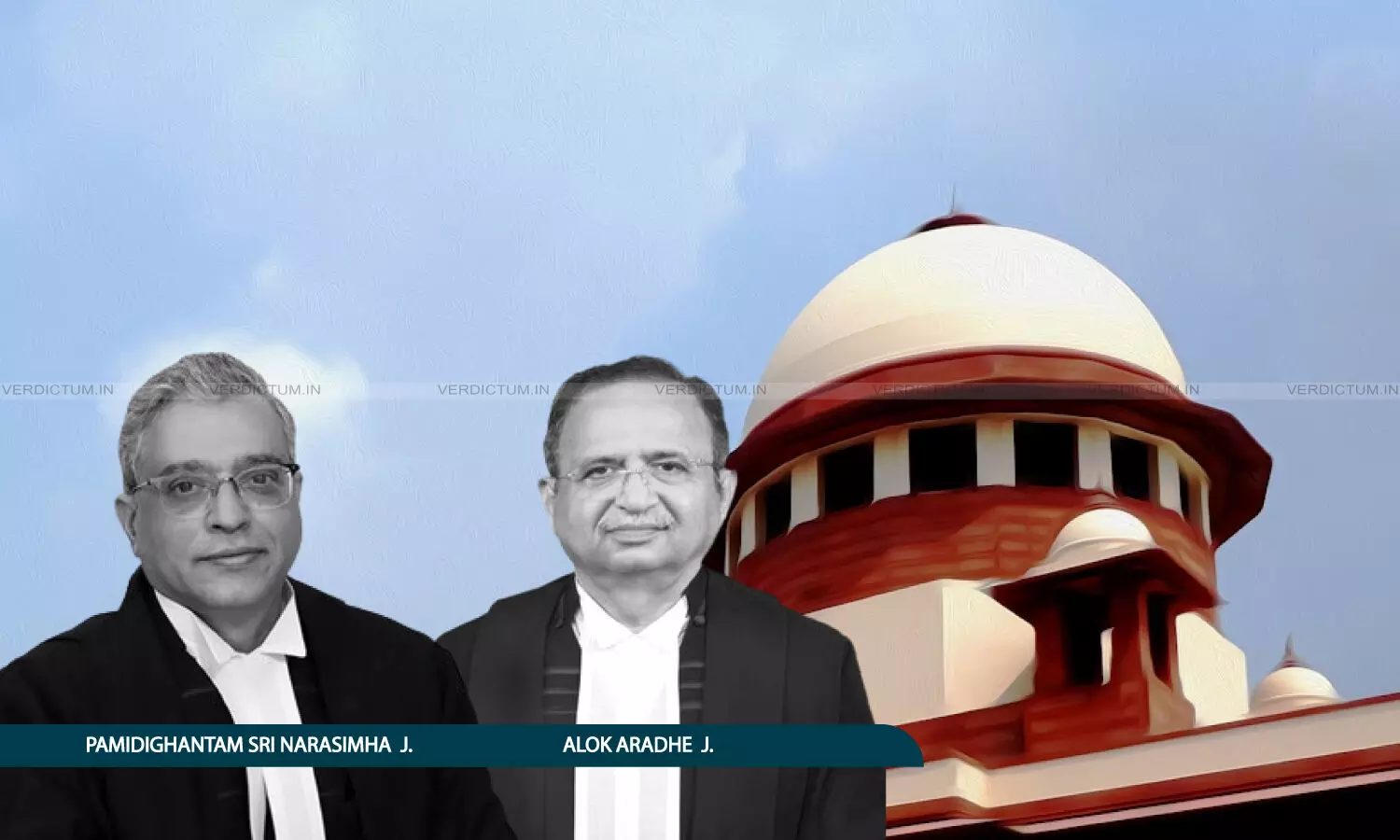
Justice Pamidighantam Sri Narasimha and Justice Alok Aradhe, Supreme Court
Zero-Tolerance For Using AI-Generated Precedents Without Verification: Supreme Court Sets Aside NCLT, NCLAT Orders Citing Fake Judgments
 |
|The Supreme Court was considering an appeal against the order of the NCLAT involving an application filed under Section 7 of the Insolvency & Bankruptcy Code.
While setting aside the orders passed by the NCLT and NCLAT where the Tribunals had relied upon non-existent, fake and hallucinated material, generated through Artificial Intelligence (AI), as if it were a precedent in support of their judgments, the Supreme Court has asked the Courts to adopt a zero-tolerance mode for producing, citing or using AI-generated precedents without verification.
The Apex Court was considering an appeal against the order of the NCLAT involving an application filed under Section 7 of the Insolvency and Bankruptcy Code.
The Division Bench of Justice Pamidighantam Sri Narasimha and Justice Alok Aradhe expressed its displeasure by observing, “This is yet again a case where the Tribunal relied on non-existent, fake and hallucinated material, generated through Artificial Intelligence (AI), as if it were a precedent in support of its judgment.”
“It is therefore compelling and necessary to have absolute and total control over the application and usage of AI. The control lies in being two steps ahead of its application and in making deliberate choices about when and where to apply”, it stated while also adding, “It is necessary for Courts to adopt a zero-tolerance mode for producing, citing or using AI-generated precedents without verification. It is a misconduct on the part of an advocate to cite such judgments without verification. Equally, it is a serious lapse if a judge relies on such a fake or hallucinated AI-generated material as precedents in support of the determination. We have no hesitation in declaring that such a decision is no decision in the eyes of the law, irrespective of whether such material had a direct or indirect bearing on the decision-making. Such decisions are to be set aside even if an iota of fake or hallucinated material enters the decision-making process, as it would violate the sanctity of adjudication.”
Factual Background
The appeal was filed by a suspended director of Essel Infraprojects Ltd. (EIL), the corporate debtor and corporate guarantor of the original borrower, namely Pan India Utilities Distribution Company Ltd. (PIUDCL). PIUDCL had availed certain loan facilities from Jammu and Kashmir Bank Limited, the first Respondent. To secure these credit facilities, a corporate guarantee was executed by EIL. In due course, PIUDCL experienced severe financial stress and failed to maintain its repayment schedules, leading to the classification of its loan accounts as non-performing assets. Following continuous defaults, the first Respondent filed an application under Section 7 of the Insolvency and Bankruptcy Code, before the National Company Law Tribunal, seeking initiation of the corporate insolvency resolution process against the EIL/corporate debtor for recovery of its outstanding financial debt.
The National Company Law Tribunal, upon finding the existence of debt and default, passed an order admitting the Section 7 application, appointing an Interim Resolution Professional, and declaring a moratorium under Section 14 of the Insolvency and Bankruptcy Code, 2016. Aggrieved by the admission order, the appellant preferred an appeal before the National Company Law Appellate Tribunal. By the impugned final judgment and order, the NCLAT dismissed the appeal, confirming the observations of the NCLT. The NCLAT also referred to judgments relied upon by the NCLT.
Reasoning
On a perusal of the facts of the case, the Bench noted that the judgments relied upon by the NCLT were non-existent, and some AI-generated paragraphs were wrongly attributed to genuine citations.
The Bench further noted that the Respondent had filed an affidavit indicating that the alleged judgments relied on by NCLT were not cited by its counsel at the bar and the affidavit also indicated that the so-called precedents relied on by the adjudicating authority were obtained through its own research. “What about the Appellate Tribunal? The fake, non-existent judgments escaped scrutiny by the first statutory appellate tribunal. Today’s courts and tribunals implicitly trust lawyers when referring to precedents cited before them. Imagine the hardship of a situation in which the Court must verify the authenticity of each judgment cited by an advocate”, it added.
The Bench further stated, “Judicial process and the judgment under challenge are tainted by the usage of materials which are said to be precedents, but in reality, they are unreal, fake, and do not exist at all. A decision of a Court or an adjudicating authority based on material which is fake and hallucinated is no decision at all, and it amounts to subversion of the rule of law. Such a decision is unsustainable and has to be set aside at the earliest.”
Thus, setting aside the judgment and orders passed by the NCLT and NCLAT, the Bench restored the Section 7 application to its original number. “The NCLT shall proceed with the said application and pass orders in accordance with law”, it ordered.
Cause Title: Pooja Ramesh Singh v. Jammu and Kashmir Bank Ltd. (Neutral Citation: 2026 INSC 668)