“Exclusion Of Wife & Children Not A Suspicious Circumstance By Itself”: Supreme Court Upholds Unregistered Will In Favour Of Testator’s Sister
 |
|The Court held that exclusion of natural heirs by itself does not constitute a suspicious circumstance sufficient to invalidate a Will and reiterated that non-registration of a Will has no bearing on its genuineness or validity in law.
The Supreme Court upheld the validity of an unregistered Will executed in favour of the testator’s sister, holding that mere exclusion of the wife and children from inheritance cannot by itself invalidate a Will in the absence of suspicious circumstances affecting its genuineness or due execution.
The Court observed that the very object of a Will is to alter the normal line of succession and that a testator is legally entitled to distribute property according to his own wishes. The Bench further reiterated that there is no legal requirement mandating registration of a Will and no adverse inference can be drawn solely because a Will is unregistered.
The Court was hearing a civil appeal challenging the judgment of the Karnataka High Court affirming concurrent findings of the Trial Court and the First Appellate Court upholding a Will executed by the deceased testator in favour of his younger sister. The appellants, being the wife and children of the deceased, had alleged that the Will was fabricated and surrounded by suspicious circumstances.
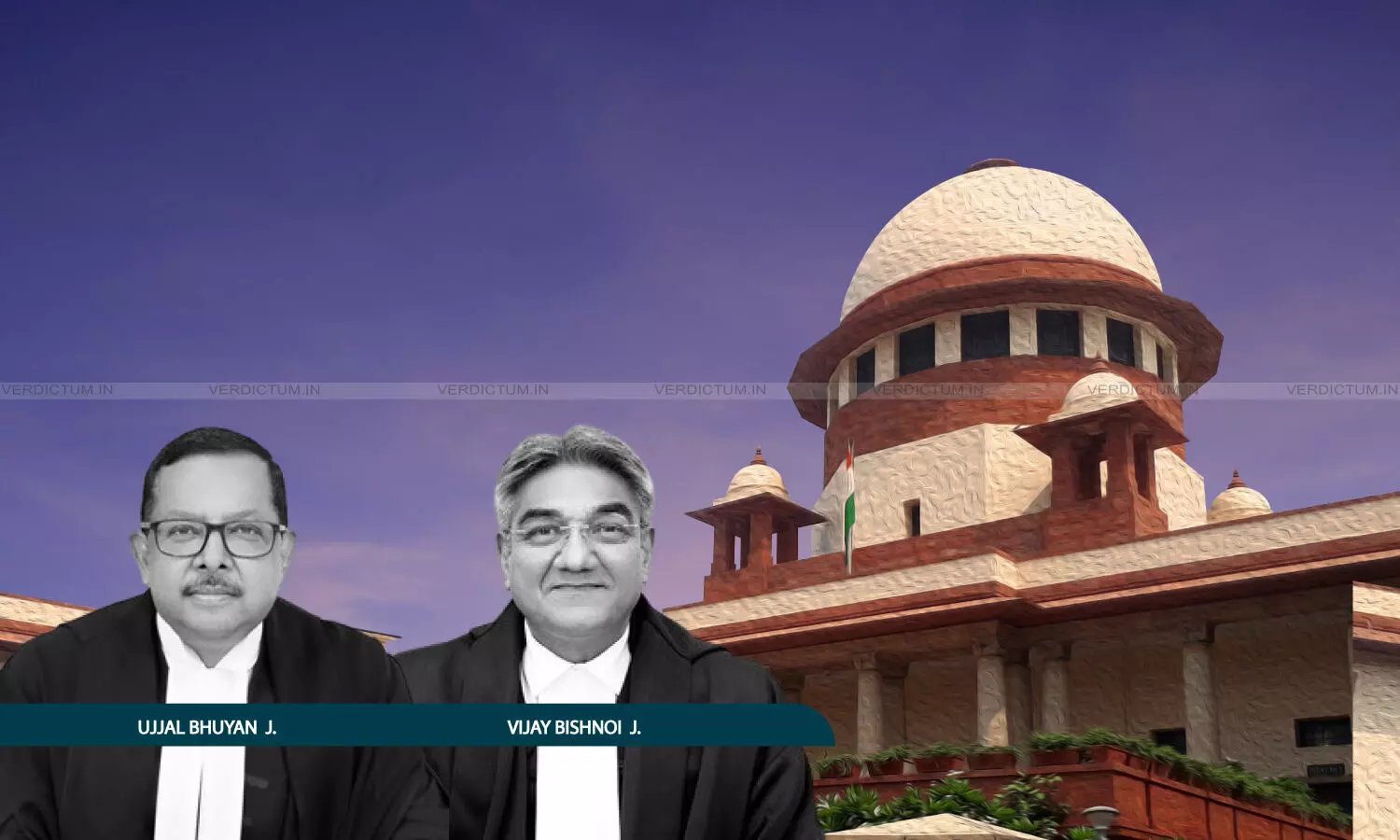
A Bench comprising Justice Ujjal Bhuyan and Justice Vijay Bishnoi observed: “Mere exclusion of the natural heirs from the property of the testator, by itself, cannot be construed as a suspicious circumstance so as to invalidate a Will outrightly. A testator is legally entitled to dispose of his property according to his own wishes, and unless the exclusion is accompanied by suspicious circumstances affecting the genuineness or due execution of a Will, such exclusion alone does not render a Will invalid.”
“Thus, … the exclusion of the natural heirs cannot be sufficient to vitiate the Will in question, particularly when the Will clearly specifies that the testator has not done any injustice to his wife, children, or other relatives, and that he has given enough to his wife and children”, the Bench added.
Furthermore, while referring to Ishwardeo Narain Singh v. Kamta Devi and Others (1953), the Bench reiterated: “There is nothing in law which requires the registration of a will and wills are in a majority of cases not registered at all. To draw any inference against the genuineness of the will on the ground of its non-registration appears to us to be wholly unwarranted.”
Senior Advocate Meenakshi Arora appeared for the appellants. Senior Advocate Vinay Navare appeared for the respondents.
Background
The dispute concerned agricultural and ancestral properties situated in Karnataka belonging to the deceased testator, who was employed as a Chartered Accountant and owned substantial immovable properties.
The testator executed a Will dated 15.05.1983 bequeathing the suit schedule properties in favour of his younger sister, Laxmi Nairthy. The Will also revoked an earlier power of attorney executed in favour of his brother-in-law. The testator died later the same year due to a heart attack.
After his death, mutation entries were effected in favour of his wife. Subsequently, the sister instituted a civil suit seeking a declaration of ownership, recovery of possession, mesne profits and injunction based on the Will.
The wife and children opposed the suit, contending that the Will was false and fabricated, that the signatures on the Will did not belong to the deceased and that the Will had been created in collusion after the death of the testator.
The Trial Court decreed the suit after finding that the Will stood duly proved through the testimony of one of the attesting witnesses and through comparison of the disputed signatures with admitted signatures of the testator. The First Appellate Court and Karnataka High Court affirmed those findings.
Aggrieved thereby, the wife and children approached the Supreme Court.
Court’s Observation
The Supreme Court examined the settled principles governing execution and proof of Wills under Section 68 of the Indian Evidence Act, 1872, and the jurisprudence developed in decisions including H. Venkatachala Iyengar v. B.N. Thimmajamma (1959), Janki Narayan Bhoir v. Narayan Namdeo Kadam (2003), Yumnam Ongbi Tampha Ibema Devi v. Yumnam Joykumar Singh (2009) and Shivakumar v. Sharanabasappa (2021).
The Court reproduced the governing principles regarding attestation, suspicious circumstances, burden of proof and testamentary capacity. The Bench reiterated that a Will must satisfy statutory formalities under Section 63 of the Indian Succession Act and that at least one attesting witness must be examined to prove execution.
The Court further reiterated: “Suspicious circumstances must be ‘real, germane and valid’ and not merely ‘the fantasy of the doubting mind’.”
Applying the aforesaid principles, the Court held that the Will stood duly proved through the testimony of one of the attesting witnesses, specifically deposed that the testator executed the Will in his presence and that both had signed the Will in the presence of each other.
The Court noted that the appellants had not entered the witness box themselves to deny execution of the Will and had failed to seriously challenge the testimony of the attesting witness during cross-examination.
The Bench also found it significant that the plaintiff had already disclosed the existence of the Will before the Tehsildar shortly after the death of the testator through a representation dated 10.02.1984 seeking mutation in her favour.
Rejecting the argument that mutation entries stood in favour of the appellants since 1984, the Supreme Court reiterated the settled principle that mutation entries do not confer ownership or title and are maintained merely for fiscal purposes.
Relying upon Balwant Singh v. Daulat Singh (1997), the Court observed that revenue entries merely enable the State to collect revenue and do not determine proprietary rights.
The Court expressly rejected the contention that the Will was suspicious because it was unregistered. Referring to Ishwardeo Narain Singh v. Kamta Devi (1954), the Court reiterated that there exists no statutory requirement mandating registration of a Will.
One of the principal arguments raised by the appellants was that exclusion of the wife and children from inheritance itself constituted a suspicious circumstance surrounding the Will.
Rejecting the contention, the Court observed that the very purpose of a testamentary disposition is to interfere with the ordinary line of succession and that deprivation of natural heirs does not automatically invalidate a Will.
The Court relied upon Rabindra Nath Mukherjee v. Panchanan Banerjee (1995), wherein it was held that exclusion of natural heirs by itself may not amount to a suspicious circumstance.
The Bench, however, clarified, relying upon Ram Piari v. Bhagwant (1990), that the absence of reasons for excluding heirs may sometimes create suspicion depending on the facts of each case.
In the present case, however, the Court noted that the Will itself expressly recorded that no injustice was being done to the wife and children or other relatives, while further stating that "when the validity of a Will is to be determined, the overall terms of a Will, the intention of the testator and the surrounding circumstances have also to be seen".
The Court therefore concluded that the exclusion of natural heirs did not create any suspicious circumstance affecting the validity of the Will.
Conclusion
The Supreme Court held that the Will stood validly executed and duly proved in accordance with law and that no suspicious circumstance existed warranting interference with the concurrent findings recorded by the Trial Court, First Appellate Court and Karnataka High Court.
Accordingly, the civil appeal was dismissed, and the judgments upholding the Will were affirmed.
Cause Title: Parvathi Nairthi (Dead) & Ors. v. Laxmi Nairthy (Dead) Through LRs. & Ors. (Neutral Citation: 2026 INSC 521)
Appearances
Appellants: Meenakshi Arora, Senior Advocate, Bina Gupta, AOR
Respondents: Vinay Navare, Senior Advocate, with Madhusmita Bora, Pawan Kishore Singh, Dipankar Singh and Pavithra V.