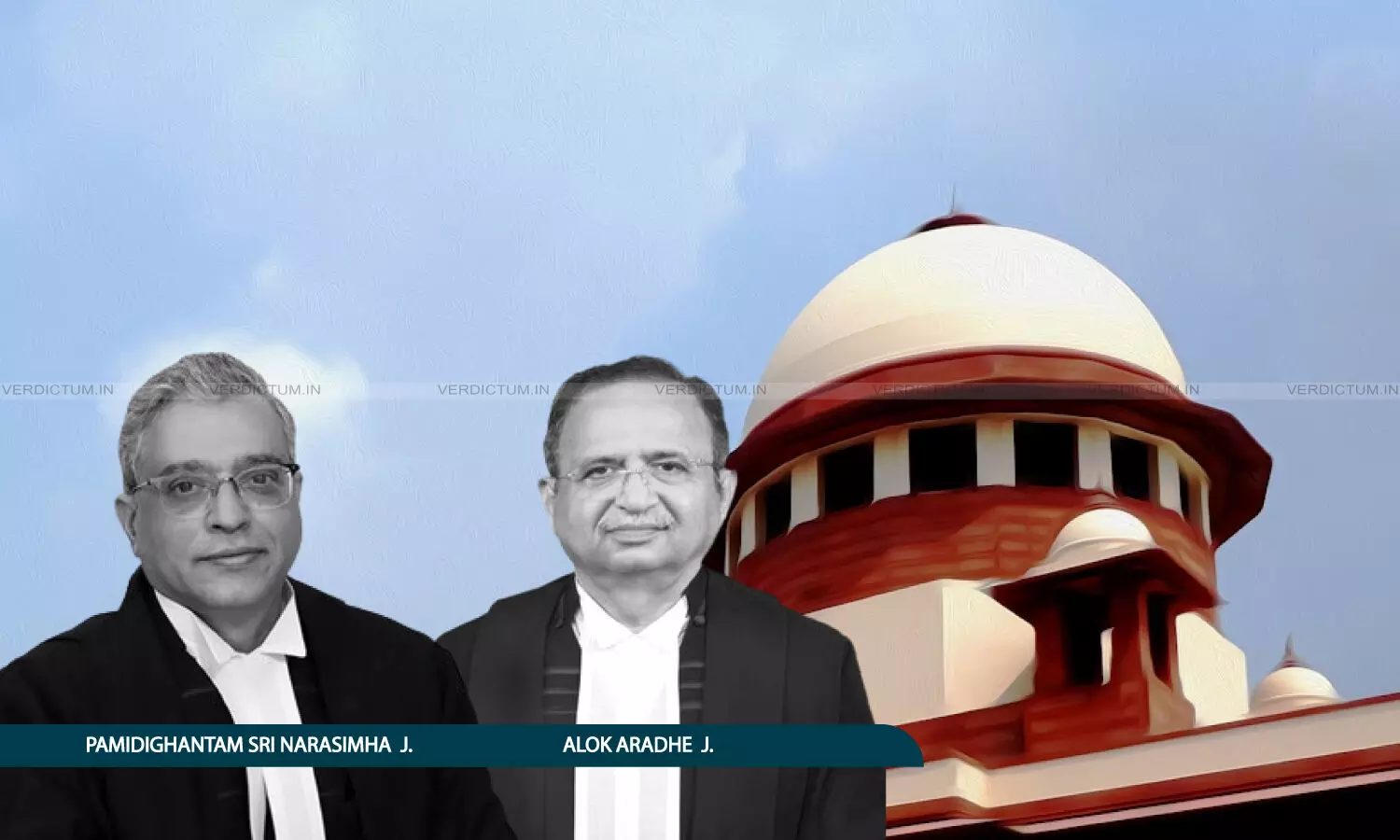
Justice Pamidighantam Sri Narasimha and Justice Alok Aradhe, Supreme Court
Policy Not To Be Interpreted Like A Statute: Supreme Court Upholds NOIDA Developer's Entitlement To 'Zero Period' Benefit Over Missing Access Road
 |
|The Bench held that a public authority cannot deny relief merely because some access existed, dismisses NOIDA's appeals and directs sanction of revised site plan after eleven-year construction stalemate over encroached 45-metre frontage.
The Supreme Court has held that beneficial policies formulated by statutory development authorities, such as NOIDA's "Zero Period" Policy, are not to be interpreted with the rigidity of a statutory provision, and that the availability of some measure of access to an allotted plot cannot be used to deny relief where a developer has been denied the effective and legitimate access contemplated at the time of allotment.
The Court held that where a public authority's own failure to provide a promised access road prevents a project from proceeding as sanctioned, the authority cannot escape its obligations under its own policy on the technical ground that alternative or partial access existed, and accordingly dismissed NOIDA's appeals against a High Court judgment that had granted "Zero Period" benefit to a commercial developer whose project had been stalled for over a decade.
The Bench, comprising Justice Pamidighantam Sri Narasimha and Justice Alok Aradhe, observed, “Having considered the matter in detail, we are of the opinion that the provisions of a policy, such as the Zero Period Policy, are not to be interpreted like the provisions of a statute. When interpreting the provisions of a policy, it is necessary for courts to consider both a micro and a macro perspective of the matter. A court must consider the purpose and object of the clause being interpreted and, at the same time, ensure that any interpretation reached sub-serves the broader goals and purposes of the policy as a whole…”.
“…In this perspective, we are of the opinion that Clause 5 of the Zero Period Policy is intended to ensure that a developer has easy, effective, and legitimate access to the allotted plot and is able to proceed with construction. This Clause is not to be interpreted so as to disapply the benefit of the Zero Period Policy in a situation where a developer struggles to gain access to the allotted plot and barely manages to keep construction ongoing. The circumstances in which a developer has to race against time, keeping in mind contractual and financial obligations, are well-known to everyone in the real estate industry”, the Bench said.
Senior Advocate Atmaram N.S. Nadkarni appeared for the appellants and Senior Advocates Mukul Rohatgi, Maninder Singh, Jayant Muth Raj and Gaurav Agarwal appeared for the respondents.
The Developer was allotted a commercial plot in Sector 94, Noida, in 2012, pursuant to which a lease deed was executed contemplating a 45-metre-wide front road and a 24-metre-wide side road as means of access.
Construction was first suspended pursuant to an interim order of the National Green Tribunal restraining activity near the Okhla Bird Sanctuary, and subsequently could not proceed on account of encroachment on the 45-metre front road, which remained unacquired inhabited land, and the non-completion of the 24-metre side road until 2020. The Developer sought the benefit of NOIDA's 2016 "Zero Period" Policy, which allows rescheduling of instalments without penal interest where construction is rendered impossible due to circumstances such as lack of access to allotted land.
NOIDA rejected the Developer's request for Zero Period benefit concerning the access road twice, notwithstanding a Tehsildar's report and findings by the Uttar Pradesh Real Estate Regulatory Authority confirming that the 45-metre front road remained encroached and unacquired.
The State Government, in revisional proceedings under the Uttar Pradesh Industrial Area Development Act, 1976, partly allowed the Developer's claim, granting waiver of penal interest and a pandemic-related extension. Aggrieved by the partial relief and NOIDA's continued refusal to sanction a revised site plan reflecting the unavailability of the front road, the Developer approached the Allahabad High Court, which allowed its writ petitions and directed NOIDA to extend full Zero Period benefit and approve the revised plan, prompting the present appeals.
“…We are of the opinion that the Developer can neither be expected to proceed with the project in terms of the original site plan nor can it be fastened with any liability for NOIDA’s failure to discharge its obligation to provide the 45- metre Front Road. Consequently, NOIDA’s denial of Zero Period Policy benefit to the Developer and its persistent refusal to sanction the revised site plan so that the project may finally go ahead are unreasonable and untenable in law…”, the Bench said.
It further held that frontage and elevation are commercially significant, and shifting from 45 metres to 24 metres required changes to the building’s setbacks, entry points and configuration, warranting a revised sanction. The Developer could not be penalised for NOIDA’s failure to fulfil its lease obligations.
Cause Title: New Okhla Industrial Development Authority & Ors. v. M/s Sunshine Trade Tower Private Limited & Anr. (Neutral Citation: 2026 INSC 975)
Appearances:
Appellants: Atmaram N.S. Nadkarni, Senior Advocate.
Respondents: Mukul Rohatgi, Maninder Singh, Jayant Muth Raj and Gaurav Agarwal, Senior Advocates.