All & Not Some Accused Persons Should Be Convicted Or Acquitted On Basis Of Same Set Of Depositions & Similar Roles: Supreme Court
 |
|The Supreme Court was considering an appeal challenging the judgment whereby 6 accused persons were charged to face trial in a criminal case.
While observing that on the very same set of depositions, assigning similar roles to all the accused persons, either all should have been convicted or acquitted, the Supreme Court has set aside the judgment of conviction in a 1993 murder case.
The Supreme Court was considering an appeal filed against the impugned judgment whereby 6 accused persons were charged to face trial in relation to a criminal case registered under Sections 147, 148, 149 & 307 of the Indian Penal Code, 1860.
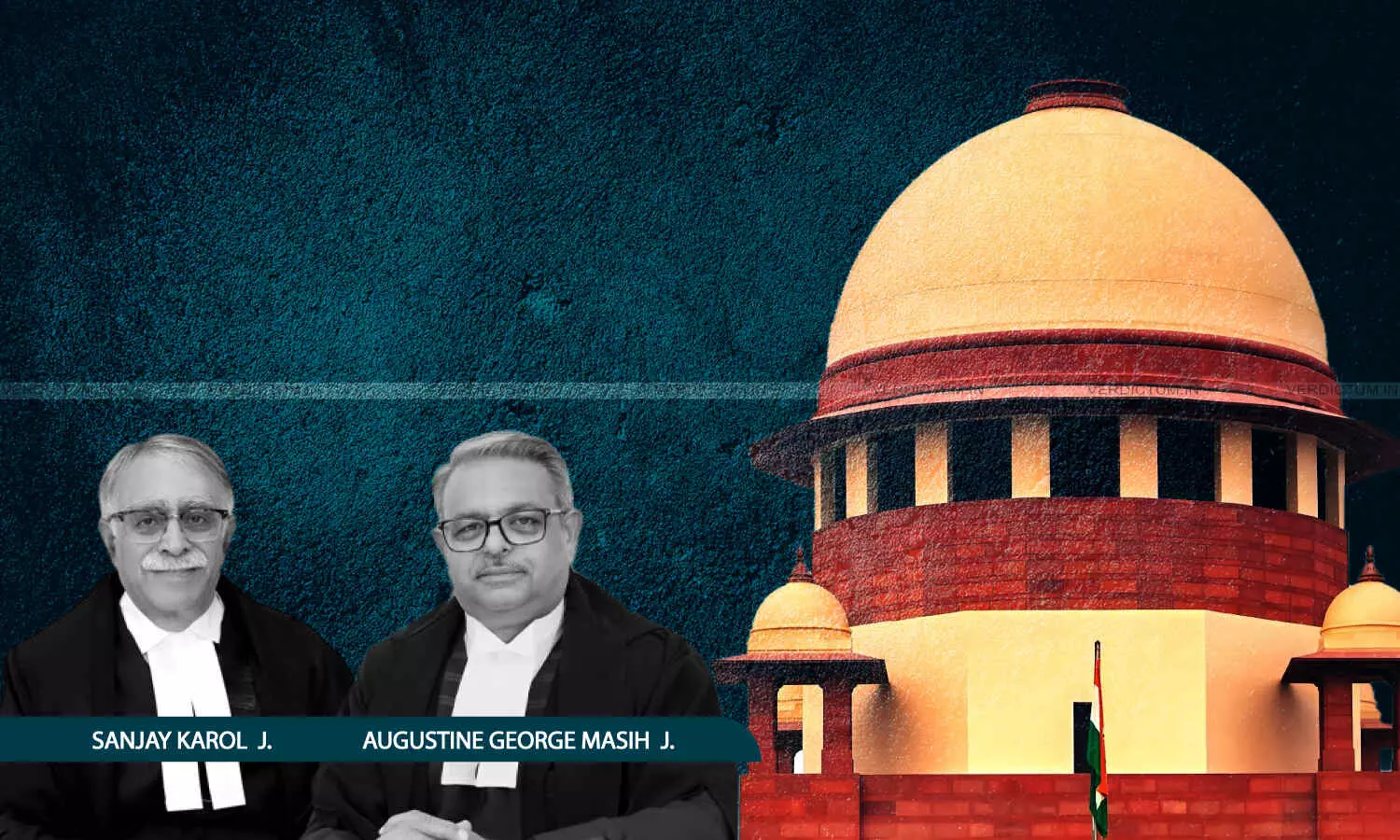
The Division Bench of Justice Sanjay Karol and Justice Augustine George Masih held, “That apart, we may also observe that on the same set of facts, the learned Trial Court convicted certain persons and acquitted others. On the very same set of depositions, assigning similar roles to all the accused persons, either all should have been convicted or acquitted. There is no discussion by the High Court as to why the reasoning adopted by the Trial Court for acquitting the co-accused could not have been adopted qua the convicts.”
Factual Background
The case dates back to the year 1993 when the accused persons allegedly formed an unlawful assembly with a common object and caused injuries to Gaflu and Bharat Singh. In furtherance thereof, they also committed an offence of rioting with deadly weapons. As a result thereof, Gaflu died. Chargesheet was presented against 11 accused persons in relation to the very same offence. To establish their case, the prosecution examined 17 witnesses, and eventually the prosecution failed to prove the case against only some of the accused. Jhallu, Karodi, Sanju, Ujju @ Ujiyar and Hannu @ Hanumat were acquitted, but the remaining five accused persons, including appellant Nepal Singh, were found guilty of having committed offences under Sections 148, 324,149 and 302,149 of IPC. One additional co-accused expired during trial.
The State did not prefer any appeal against the judgment of acquittal of 5 accused amongst 11 accused persons. However, in the common appeal preferred by the convicts, the High Court dismissed the appeal and concurred with the view taken by the Trial Court.
Reasoning
The Bench took note of the undisputed fact that Gaflu died as a result of the injuries sustained by him and the same also stood proved on record through the medical record and the deposition of the doctor. The Bench noted that as per the examination-in-chief part of the testimonies of the witnesses, the assailants were the perpetrators, who, without any sufficient cause, assaulted the deceased as well as the eye-witness.
However, on a careful perusal of the cross-examination part of the testimonies, the Bench found them to have mutually contradicted themselves. “These testimonies are full of embellishments. To our mind they do not inspire confidence at all. Their depositions are not worthy of credence. Their testimonies cannot be believed”, it added.
The Bench further noticed that the High Court had only considered the testimonies of the two witnesses on the premise that there was no other witness who witnessed such an incident. “The mere recovery of weapons such as lathi, farsa, ballam etc., cannot, by itself establish any linkage with the accused, particularly when such articles are commonly found in every household in the rural areas”, it added.
Considering that there was a land dispute between the parties and the possibility of the accused being falsely implicated could not be ruled out, the Bench stated, “We may also notice that testimonies of PW8 and PW-9, who allegedly witnessed the occurrence of the incident is not worthy of credence, for from their cross examination part of the testimony, they appear to have been planted by the prosecution.
Thus, setting aside the conviction of the appellant, the Bench quashed the impugned judgment. “Accordingly, the accused, if in jail, is directed to be set free”, the Bench ordered.
Cause Title: Nepal Singh v. The State of Madhya Pradesh (Neutral Citation:2026 INSC 869)