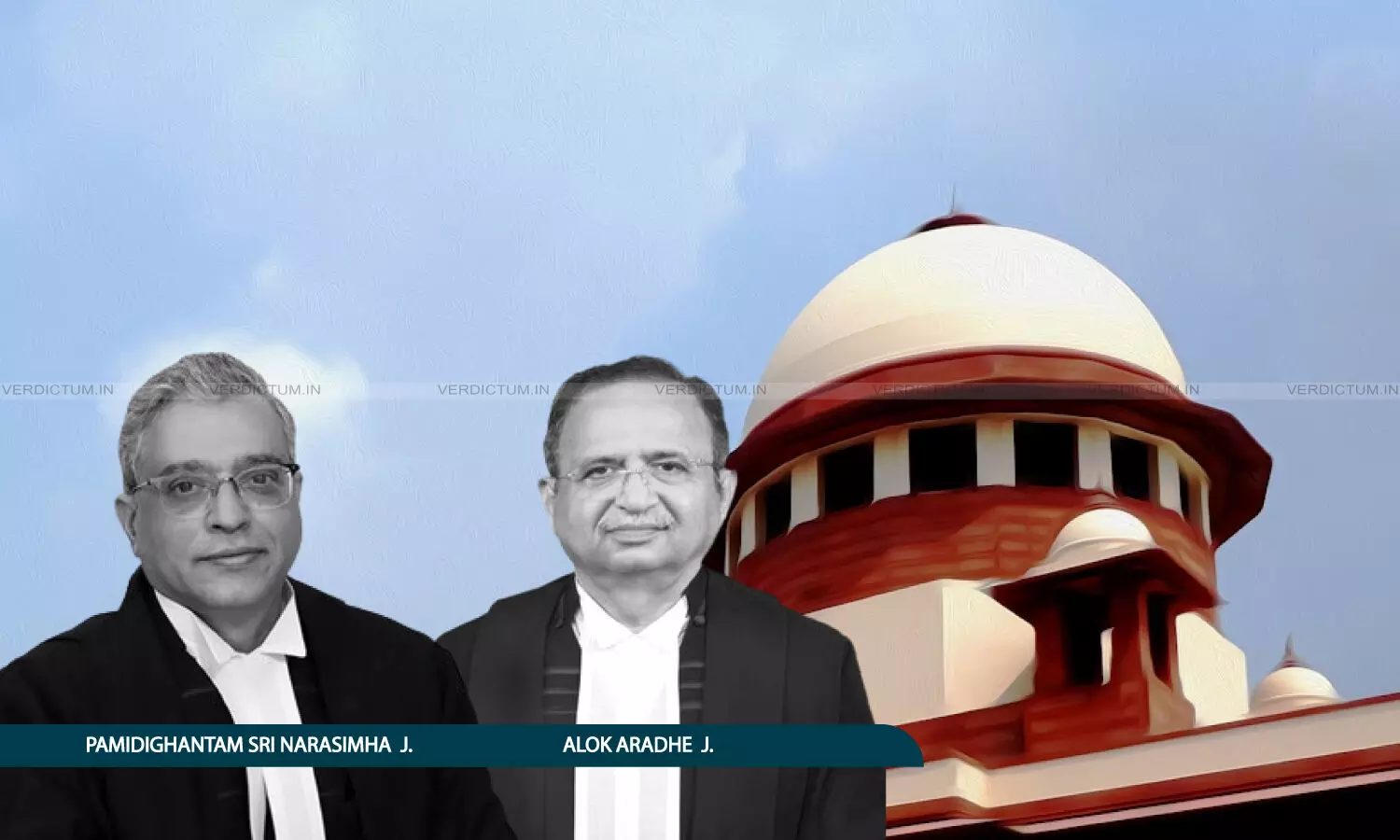
Justice Pamidighantam Sri Narasimha and Justice Alok Aradhe, Supreme Court
Regulatory Power To Demand Accountability Can Be Incidental Even Without Express Mandate: Supreme Court Upholds NCTE's PAR Directive
 |
|Quoting Dr Sarvepalli Radhakrishnan to underline the importance of teachers, the Court held that executive committee validly implemented council's mandate through public notice to teacher education institutes.
The Supreme Court has held that a statutory regulator's power to demand accountability from institutions under its jurisdiction need not always be traceable to an explicit provision of the parent statute, since such regulatory measures can be incidental and ancillary to the regulator's core duties and functions. Applying this principle, the Court upheld the National Council for Teacher Education's (NCTE) authority to direct Teacher Education Institutes (TEIs) to submit annual Performance Appraisal Reports (PAR), reversing a Delhi High Court judgment that had quashed the underlying public notice as procedurally unsustainable.
The Bench specifically rejected the Delhi High Court's technical approach of scrutinising whether a specific proforma had been formally placed before and approved by the Council, holding instead that once the Council had approved the concept of a Performance Appraisal Report and authorised the Executive Committee to implement it, the Committee's issuance of a notice through its Member Secretary was a legitimate exercise of delegated regulatory authority, not requiring further Council-level ratification of implementation details.
A Bench comprising Justice Pamidighantam Sri Narasimha and Justice Alok Aradhe observed, “We fail to understand as to how a regulatory measure of a statutory body, empowered to achieve planned and coordinated development of teacher education system in the country could be restrained from calling upon the TEIs to file Performance Appraisal Report. We are of the opinion that even without a specific empowerment under the statute, such a regulatory measure can always be incidental and ancillary to the duties and functions of a regulator. As there is a performance audit of NCTE itself by the Comptroller and Auditor General of India (CAG), it is but natural and incidental that NCTE would require the stakeholders, over which it exercises the regulatory jurisdiction, to provide the necessary Performance Appraisal Report”.
Senior Advocate Manisha T Karia appeared for the appellant and Indira Goswami, AOR appeared for the respondent.
The Executive Committee of NCTE, through its Member Secretary, issued a Public Notice dated September 22, 2019 requiring all TEIs recognised under the NCTE Act, 1993, to mandatorily submit an annual Performance Appraisal Report online, along with prescribed fees, failing which action under Section 17(1) of the NCTE Act would follow. This measure had replaced an earlier, litigation-plagued scheme of annual renewal of recognition, following a decision taken by the Council's General Body at its 48th meeting on February 05, 2019.
TEIs challenged the Public Notice before the Delhi High Court, contending that only the Council itself, not the Executive Committee, could issue such a direction, and that the proforma used had never been placed before or approved by the Council. A Single Judge dismissed the writ petition, but a Division Bench allowed the intra-court appeals and quashed the notice, holding there was nothing on record to show that the proforma had been developed or approved by the Council as required.
The Court held that the power to call for a Performance Appraisal Report was clearly traceable to Section 12(k) of the Act. It noted, “The Executive Committee, being the executive arm of the Council authorised to implement the decision of the Council dated 05.02.2019, through its Member Secretary, issued the Public Notice for implementing the requirement of Performance Appraisal Report”.
“Though free and compulsory elementary education to all children aged 6 to 14 years has now attained the status of an enforceable fundamental right, we have not bestowed on teacher education the attention that it deserves. Our former President, Dr. S. Radhakrishnan, whose birthday we celebrate as Teachers’ Day, also observed that, ‘Teachers have a great deal to do with the shaping of the minds and hearts of our youth. This is so obvious that it does not need repetition, but in spite of much repetition we do not seem to have a real understanding of the place of the teacher in the present context.”, the Bench noted at the outset.
The Court emphasised that "even without a specific empowerment under the statute, such a regulatory measure can always be incidental and ancillary to the duties and functions of a regulator", and it noted,
“It is necessary for the Council and its bodies to ensure accountability of educational institutions. Accountability in itself is an essential principle of administrative law. Judicial review of administrative action undertaken by the Council will only be effective and meaningful if accountability of Teacher Education Institutes is ensured by it. Accountability has three essential constituent dimensions: (i) responsibility, (ii) answerability and (iii) enforceability. Responsibility requires identification of duties and performance obligations of individuals and authorities. Answerability requires reasoned decision-making and enforceability requires corrective action against lack of responsibility and accountability. Accountability enables action against officials or institutions for dereliction of duty and also ensures that procedures and policies are improved upon. Apart from the duty to ensure that the executive authority/statutory bodies do not exercise powers that are not vested in them, Constitutional courts also have a positive duty to ensure that Authorities, more particularly, the regulators do exercise their powers effectively, efficiently and in an accountable manner. In this context, Courts cannot adopt a technical or a pedantic view of the action taken by the regulators”, it noted further.
Accordingly, the appeal was allowed, and the judgment of the Delhi High Court dated March 13, 2023 was set aside. The Court declared the Public Notice dated September 22, 2019 legal and valid, affirming that both the Council and the Executive Committee were within their jurisdiction in calling upon TEIs to upload Performance Appraisal Reports. No order as to costs was made.
Cause Title: The National Council for Teachers Education v. Association of NCTE Approved Colleges Trust and Ors. (Neutral Citation: 2026 INSC 953)
Appearances:
Appellant: Manisha T Karia, Sr. Adv., Geetanjali Mohan, AOR, Anuj Kapoor, Ananya Arora, Shreya Gupta, Saumya Tiwari, Arth Arora, Deepin Deepak Sahni, Varun Khetwani, Vishal Navale, Advocates.
Respondent: Indira Goswami, AOR, Amitesh Kumar, Priti Kumari, Chandra Prakash, AOR, Vivek Singh, C.P. Rajwar, Rohan Chandra, Aindri Saha, Krishan Kumar, Advocates.