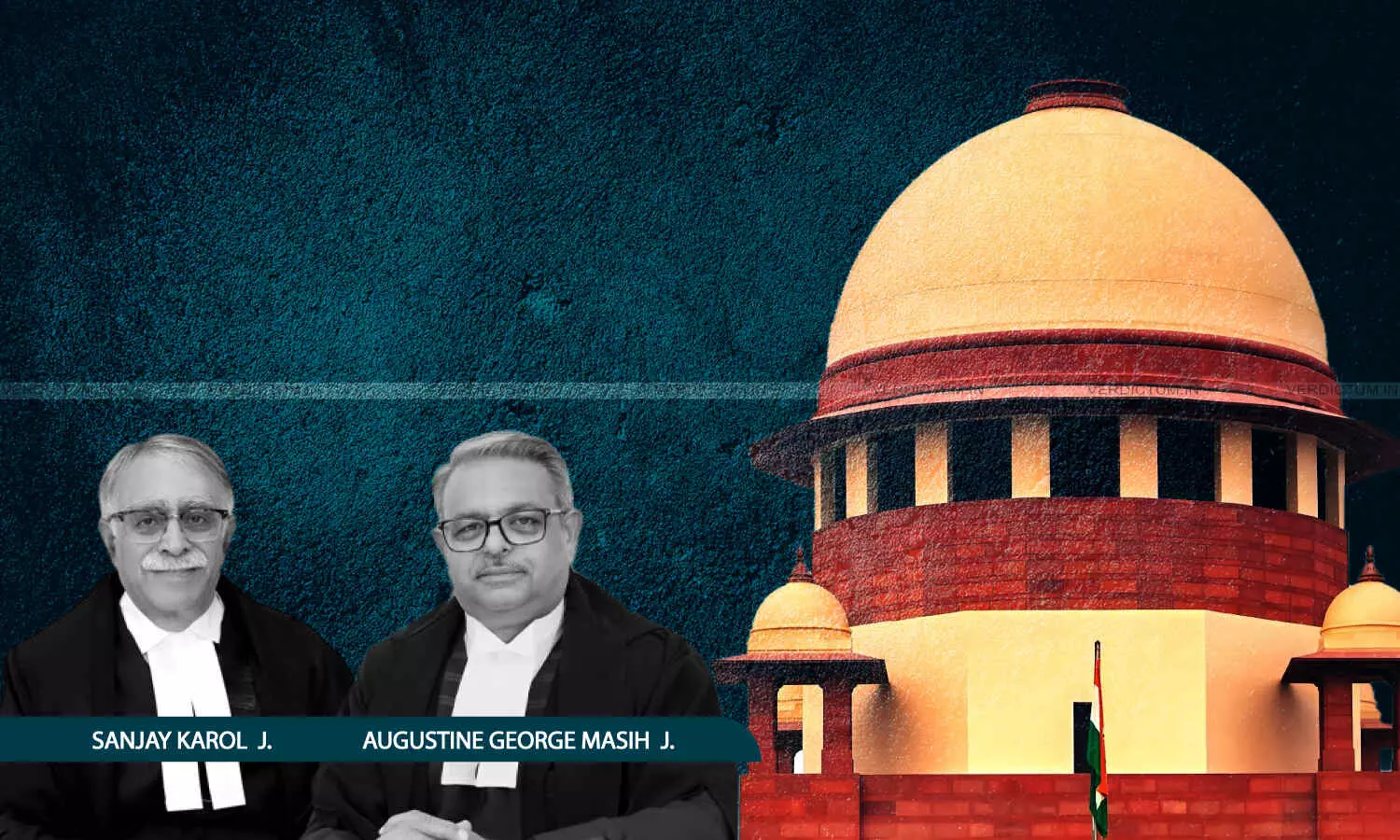
National Commission For Scheduled Caste Can’t Take Over Adjudicatory Functions To Pass Orders In Service Matters: Supreme Court
 |
|The Supreme Court was dealing with an appeal challenging an order passed by the Bombay High Court.
While setting aside an order upholding the directions passed by the National Commission for Scheduled Caste in respect of a service matter, the Supreme Court has held that the directions issued by the Commission, as they related to the payment of arrears, were contrary to the provisions of the Constitution. The Apex Court also held that the Commission cannot take over adjudicatory functions.
The Apex Court was dealing with an appeal challenging an order passed by the Bombay High Court.
The Division Bench of Justice Sanjay Karol and Justice Augustine George Masih held, “The powers entrusted to NCSC are limited in nature. Clearly NCSC and its other compatriots under Articles 338A and 338B are Constitutional Bodies with a socially beneficent purpose but quite apparently, the Legislature has prescribed a role that is recommendatory and advisory, but certainly not adjudicatory. They are not meant to be bodies taking over adjudicatory functions.”
“The directions issued by the NCSC in as much as it relates to the payment of arrears is declared to be contrary to the provisions of the Constitution and as such non-est in law”, it ordered.
Senior Advocate Rekha Palli represented the Appellant while AOR P. V. Yogeswaran represented the Respondent.
Factual Background
The third respondent, Madhavi K. Chandorkar, a member of the scheduled caste, was employed by the appellant as a typist cum computer clerk on July 9, 1997. Pursuant to the rules, at the time in force, i.e. Office Memorandum dated January 21, 2002, she was promoted to Stenographer Grade-I. The said OM had withdrawn an earlier OM dated January 30, 1997. The 2002 OM was challenged before the Bombay High Court in a writ petition. The said challenge mounted by Mumbai Port Trust Non-SC/ST Employees Association succeeded. The impugned OM was quashed. The directions issued were implemented, and the seniority of the employees of the appellant was reset accordingly. For implementing the directions issued in the aforesaid judgment, a circular dated December 27, 2018 was issued by the Deputy Secretary of the Appellant stating that no promotions will be granted to SC/ST employees except those made in accordance with the 1997 OM.
Resetting the seniority, it was directed that all promotions slated not to be in accordance with the judgment in M. Nagaraj v. Union of India (2007) will be revisited. This circular was challenged in a Writ Petition before the Bombay High Court by the Mumbai Port Trust, but the same was dismissed. The third Respondent was one of the nine cases identified from amongst the stenographers and a show cause notice was issued to her. After an opportunity of hearing was afforded, she was demoted notionally from Grade I to Grade II. The third Respondent, aggrieved by the demotion, made a representation to the second Respondent, NCSC, through its member, to which the appellant responded.
The NCSC had, along with many other directions, ordered strict adherence to DoPT’s guidelines/instructions and payment of arrears within 30 days. The appellant sought review/appeal of the order before the Chairperson of the NCSC. The appellant also challenged the aforesaid order, which resulted in the impugned judgment in rejection of the same. The main ground agitated was that the NCSC did not possess the powers to issue directions except as contained in Clause 5 of Article 338 of the Constitution. The writ petition was accordingly dismissed.
Reasoning
The Bench, at the outset, noted that the NCSC has been established under Article 338 of the Constitution. Taking note of Sub-article (5), which lays down the powers of the NCSC, the Bench held that the Division Bench fell in error in holding that the directions issued by the NCSC were within the scope of powers provided under the Constitution.
“The legislature has been quite categorical in the powers of the Civil Court that have been extended to the NCSC. The word used is “namely” whereunder certain powers have been enumerated. That indicates the limited scope of the powers granted to it. It is therefore clear that while it has powers to requisition documents and receive evidence it does not have the power to make an order in furtherance of that evidence. In other words, NCSC can record a factual finding and then ask the concerned Government, either the Centre or the State to act thereupon”, it added.
The Bench found support through Sub-clauses (a) and (d). The Bench noted that Sub-clause (a) gives the power to the NCSC to investigate and monitor all matters regarding safeguards provided for the Scheduled Castes under the Constitution or in any other law. “It flows from this that the provision of safeguards is a function of the Legislature, and the NCSC’s role is to monitor that the true intent of the safeguards is being implemented and met with as a ground reality. Sub-clause (d) provides that the Commission will present annually or at other times as seen fit, reports to the President regarding the working of their safeguards. This implies that safeguards are those recommendations made to the State or the Union Government that are in furtherance of its functions”, it explained.
The Bench concluded the matter by holding that the powers entrusted to NCSC are limited in nature and they are not meant to be bodies taking over adjudicatory functions. Thus, setting aside the judgment of the High Court, the Bench allowed the appeal.
Cause Title: Mumbai Port Authority v. National Commission For Scheduled Caste (Neutral Citation: 2026 INSC 755)
Appearance
Appellant: Senior Advocate Rekha Palli, AOR M/S. Meharia & Company, Advocates Amit Meharia, Tannishtha Singh, Abinash Agarwal, Sambhav, Priya S. Bhalerao, Anish Venkatesh Bindlish, Bhavya Sharma, Vaidushya Parth
Respondent: AOR P. V. Yogeswaran, Advocates Ashish Kumar Upadhyay, Y. Lokesh, V. Kandha Prabhu, Dhatri Singh, Maitri Goal, Hari Preethi, Harshit Vashish, Bhavini Vashisht, Suchismita Bhuyan, Guneswaran PV, Subodh Kr. Pathak, Pawan Kumar Sharma, Arunima Chatterjee, V. Elangovan, Kanishk Mor, AOR Dharmendra Kumar Sinha, Advocate Vinod K. Soni