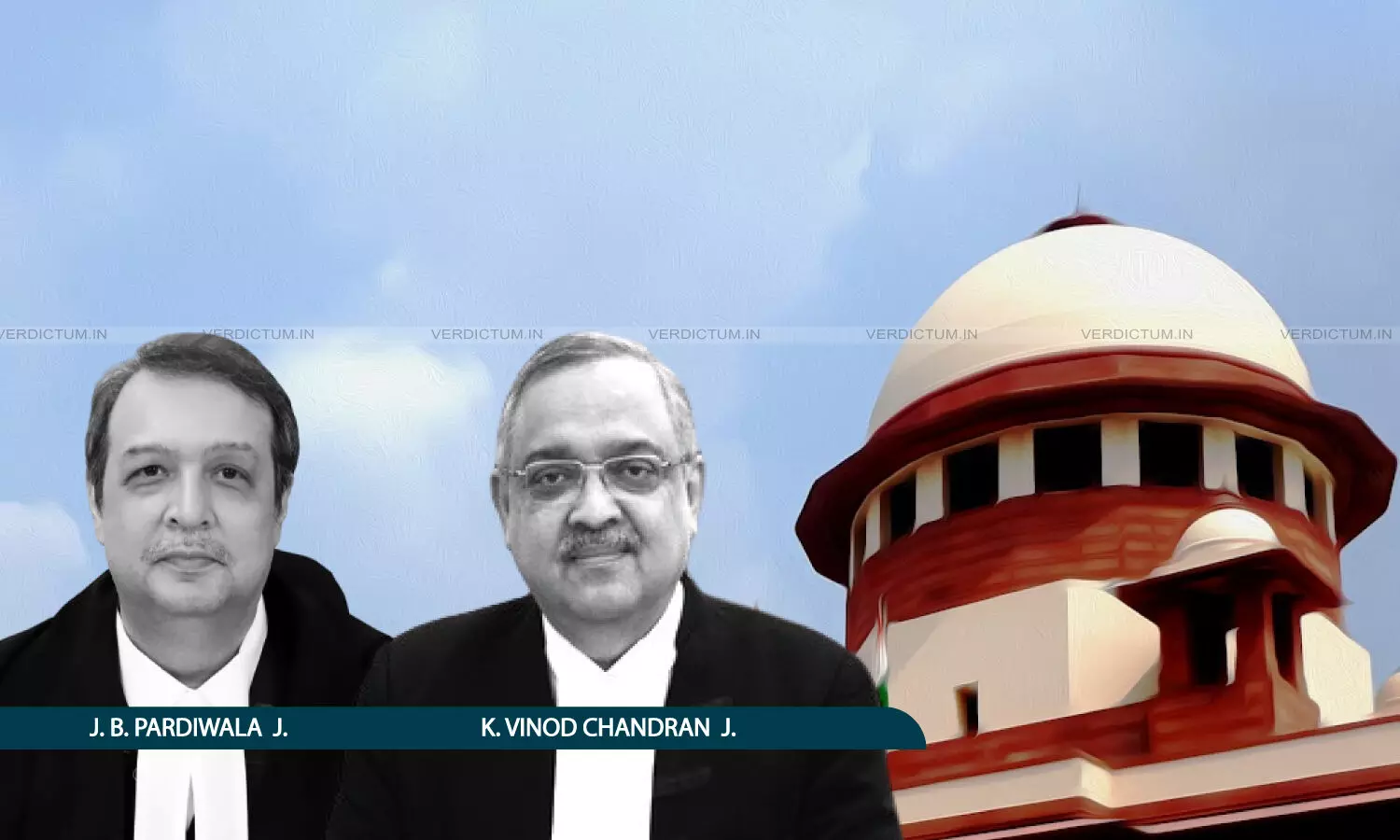
Justice J. B. Pardiwala, Justice K. Vinod Chandran, Supreme Court
Extended Limitation U/S 74 CGST Act Cannot Be Invoked Based On Mechanical Recital Of Suppression: Supreme Court
 |
|The Court found that the show cause notice was issued beyond the limitation available under Section 73 of the CGST Act, and that any fresh Section 74 proceeding must itself disclose foundational facts and conclude within the remaining extended period.
The Supreme Court, while setting aside the show cause notice issued to Tata Steel Limited and the consequential Order-in-Original, has held that the extended limitation period under Section 74 of the Central Goods and Services Tax Act, 2017 cannot be invoked by merely reciting expressions such as fraud, wilful misrepresentation or suppression.
The Court was hearing a civil appeal arising out of a challenge to a show cause notice issued for the financial years 2018-2019 to 2020-2021, purportedly under Section 74 of the CGST Act, following audit objections concerning mismatch of input tax credit and alleged short payment of tax.
A Bench of Justice J.B. Pardiwala and Justice K. Vinod Chandran observed: “It is not mere lip service to the provisions that is intended when an extended limitation period is provided for recovering an excess benefit availed, short payment or excess refund, from the assessee, especially when the allegation is of fraud/willful misrepresentation/suppression. The foundational facts which led to the inference arrived at of fraud/willful misrepresentation/ suppression should be evident from the notice itself. The mere employment of such words will not indicate an application of mind, upon which alone the satisfaction can be arrived at. The words are not to be mechanically recited in the notice to enable recovery outside the normal limitation provided under the statute”
The Bench further held: “In the facts of the above case, we do not find any such factual facts having been stated to make out a case of a deliberate device employed to evade tax or avail excess ITC, as coming out from the SCN. The bland statement made at some places of suppression of facts, merely to avail the extended period of limitation would barely suffice and puts to peril the notice under Section 74. The SCN on the above reasoning, cannot be sustained and the consequential Order-in-Original dated 26.12.2025 too is put in peril and both are set aside.”
Senior Advocates A.M. Singhvi and Kavin Gulati appeared for the appellant-assessee. Additional Solicitor General S. Dwarakanath appeared for the Department.
Background
The appellant challenged a show cause notice issued for three financial years under Section 74 of the CGST Act. Its case was that there was no allegation of fraud, wilful misstatement or suppression of facts sufficient to invoke Section 74, which provides an extended period of five years as distinct from the three years under Section 73.
The appellant also submitted that the Assessing Officer was not convinced about the audit objection and had kept the matter in the “call book”, meaning that it was kept in abeyance. It was argued that the notice was later issued because limitation was closing, as a protective measure, though such a concept was alien to the GST regime.
The Department contended that the proceedings had commenced before limitation under Section 73 expired and that the proceedings indicated suppression of material facts and wilful misrepresentation. It also relied on Explanation 2 to Section 74 to argue that suppression could include non-declaration of facts or information which an assessee was obliged to declare.
Court’s Observations
The Court examined Section 73 of the CGST Act and held that the limitation period for the three relevant financial years stood extended in light of statutory extensions for filing annual returns and the Supreme Court’s suo motu extension of limitation during the pandemic.
The Court observed: “Thus, the limitation from the last date of furnishing of annual returns stands extended to 28.02.2025 for the above two years and for the year 2020-2021, it remains unchanged at 28.02.2025, since even as per the statute and notifications period of limitation only commenced on 28.02.2022, the extension granted by this Court being inapplicable. The SCN dated 13.06.2025 is past the extended limitation period.”
The Court held that proceedings under Sections 73 or 74 can be initiated only on the satisfaction of the Assessing Officer.
The Court observed: “Even if observations/objections are made on audit, the Assessing Officer should enter his satisfaction before a notice is issued.”
It further held: “Insofar as a notice under Section 74, the satisfaction should be not only of mismatch of ITC and short payment of tax having occurred, as is alleged in this case, the Officer should be satisfied that either fraud/willful misrepresentation/suppression had led to such mismatch or short payment of tax.”
The Court rejected the Department’s reliance on Explanation 2 to Section 74, noting that the provision had stood omitted.
The Court observed: “We are unable to countenance the argument of the learned ASG that Explanation 2 to Section 74 applies, since even according to him it stood omitted with effect from 01.11.2024.”
The Court also rejected the argument that initiation before expiry of Section 73 limitation was enough.
The Court held: “Equally fallacious is the argument that the proceedings were initiated prior to the expiry of limitation under Section 73. The limitation under Section 73 (10) is also to issue the order under Section 73 (9) and not to issue a notice and sub-section (2) of Section 73 provides for a notice, at least three months before the time limit under Section 73 (10).”
The Court noted that the Department had itself taken up the audit objection before the Public Accounts Committee, indicating absence of satisfaction by the Assessing Officer.
The Court observed: “The fact that the Department had taken up the objections on audit with the Public Accounts Committee itself indicates that there was no satisfaction at the end of the Department, meaning the Assessing Officer; as to the mismatch or the short fall of payment of tax having occurred, not to say anything about the suppression alleged.”
It further found that the show cause notice contained only a bland statement alleging availment of ITC without documentary evidence and suppression of facts.
The Court observed: “Further, but for a bland statement of availing of ITC for the three years ‘without documentary evidence and suppress the facts’ (sic), the SCN did not contain any foundational facts to validate such allegation of suppression.”
Conclusion
The Supreme Court allowed the appeal, set aside the show cause notice and the consequential Order-in-Original. It, however, reserved liberty for the Department to initiate appropriate proceedings under Section 74, if thought fit, provided the foundational facts come out from the notice itself and the order is passed before February 28, 2027. Pending applications were disposed of.
Cause Title: M/s Tata Steel Limited v. Union of India through the Secretary Ministry of Finance and Ors. (Neutral Citation: 2026 INSC 920)
Appearances
Appellant: Senior Advocates A.M. Singhvi and Kavin Gulati
Respondent: Additional Solicitor General S. Dwarakanath