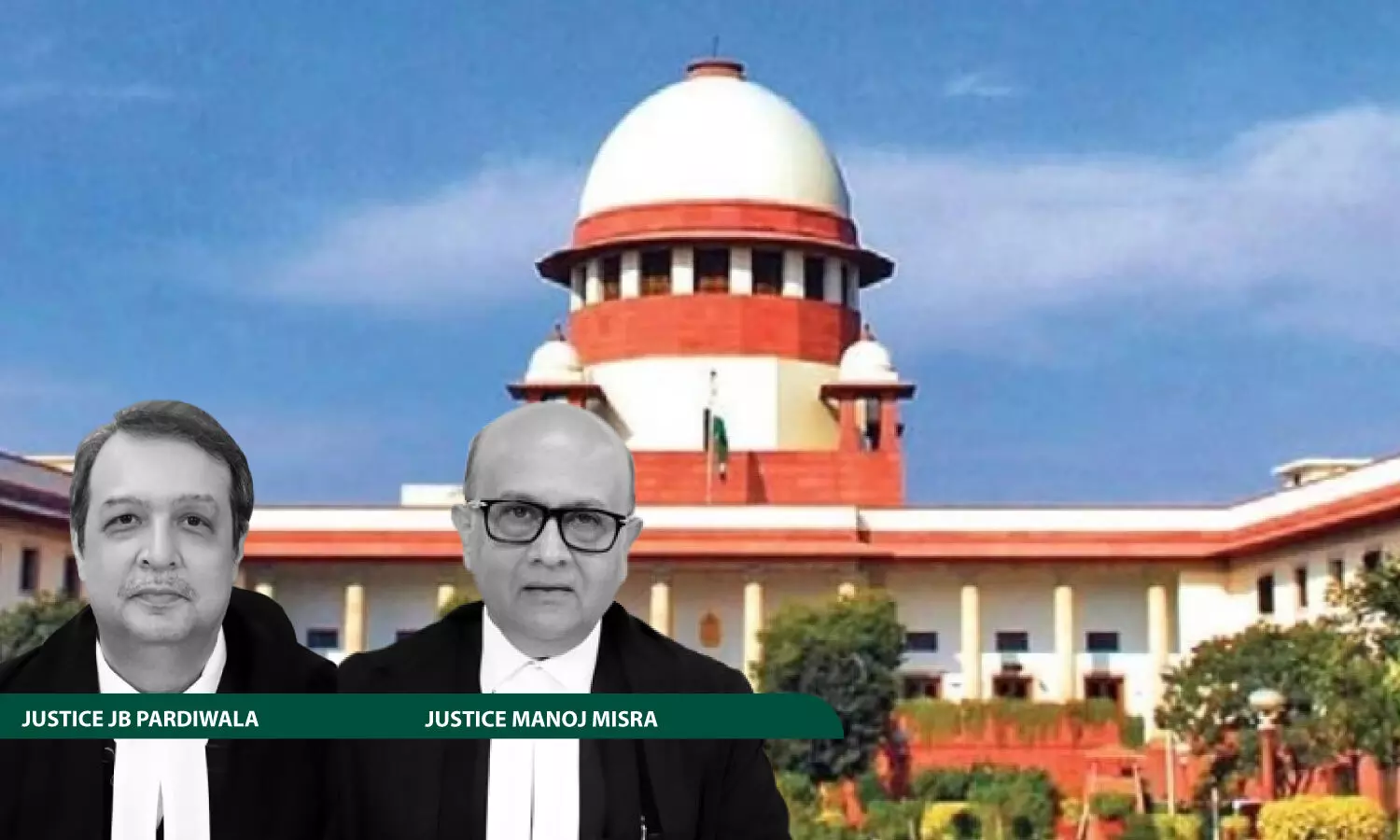
Justice J.B. Pardiwala, Justice Manoj Misra, Supreme Court
Land Allotment Not Necessary For Seeking Environmental Clearance To Establish Bio-Medical Waste Treatment Facility; Identification Is Enough: Supreme Court
 |
|CPCB's revised guidelines for bio-medical waste facilities held mandatory despite non-publication in official gazette; the Court also upheld the land-area relaxation and validity of terms of reference.
The Supreme Court has held that mere identification of a prospective site, and not successful allotment or legal possession of land, is sufficient for a project proponent to apply for prior Environmental Clearance to establish a Common Bio-Medical Waste Treatment Facility, clarifying that a firmer showing of land status is required only at the subsequent appraisal stage of the clearance process.
The Court also noted that the Central Pollution Control Board's Revised Guidelines for Common Bio-Medical Waste Treatment and Disposal Facilities, 2016 are mandatory and binding despite never having been published in the Official Gazette, holding that publication through the CPCB's official website was a reasonable alternative mode sufficient to give the guidelines the force of law; it went on to uphold the grant of land-area relaxation to the appellant and the continued validity of an earlier Terms of Reference despite the intervening quashing of the appellant's first clearance.
A Division Bench of Justice J.B. Pardiwala and Justice Manoj Misra observed, “…land allotment for the particular purpose/project is not necessary before the application under Form 1 can be made, i.e., before the first stage of screening. Identification is enough. Such a view is further substantiated by two things: (i) when the EC is inherently site-specific there arises no reason for placing such a high burden at the Form 1 stage itself, and (ii) a reading of the prescribed Form 1 enclosed as Annexure-I to the EIA, 2006, under the head ‘Basic Information’, requires the applicant to provide details of the “Location/site alternatives under consideration”, meaning thereby that the applicant is only to provide details of the site(s) in which he intends to setup the project/activity concerned”.
“The second take-away is that, when the stage of appraisal arrives, a credible document becomes crucial. What could be this credible document in the context of the present matter? Undoubtedly, it would either be a successful allotment in favour of the appellant or, if the allotment is not in vogue, then a provisional allotment/ acknowledgment issued by the UPSIDA”, the Bench noted further.
Senior Advocate Shyam Divan appeared for the appellant and Senior Advocate Pinaki Misra appeared for the respondent.
The appellant sought to establish a Common Bio-Medical Waste Treatment Facility (CBWTF) on plots in the UPSIDC Industrial Area, Babrala, Uttar Pradesh.
After its initial applications for land allotment were rejected by the Uttar Pradesh State Industrial Development Authority (UPSIDA), the appellant nonetheless obtained a Terms of Reference (ToR) from the State Environment Impact Assessment Authority (UP SEIAA) and later secured land allotment for a different purpose, before eventually obtaining a Consent to Establish (CTE) and an Environmental Clearance (EC) for the CBWTF in 2022.
These were challenged before the National Green Tribunal (NGT) by a competitor, Indotech Waste Solution, and were set aside in Aniruda Panwar & Anr. v. Ministry of Environment, Forests and Climate Change & Ors., on the ground that Clause 2 of the RG, 2016 required land to be procured before an EC/CTE could be sought, and that the appellant's plot fell short of the one-acre requirement under Clause 7 without valid relaxation. The Tribunal granted liberty to the appellant to either procure additional land or seek relaxation of the land requirement afresh.
Pursuing the liberty granted, the appellant obtained land-area relaxation from the CPCB and secured a second EC and second CTE in December 2023, based on the earlier (first) ToR rather than a fresh one. Indotech again approached the NGT, contending that the ToR itself stood vitiated once the first EC/CTE were quashed, that the land relaxation was arbitrarily granted, and that the site did not satisfy the population/rural-area precondition under Clause 7(b) of the RG, 2016.
The NGT, in its impugned judgment dated July 05, 2024, set aside the second EC and second CTE, holding that the RG, 2016 were mandatory, that Babrala did not meet the criteria for relaxation, and that the relaxation process was vitiated by malice in law. The appellant approached the Supreme Court, which, during the pendency of the appeal, directed the District Magistrate, Sambhal to submit a factual report on the location and population status of the site.
The Court addressed four principal issues:
-Mandatory Nature of RG, 2016: Non-publication in the Official Gazette does not invalidate the guidelines. Backed by statutory authority, CPCB website publication satisfied notice requirements, especially since project proponents were aware of them during the clearance process.
-Permissibility of Land-Area Relaxation: Located in rural Village Noorpur rather than Babrala Nagar Panchayat, the site met Clause 7(b) criteria. The relaxation, granted after CPCB consultation with extra control measures, was legally sound and free of malice in law.
-Status of Land Acquisition: Form 1 EC applications require only site identification, with credible ownership documents required at the appraisal stage. Land procurement is not a precondition for a ToR or Consent to Establish (CTE), though it remains mandatory before obtaining a Consent to Operate.
-Effect on the First ToR: Quashing an EC does not automatically invalidate the underlying ToR unless the initial Form 1 application was defective. Because Form 1 contained no material concealment and the ToR remained within its four-year validity period, it validly supported the second EC.
Holding that the second EC and second CTE satisfied all applicable land-acquisition and land-area requirements, and that the underlying ToR remained valid, the Court concluded that the NGT had committed an "egregious error" in quashing the second EC and second CTE.
The appeal was accordingly allowed, and the impugned judgment of the NGT, Principal Bench, was set aside. Pending applications were disposed of, and the Registry was directed to forward a copy of the judgment to the NGT, Principal Bench, for circulation to all circuit benches of the Tribunal.
Cause Title: M/s Punahchakran Private Limited v. Indotech Waste Solution & Ors (Neutral Citation: 2026 INSC 956)
Appearances:
Appellant: Shyam Divan, Senior Advocate.
Respondent: Pinaki Misra, Senior Advocate.