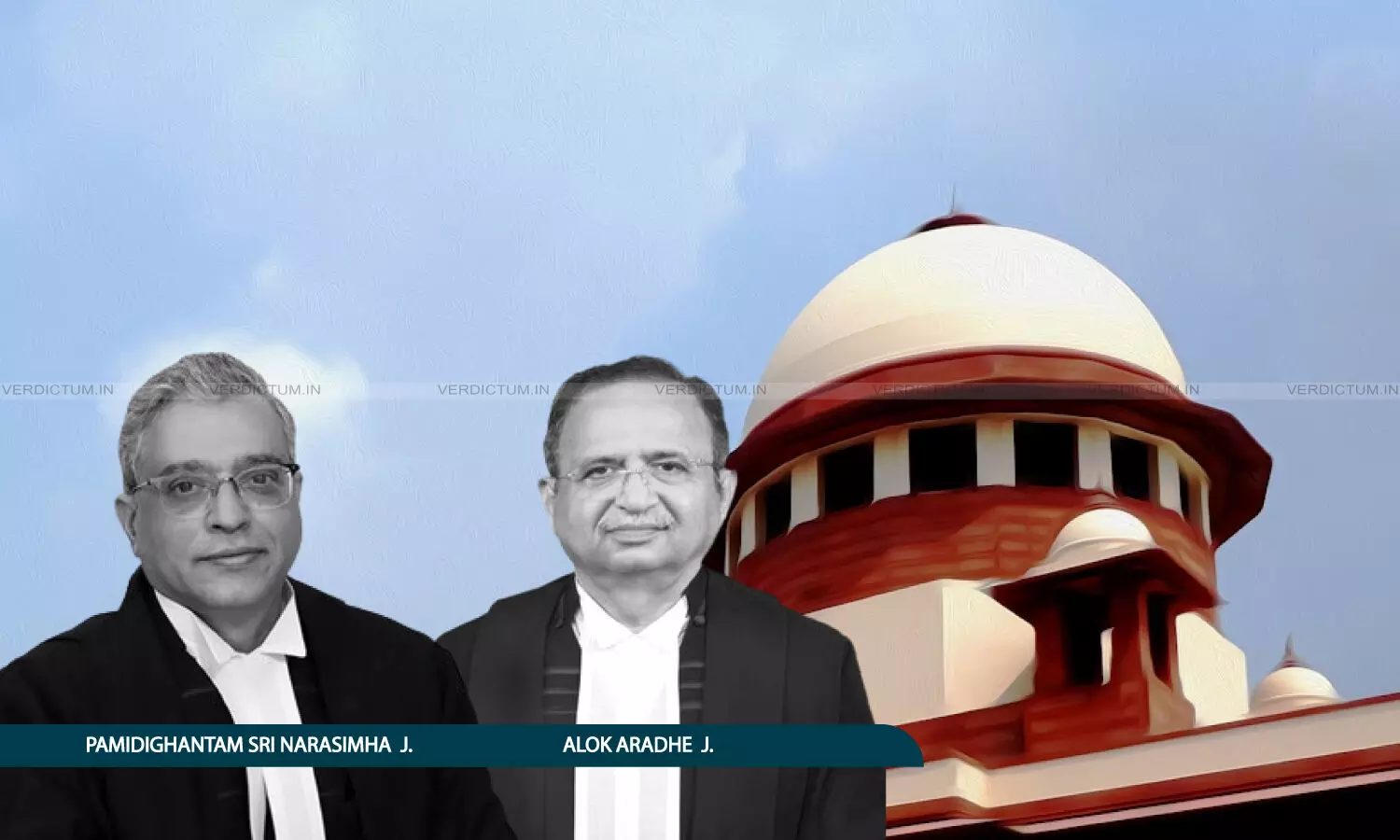
Justice Pamidighantam Sri Narasimha and Justice Alok Aradhe, Supreme Court
Whether Particular Claim Falls Outside Excepted Matters Clause Of Work Contract Is Matter Within Arbitral Tribunal’s Competence U/S.16 A&C Act: Supreme Court
 |
|The Supreme Court was considering an appeal filed against the judgment passed by the Telangana High Court involving an arbitral dispute.
The Supreme Court has held that the question whether a particular claim is covered by, or falls outside, an “excepted matters” clause of a works contract is a matter squarely within the competence of the Arbitral Tribunal under Section 16 of the Arbitration and Conciliation Act, and not a question for a Court exercising even the wider, appointment-stage jurisdiction under Section 11.
The Apex Court was considering an appeal filed against the judgment passed by the Division Bench of the Telangana High Court.
The Division Bench of Justice Pamidighantam Sri Narasimha and Justice Alok Aradhe held, “What emerges from the foregoing survey is that, under the Act, the question whether a particular claim is covered by, or falls outside, an “excepted matters” clause of a works contract is a matter squarely within the competence of the Arbitral Tribunal under Section 16, and not a question for a court exercising even the wider, appointment-stage jurisdiction under Section 11, much less for a court exercising the discretionary jurisdiction of judicial review under Article 226 of the Constitution, whose very engagement with the merits of the dispute, in the present case, was declined on the ground that it involved complicated questions of fact.”
Reference was made to the judgments in Vidya Drolia and Others v. Durga Trading Corporation (2021), Uttarakhand Purv Sainik Kalyan Nigam Ltd. v. Northern Coal Field Ltd (2020), SBI General Insurance Company Ltd. v. Krish Spinning (2024), Office for Alternative Architecture v. Ircon Infrastructure and Services Ltd. (2025).
Senior Advocate Gaurav Agarwal represented the Appellant while Additional Solicitor General Vikramjit Banerjee represented the Respondent.
Factual Background
In 2017, South Central Railway (second respondent) invited tenders for the work of “Doubling of track between Guntur-Guntakal SectionEarthwork in formation including blanketing to GE: 0014 specifications, construction of bridges, RUBs for LCs and other miscellaneous works….” (‘Work’). In response to the aforesaid tender, the appellant, a private limited company and is engaged in construction and infrastructure works, submitted its bid. The appellant’s bid was accepted, and a formal Contract Agreement was executed stipulating the due date of completion of the Work as October 23, 2018.
In 2022, the said contract was terminated under Clause 62 of Indian Railways Standard General Conditions of Contract (GCC) and the performance guarantee and security furnished by the appellant were also forfeited. Further, the appellant was held to be disentitled to any compensation for any loss. The appellant sought quashing of the aforesaid order of termination in a writ petition but the Single Judge dismissed the same. The Division Bench granted liberty to the appellant to raise all its claims before the Arbitral Tribunal, which in turn was granted the liberty to decide the claims of the appellant strictly in accordance with the terms of the contract agreed upon between the parties.
In pursuance of the order passed by the Division Bench of the High Court, a former judge of the Apex Court was appointed as the Sole Arbitrator and arbitration proceedings commenced. The Arbitral Tribunal framed twelve issues including the issue of the validity of the order of terminationnd the question whether any claims were barred by limitation or fall under “excepted matters” or were not otherwise arbitrable.
Reasoning
On a perusal of the Indian Railways Standard General Conditions of Contract, the Bench noted that Clause 63 only excludes the excepted matters from the purview of the Arbitration Clause but does not exclude the jurisdiction of the Court of Law to examine the validity of the decision taken in respect of excepted matters.
Explaining the provisions of the Arbitration & Conciliation Act, the Bench explained that Section 16(1) empowers the Arbitral Tribunal to rule on its jurisdiction “including ruling on any objections with respect to existence or validity of the arbitration agreement”. “Section 16 incorporates the principle of kompetenz-kompetenz, which lies at the foundation of the Act and makes a decisive departure from the preceding statutory regime contained in the Arbitration Act, 1940”, it added.
The Bench further explained that the Arbitration and Conciliation (Amendment) Act, 2015, on the basis of the recommendations contained in the 246th Report of the Law Commission of India, inserted Section 11(6A)9 in the Act, by which the scope of examination by the Court, “notwithstanding any judgment, decree or order of any Court”, is confined, at the stage of appointment, to the existence of the arbitration agreement.
The Bench was of the view that if a court exercising the power of appointment under Section 11(6A) has no jurisdiction to enter upon, still less to predetermine, the touchstone by reference to which the Arbitral Tribunal is to adjudicate a claim said to fall within an “excepted matters” clause, a writ appellate court, whose task was confined to testing the correctness of the Single Judge’s disposal of a writ petition impugning a termination notice, had, by parity of reasoning and a fortiori, no such jurisdiction.
“Whether the dispute regarding termination is, in whole or in part, an “excepted matter” outside the Arbitrator's jurisdiction, and, if so, what remedy survives to the appellant in that behalf, are questions that Section 16 of the Act commits to the Arbitrator in the first instance”, it mentioned while also adding, “It was not open to the Division Bench, in the exercise of its writ appellate jurisdiction, to prescribe in advance the manner of, or to place constraints upon, that adjudication. For yet another reason, the Division Bench ought not to have made such an observation as the issue of arbitrability of termination of agreement was not an issue before it. Accordingly, the issue is answered.”
The Bench thus disposed of the appeal by clarifying that the direction issued by the Division Bench to the Arbitrator to decide all claims of the appellant strictly in accordance with the terms of the contract agreed upon between the parties should not be construed to impinge upon the jurisdiction of the Arbitral Tribunal, to adjudicate the dispute with regard to termination of contract.
Cause Title: M/s. GVV Constructions Private Limited v. The Union of India (Neutral Citation: 2026 INSC 976)
Appearance
Appellent: Senior Advocate Gaurav Agarwal, AOR P. Mohith Rao, Advocates Kasi Nageshwar Rao, A.s Vasudevan, J. Akshitha, J. Venkat Sai, Eugene S Philomene, Dipankar Mukherjee, Nakul Patwardhan, Sejal Jain, Jagatjeet Singh, Kaarunya Lakshmi, Shrija Rawat, Utkarsh Krishna
Respondent: Additional Solicitor General Vikramjit Banerjee, Advocates Abhishek Singh-II, Bharat Sood, Gaurav Arya, Padmesh Mishra, Dumni Soren, AOR Amrish Kumar, Advocate Dr. Arun Kumar Yadav