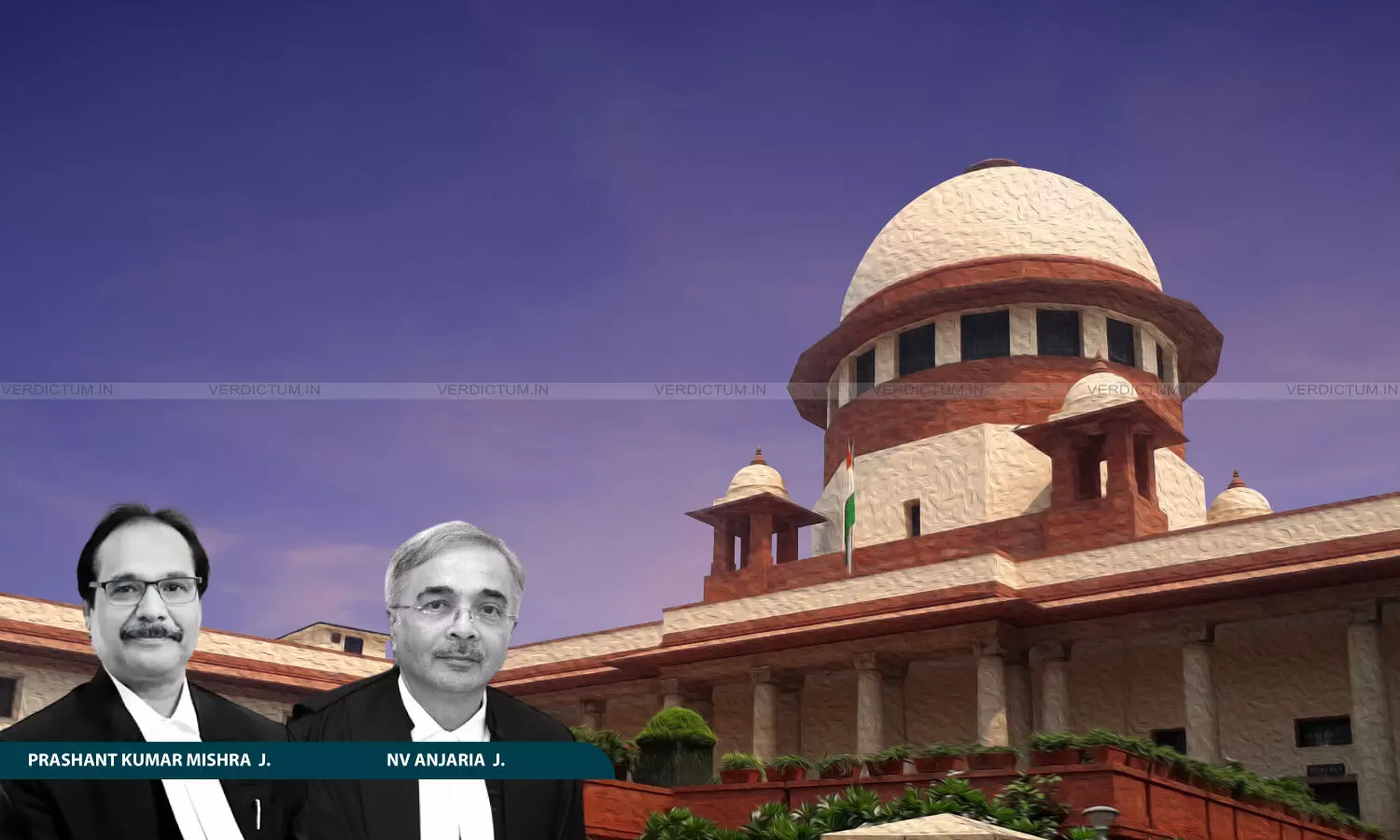
Supreme Court, Justice Prashant Kumar Mishra, Justice N.V. Anjaria
"Readiness" In Specific Performance Suits Must Be Proved With Reference To Relevant Period; Subsequent FDRs Insufficient: Supreme Court
 |
|The Court observed that Fixed Deposit Receipts created years after institution of the suit cannot be relied upon to establish readiness and willingness during the period when the contract was required to be performed.
The Supreme Court has dismissed a suit for specific performance, ruling that the plaintiff failed to demonstrate continuous readiness and willingness to fulfil his obligations under the agreement to sell.
The Court observed that financial documents generated years after the institution of the suit cannot be relied upon to prove the availability of funds during the relevant period for performance of the contract.
The Court reiterated that readiness under Section 16(c) of the Specific Relief Act, 1963, relates to the financial capacity of the plaintiff, while willingness is reflected through his conduct. Both requirements, the Court held, must be continuously satisfied from the date of the agreement until adjudication of the suit.
A Division Bench of Justice Prashant Kumar Mishra and Justice N.V. Anjaria observed: "Though it was not necessary for the appellants to physically deposit the consideration amount before the Court, they must nevertheless have to place reliable and acceptable evidence on record to show that they possessed sufficient funds to complete the transaction at the relevant time."
Senior Advocate Jayant Mehta appeared for the appellants, while Advocate P.R. Ramasesh appeared for the respondent.
Background
The dispute arose from an agreement to sell executed in December 1990 regarding an immovable property. Under the agreement, a portion of the sale consideration was paid as earnest money, and the balance amount was required to be paid within four months at the time of execution of the sale deed.
Subsequently, disputes arose between the parties regarding the performance of the agreement. Several legal notices were exchanged, following which the purchaser instituted a suit for specific performance in December 1993, seeking enforcement of the agreement.
The Trial Court decreed the suit in favour of the plaintiff. However, the High Court reversed the decree and dismissed the suit, holding that the plaintiff had failed to establish readiness and willingness to perform his part of the contract. The matter thereafter reached the Supreme Court.
Court's Observations
The Court examined the statutory requirement contained in Section 16(c) of the Specific Relief Act and reiterated that a plaintiff seeking specific performance must plead and prove continuous readiness and willingness throughout the subsistence of the contract.
Referring to settled precedents, the Bench observed:
"The term ‘readiness’ refers to the financial capacity, and the term ‘willingness’ reflects the conduct and intention of the party seeking the relief to perform the contract. Thus, both these conditions cumulatively have to be seen for making out a case of specific performance."
The Court noted that the appellants sought to establish their financial readiness by relying upon four Fixed Deposit Receipts aggregating ₹2,80,000. However, the Court found that all four FDRs had been created several years after the institution of the suit.
The Bench held:
"Coming to the case before us, it was argued on behalf of the appellants that they possessed a sum of Rs. 2,80,000/- at the relevant period, through four FDRs and that such availability of funds established their readiness and willingness to perform their part of the contract. However, looking at the dates on these FDRs, it can be seen that these four FDRs are dated 04.10.1999, 22.11.1999, 03.04.2001 and 23.08.2001, all of which were created after several years of the institution of the suit on 20.12.1993. Therefore, these FDRs cannot be said to establish appellants’ financial readiness during the relevant period, namely from the date of the agreement till the filing of the suit."
The Court emphasised that the law does not require a plaintiff to deposit the consideration amount in court. Nevertheless, the plaintiff must adduce reliable evidence demonstrating the availability of sufficient funds when the contract was to be performed.
The Bench observed:
"Though it was not necessary for the appellants to physically deposit the consideration amount before the Court, they must nevertheless have to place reliable and acceptable evidence on record to show that they possessed sufficient funds to complete the transaction at the relevant time."
Examining the record, the Court found a complete absence of evidence showing availability of the balance sale consideration either at the time of execution of the agreement, during the contractual period fixed for completion of the transaction, or even when the suit was instituted.
The Court held:
"In the present case, there is no material whatsoever to show that the appellant/plaintiff had the balance sale consideration available either at the time of execution of the agreement, within the stipulated period of four months for performance of the contract, or even at the time of filing of the suit in the year 1993. Thus, in our view, the High Court has rightly observed that the availability of funds must be proved with reference to the relevant point of time and not by relying upon financial documents generated long after the filing of the suit."
The Court further found that the plaintiff had also failed to establish willingness through his conduct. The Bench noted that despite contractual obligations requiring cooperation in obtaining statutory permission, the plaintiff had not furnished the necessary documents and had remained passive.
The Court observed:
"The appellant/plaintiff instead remained passive and waited for the respondent/defendant to take steps. Such conduct clearly establishes that the appellant/plaintiff failed to prove his continuous readiness and willingness."
The Court also took note of the plaintiff's delay in instituting the suit. Though filed within the prescribed period of limitation, the suit was instituted nearly two years and nine months after the respondent had clearly refused to perform the agreement.
The Bench observed:
"This conduct of the appellant/plaintiff, in our view, reflects a lack of continuous readiness and willingness to perform his part of the contract, which is a sine qua non for the grant of relief of specific performance."
Conclusion
Holding that the plaintiff failed to establish both financial readiness and willingness to perform his obligations under the agreement, the Supreme Court upheld the High Court's judgment dismissing the suit for specific performance.
The Court concluded that the appellants had failed to demonstrate the twin statutory requirements of readiness and willingness and had also failed to approach the Court with the promptitude expected for the grant of an equitable relief.
Consequently, the appeal was dismissed.
Cause Title: Mohammed Khaleel (D) Through LRs & Ors. v. Jayamma (Neutral Citation: 2026 INSC 651)
Appearances
Appellants: Senior Advocate Jayant Mehta with Advocates Sonakshi Banga, Mansvini Jain, Sukant Vikram, AOR.
Respondent: P.R. Ramasesh, AOR with Advocate Abdul Azeem Kalebudde.