Supreme Court Modifies Civil Judge Recruitment Criteria With 1-Year Academy Training & Law Clerkship In Lieu of 3-Year Bar Practice
 |
|Justice K Vinod Chandran dissented from the majority's view.
The Supreme Court has modified its previous judgment, which mandated three years of legal practice for candidates seeking direct recruitment as Civil Judges (Junior Division), and reduced the requirement to one year of experience at the bar.
The Court held that candidates who are selected shall undergo one year of training at the State Judicial Academy, followed by six months of law clerkship under the District and Sessions Judge or a member of the Higher Judicial Service, and thereafter another six months of law clerkship under a sitting judge of the concerned High Court.
The Court allowed all law graduates to appear in the examinations for lower judicial service without meeting the requirement of three years of practice immediately and provided for a transitional relaxation till March 31, 2027.
The Court directed that the recruitment notifications issued on or after April 1, 2027 will require the candidates to have a minimum of one year of verified active practice at the Bar.
Justice K Vinod Chandran dissented from the majority view.
On July 30, 2026, the Bench reserved its verdict on a batch of review petitions that challenged its earlier judgment mandating three years of legal practice for candidates seeking direct recruitment as Civil Judges (Junior Division).
The Court also heard a writ petition that sought the relaxation of this three-year mandate for persons with disabilities.
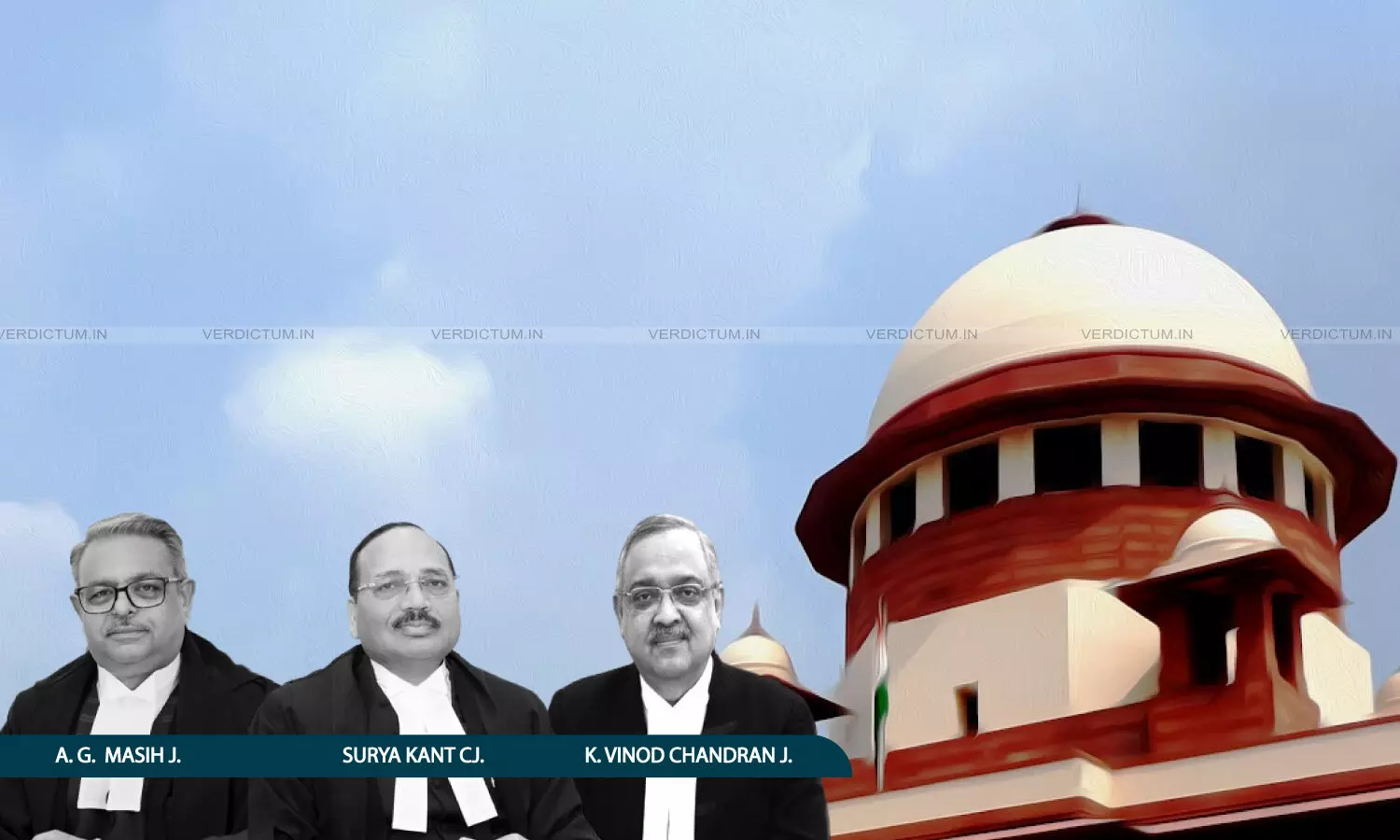
A Bench comprising Chief Justice of India Surya Kant, Justice August George Masih and Justice K. Vinod Chandran held, "Notwithstanding the above, candidates shall undergo one year of intensive training at the State Judicial Academy, followed by six months of law clerkship under the District and Sessions Judge or a member of the Higher Judicial Service, and thereafter another six months of law clerkship under a sitting judge of the concerned High Court, in terms of the directions that we have already explained in detail...For abundant caution, we clarify that notifications to be issued hereafter for recruitment to the post of Civil Judge (Junior Division) shall be in conformity with the aforesaid directions."
Senior Advocate Siddharth Bhatnagar was Amicus Curiae in the matter, while Senior Advocate Pinky Anand and Senior Advocate Colin Gonsalves appeared for Petitioners, and ASG Aishwarya Singh Bhati appeared for the Union.
The petitions sought reconsideration of the Court's May 2025 decision which restored the three-year practice requirement, contending that the rule deterred bright law graduates from joining the lower judiciary immediately after completing their education.
Chief Justice Kant observed that as far as the scope is concerned, we are well conscious of the requirement for finality and the fundamental principle that conclusions and reasoning are not under review. The Court added that extensive prior exposure to the functioning of courts is desirable for a person seeking to enter judicial service.
It added that there is a reason that Civil Judges must deal with matters affecting life, property and personal rights, and therefore familiarity with the actual working of courts, court procedures and the respective roles of the Bench and Bar is necessary.
"We are convinced that the requirement of prior experience must also bear a reasonable nexus to the objective it seeks to achieve and that the sudden restoration of the requirement without any transition risks hardship upon law graduates who have planned their professional lives based on the regime that remained in force", the Court said.
The Court said that after considering feedback from High Courts, law universities, and National Law Schools, the Court found no reason to reconsider the core desirability of practical experience for judicial officers.
However, the Court agreed to grant a limited modification regarding how the three-year requirement is implemented.
The Court observed that the three-year mandate can be satisfied through a structured combination of State Judicial Academy training and supervised probation, which will count as equivalent to Bar practice.
The Court held the following:
For the Transitional phase i.e. upto March, 2027:
1. All law graduates may apply without immediately possessing three years of practice, acknowledging that over a year has passed since the original judgment.
2. Applicants will be deemed to have completed one year of active practice automatically and do not need to submit a practice certificate for that period.
3. Appointees will be designated as Trainee Judicial Officers and undergo a mandatory one-year intensive program at their State Judicial Academy. This year counts as the second year of equivalent practice.
4. Trainees will then complete a one-year structured clerkship (six months under a Principal District Judge/HJS officer and six months under a High Court Judge). This serves as the third year of equivalent practice.
5. During both the academy training and clerkship, they will receive 50% of the gross remuneration of a Judicial Magistrate First Class, alongside standard academy facilities. Full appointment and regular pay scales will be granted only after a High Court Judge submits a satisfactory evaluation report.
On or after April 1, 2027
1. Candidates applying under future recruitment notifications must possess at least one year of active practice at the Bar.
2. Active practice will be strictly verified through official certification mechanisms confirming the candidate's actual presence and participation in effective court proceedings.
The Court also ordered, "The High Courts concerned shall undertake an exercise to modify the relevant rules governing the cadre of judicial service in conformity with these directions, and in any case within three months from the date of this judgment...We may also observe that these directions should adequately address the grievances expressed in Writ Petition No. 110 of 2025, particularly with respect to the need for appropriate accommodation for persons with disabilities."
The Court, while restoring 3-year minimum legal practice experience for entry-level Civil Judges, held that the experience should be counted from the date on which provisional registration has been granted to a candidate. The Court also held that held that judicial officers, who are appointed before the passing of its judgment dated May 20, 2025, do not need three years of practice at the Bar in case they apply for Judicial Services in any other State. The Apex Court made it clear that the same is subject to their completing three years’ service in their present State.
In September 2025, the Court set aside a Madhya Pradesh High Court ruling which made three-year legal practice mandatory to be eligible for the civil judge's post.
In December, 2023, the Court provisionally permitted all law graduates, who were earlier barred for not meeting the mandatory prerequisite of three years of advocacy practice, specifically those law graduates who fell short of achieving a minimum aggregate of 70% marks in their LL.B. examination, to partake in the Civil Judge, Jr. Division (Entry Level) Recruitment Examination in Madhya Pradesh.
In October, 2023, the Supreme Court also dismissed a Public Interest Litigation challenging the Madhya Pradesh Judicial Service Rules mandating a prerequisite of 3 years of practice as an advocate for law graduates who did not achieve a minimum aggregate of 70% marks in their LL.B. examination, as a condition for eligibility in recruitment to the subordinate judiciary as Civil Judges.
Cause Title: Bhumika Trust v. Union of India and Ors. [(W.P. (C) No. 1110/2025]
Click here to read/download the Judgment
[This is a hearing story; the judgment was uploaded later]