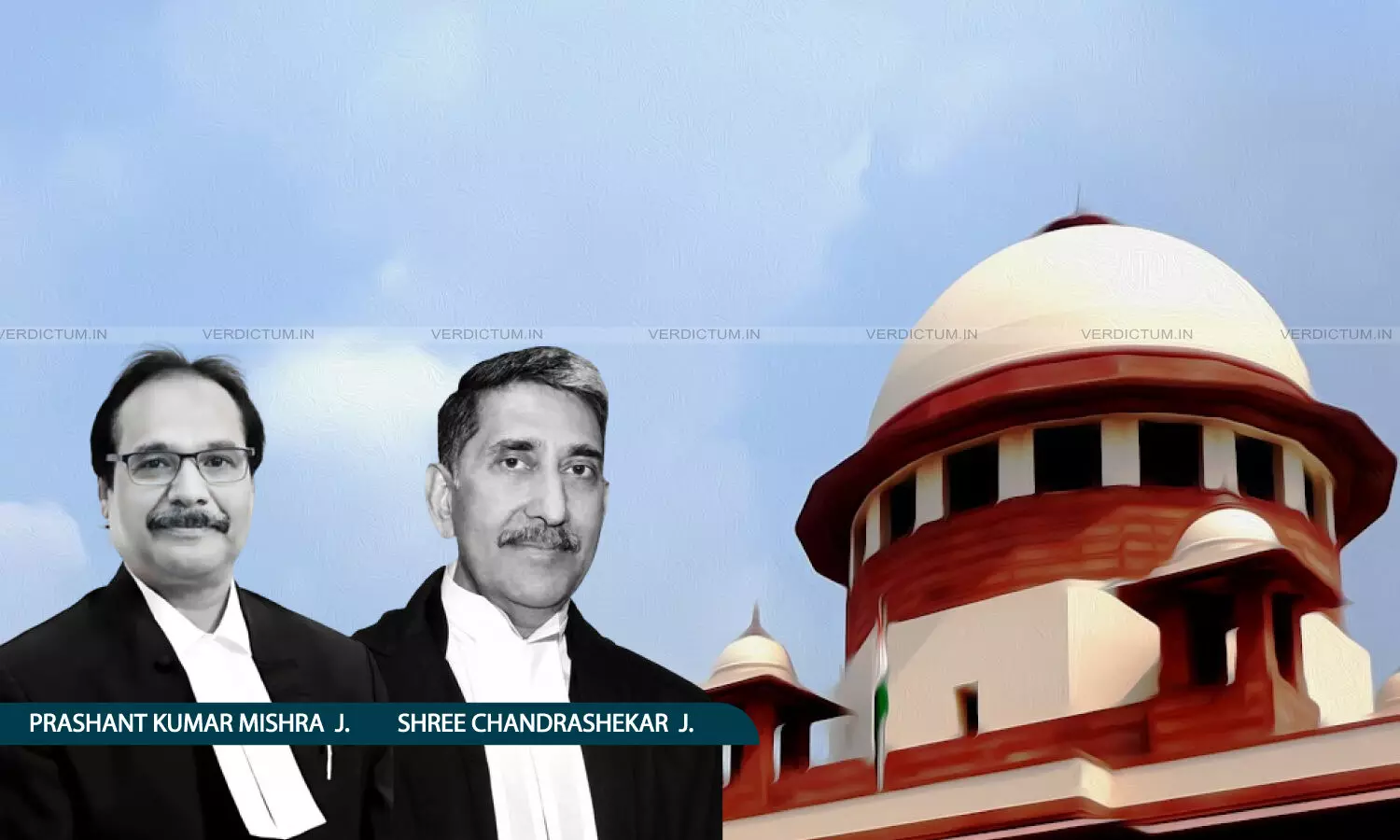
Justice Prashant Kumar Mishra, Justice Shree Chandrashekhar, Supreme Court
Right To Receive Family Pension Can't Be Treated As Bounty: Supreme Court Holds Widow Entitled To Pension From Death Of Railway Employee Husband
 |
|The Supreme Court was considering the issue of the appellant's entitlement to arrears of family pension consequent upon the death of her husband.
While holding that a widow is entitled to receive family pension from the date of the death of her husband, who was an employee of the Railways, the Supreme Court has held that the right of an individual to receive family pension is akin to a valuable right and property and is no longer treated as a bounty.
The Apex Court was considering the issue of the appellant's entitlement to arrears of family pension consequent upon the death of her husband. The High Court had allowed the family pension to the appellant from the year 2014, the time when she first approached the Central Administrative Tribunal, instead of allowing the same when it fell due upon the death of her husband.
The Division Bench of Justice Prashant Kumar Mishra and Justice Shree Chandrashekhar held, “In our considered view, considering the right of an individual to receive family pension which is held akin to a valuable right and property in her hand and is no longer treated as a bounty, restricting the same from 2014 onwards would not only be arbitrary, but it will amount to inflicting injustice upon a poor widow who was earning livelihood by working as a house maid in the neighbourhood when her husband died in harness. Not only that her husband was dismissed after his death which was impermissible as per the Railway Board’s own circular, the appellant’s subsequent representation claiming family pension was rejected on the ground of incongruity as to the date of death of her late husband.”
Advocate P. V. Yogeswaran represented the Appellant while Additional Solicitor General Anil Kaushik represented the Respondent.
Factual Background
The appellant is the widow of Late K.M. Banerjee, an employee of Railways, who died on November 12, 2000, while in service as a Leverman. It was the appellant’s case that she was living separately from her husband on account of some dispute and she used to earn a livelihood while offering maid services in the neighbourhood. The appellant was unknown about her husband’s service and his place of posting. As per the Railway Board’s Letter, in the event of death of the charged employee during the pendency of the proceedings, the same had to be closed immediately on the death of the charged railway servant. Despite this rule, the appellant’s late husband was dismissed from service on October 10, 2001.
Taking note of the order of dismissal, the appellant preferred an appeal before the competent authority, which was rejected on the ground that the appeal was belatedly filed and there were two varying dates of death available on record. The appellant served a legal notice on the respondents seeking settlement of dues in her favour. When no action was taken, the appellant preferred an original application which came to be dismissed by CAT on the ground of limitation.
The appellant also preferred a suit seeking declaration about the date of death of her late husband. The appellant thereafter moved the High Court by way of a writ petition in which the impugned order was passed allowing the appellant’s claim to family pension. Yet the same was restricted from 2014 onwards, the time when the appellant first approached the CAT. The appellant thus approached the Apex Court on the ground that she was entitled to family pension, which fell due immediately after the death of her husband and restricting the pension from 2014 onwards was not in accordance with law.
Reasoning
The Bench referred to the judgment in S.K. Mastan Bee vs. General Manager, South Central Railway and Another (2004), where it was held that the aggrieved litigant could be granted the relief of the past arrears of pension from the date of the death of her husband. Further reference was made to the judgment in Union of India and Others vs. Tarsem Singh (2008), wherein it was held that the High Courts would restrict the consequential relief relating to arrears normally to a period of three years prior to the date of filing of the writ petition.
Considering such stand, the Bench stated, “When the principles concerning the binding value of two conflicting decisions rendered by the Benches of equal strength are settled, as quoted in the above referred judgments, we have to apply the principles in the case in hand to decide whether the appellant would be entitled to family pension from the date it fell due or she is entitled to it from the year 2014 as has been directed by the High Court.”
The Bench noted that the ratio in S.K. Mastan Bee (supra) has dealt with the specific issue of restricting the past arrears of pension in a more appropriate manner. Considering that the same was not considered by the latter Bench of equal strength in Tarsem Singh (supra), the Bench relied upon S.K. Mastan Bee (supra).
The Bench was of the view that restricting the right to family pension from 2014 onwards would amount to inflicting injustice upon a poor widow who was earning a livelihood by working as a housemaid in the neighbourhood when her husband died in harness. The Bench held that the appellant had to file a civil suit to obtain a declaration as to the exact date of death of her husband, for which, otherwise, a death certificate, a statutory document, had already been issued in her favour. “Thus, the appellant was not at fault in laying the delayed challenge to the Railways’ refusal to grant family pension to her”, it added.
Thus, following the principles laid down by this Court in S.K. Mastan Bee (supra), the Bench allowed the Appeals and modified the order passed by the High Court to direct that the appellant would be entitled to family pension from the date of death of her husband i.e., from November 12, 2000. “The entire arrears shall be paid to the appellant with interest at the rate of 6% per annum within a period of three months from today”, it clarified.
Cause Title: Maya Banerjee v. Union of India & Ors. (Neutral Citation:2026 INSC 959)
Appearance
Appellant: Advocates P. V. Yogeswaran, Y. Lokesh, Bibek Tripathi, Arun Singh, V. Kandha Prabhu, Dhatri Singh, Hari Preethi, Surya Narayana Patro, Guneswaran PV, AOR Ashish Kumar Upadhyay
Respondent: Additional Solicitor General Anil Kaushik, Advocates Rajat Nair, Pranjal Singh, Nasadiya Singh, Ishaan Sharma, Vibhu Shankar Mishra, AOR Amrish Kumar