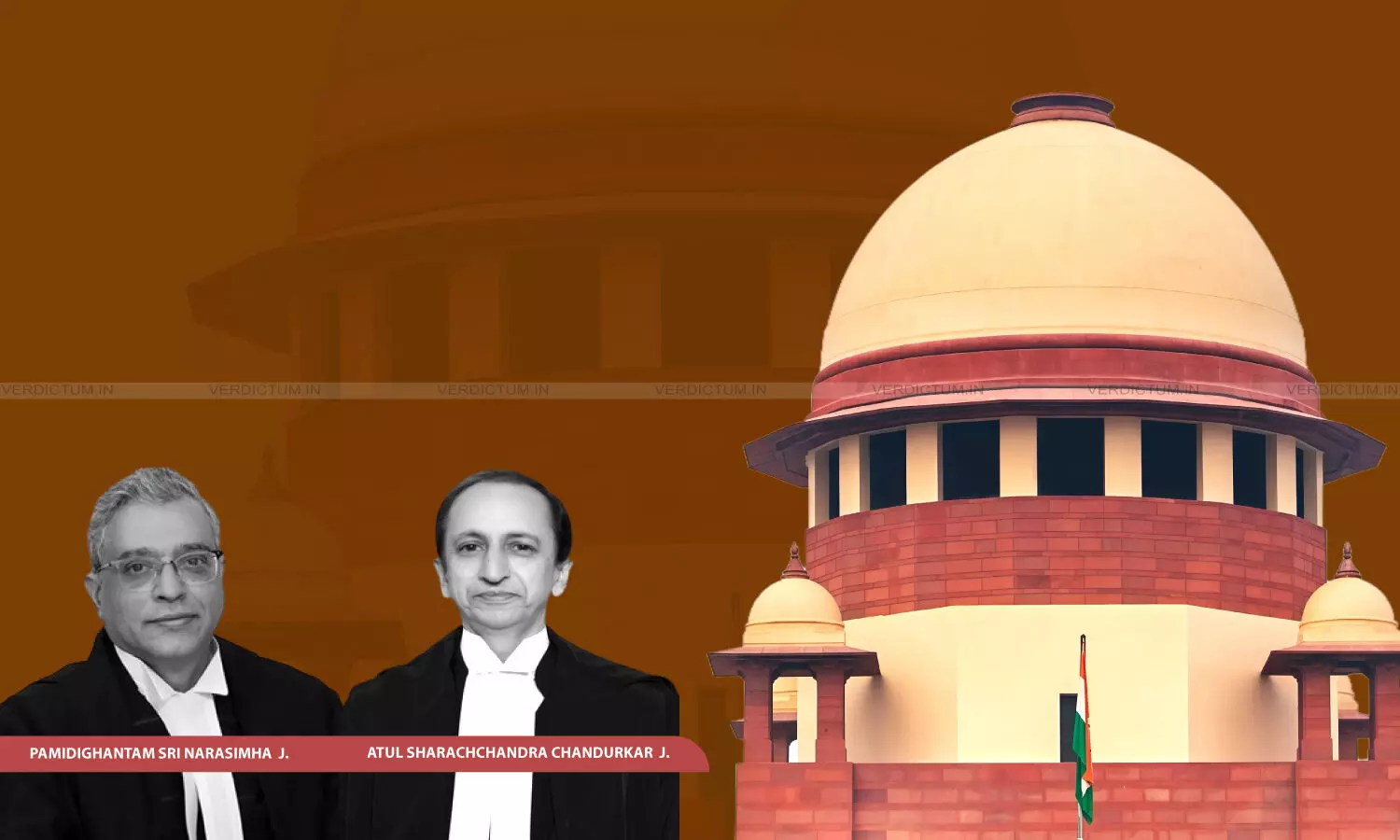
Justice Pamidighantam Sri Narasimha, Justice Atul S. Chandurkar, Supreme Court
Citizens Can Enforce Restitutionary Remedy If Fundamental Right To Walk On Demarcated Footpath Is Violated: Supreme Court
 |
|The appeal before the Supreme Court was filed by a man who lost his young son.
While observing that the right to walk is a fundamental right under Part III of the Constitution and a citizen can enforce restitutionary remedy if this right to walk on a demarcated footpath is violated, the Supreme Court has suggested the institution of a regulatory body to oversee such matters and effectuate such a right.
The appeal before the Apex Court was filed by a man who lost his young son. The five-year-old boy was crushed by a tanker on his way to school.
Highlighting how the Apex Court has long been struggling to squeeze in pedestrian rights in the nooks and crannies of the Motor Vehicles Act, the Division Bench of Justice Pamidighantam Sri Narasimha and Justice Atul S. Chandurkar held, “To enhance and effectuate the fundamental right to walk on demarcated footpaths, it is necessary to establish a regulatory body. Working with perpetual seal and succession, such a regulator will develop and retain institutional memory so that it can act on the basis of the experience, data, and information it has gathered and processed. Institutional expertise is critical, and such a regulator will employ human resources with domain expertise and talent. The regulator will maintain institutional integrity by taking independent and objective decisions without governmental or industrial control. These values shall flow naturally if there is institutional transparency and accountability. It is in this perspective that we need to effectuate the fundamental right to walk.”
“It is important to recognise that if the fundamental right to walk on a demarcated footpath is violated, a citizen is entitled to enforce restitutionary remedy. This remedy is distinct from that of the claim that a person may make under the Motor Vehicles Act. The restitutionary remedy under the Constitution or under Sections 38-40 of the Specific Relief Act, 1963 for the enforcement of public duties can be enforced against the Urban Development Authorities, Municipal Corporations, Municipalities, or the Panchayats”, it added.
Factual Background
The appellant was taking his son to school when a tanker came from behind and struck the boy, crushing his waist and lower body. He succumbed to the injuries. The claim petition filed by the father for compensation of Rs 25,00,000 was considered, and MACT granted Rs 7,82,000 with interest. In an appeal filed by the appellant as well as the Insurance Company, by the order impugned before the Apex Court, the High Court dismissed the appellant’s appeal and, while allowing the respondent’s appeal, reduced the compensation to Rs. 4,70,000.
Reasoning
The Bench, at the outset, mentioned, “The issue is something more fundamental, and it is in recognition of the simplest of the simple human activity- “Walking”. While the right to walk is inextricably connected to life, our Constitution recognises and guarantees it as a fundamental right – “All citizens shall have the right…to move freely throughout the territory of India”.
The Bench also declared, “The right to walk is a fundamental right under Part III of the Constitution. It is integral to the right to movement guaranteed under Article 19(1)(d), read with Article 19(1)(a), Article 19(1) (b), Article 19(1) (c) and Article 21 of the Constitution of India. The fundamental right to walk will take within its sweep the right to demarcated footpaths. These rights are primary and shall have priority over movement by motorised vehicles.”
The Bench stated that there must then be a duty to ensure that a footpath is demarcated and maintained for the walkers if a road exists. It further stated that it is an enforceable duty and the fundamental right to walk on demarcated footpaths overrides the privilege of a motorised vehicle. The Bench further noted that though the right to walk on demarcated footpaths is integral to Articles 21 and 19(1) (d), there is no legislation.
“It is compelling to lay down a statutory framework not only for declaring the right, but also to recognise the duty bearers.The Act must protect, enhance, and provide quick remedies for violations, and also establish a full-time regulator to plan, enforce, and implement this precious right. We direct the Registry to send a copy of our judgment to the Ministries of Housing and Urban Affairs, Rural Development, Road Transport and Highways, to reflect on the compelling necessity for initiating the necessary legal framework”, it stated.
On a perusal of the facts of the case, the Bench noted that the High Court committed an error in reducing the compensation granted by the MACT. Reference was made to the judgment in Karuna Parmar v. Prakash Sinha (2025), involving a similar factual situation in which the deceased minor was 6 years old, and the Court fixed the child’s daily income at Rs 223 by referring to the notification issued under the Minimum Wages Act, 1948. The Bench thus held the appellant entitled to compensation of Rs 11,44,628.
The Bench concluded the matter by ordering, “We direct the Registry to re-number this case as a petition under Article 32 of the Constitution by changing the cause title to Re: Fundamental Right to Walk and Footpath. The Government of India, through the Ministries of Housing and Urban Affairs, Rural Development and Road Transport and Highways, is impleaded as a party in person. We request Mr. K.M. Nataraj, ASG, to assist the court.”
Cause Title: Maniyar Iliyaz @ Shaik Riyaz v. P. Ayyappan (Neutral Citation: 2026 INSC 647)