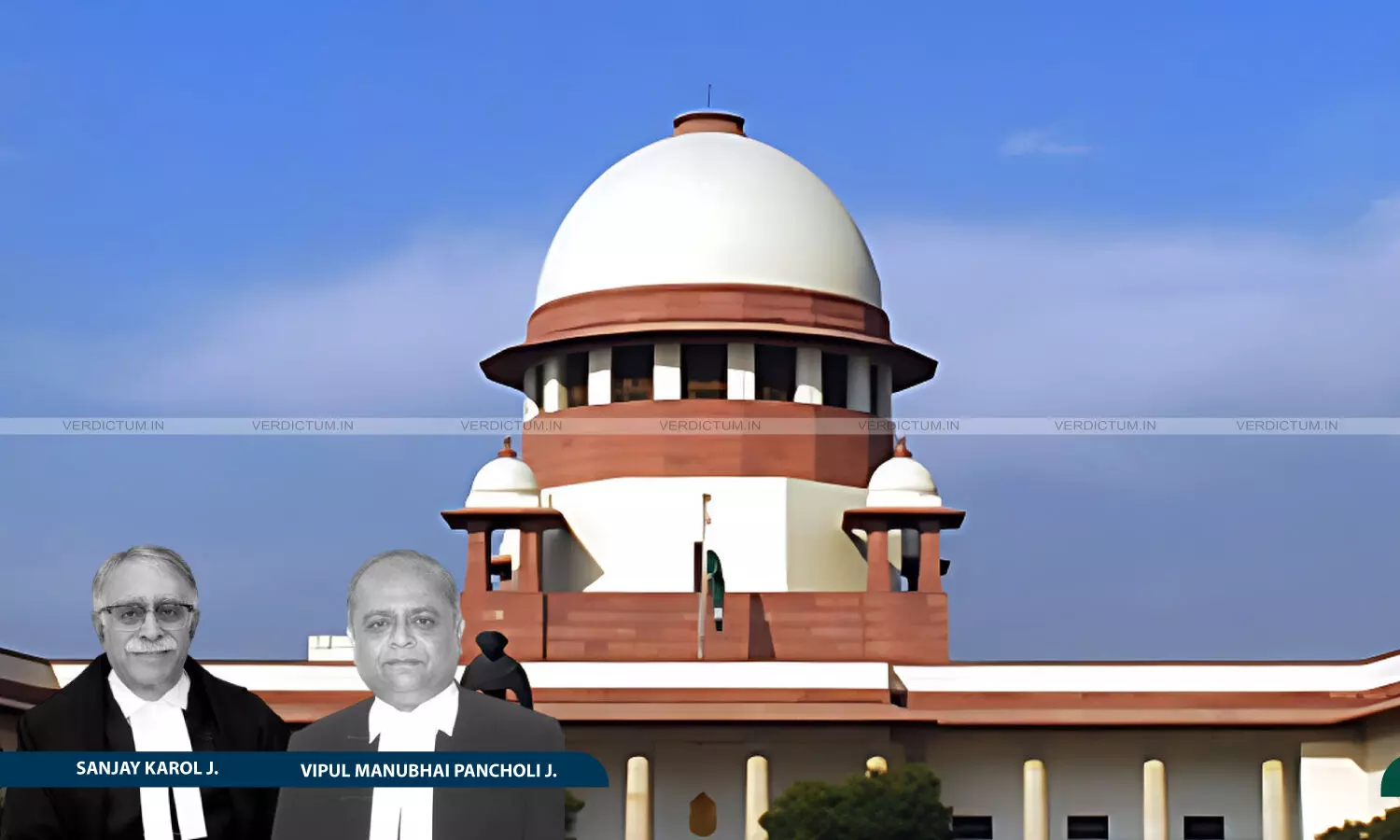
Obscenity Is Not Synonymous With Vulgarity, Abuse Or Profanity: Supreme Court Sets Aside Conviction U/S. 294 IPC
 |
|The Supreme Court set aside the conviction under Sections 294(b) and 506(ii) IPC, holding that abusive or vulgar words do not become obscene in law unless the statutory ingredients of obscenity and annoyance are proved, but affirmed the conviction for grievous hurt caused with a billhook.
The Supreme Court has held that abusive, vulgar or uncivil words used during an altercation over a land dispute cannot by themselves constitute obscenity under Section 294(b) IPC unless they are shown to be lascivious, appeal to prurient interests, tend to deprave and corrupt, and cause annoyance to others in or near a public place.
The Court was hearing an appeal against a Madras High Court judgment which had acquitted the appellant of offences under the Scheduled Castes and Scheduled Tribes (Prevention of Atrocities) Act, 1989, but confirmed his conviction under Sections 294(b), 326 and 506(ii) IPC.
A Bench of Justice Sanjay Karol and Justice Vipul M. Pancholi held that “For an utterance to be considered obscene, it must be shown that it was lascivious, appealed to prurient interests and had the tendency to deprave and corrupt the minds of those who are exposed to it. Tested on this anvil, even if all the allegations levelled in the complaint are taken at their face value and accepted to be true in entirety, the same cannot be held to be obscene. Such words, howsoever abusive, unpalatable or uncivil, do not satisfy the requirement of Section 294(b) IPC for there being nothing on record to show that they had any one or all three elements referred to hereinabove. Further, it is nobody’s case that use of such words caused annoyance to others in a public place, which is a mandatory ingredient of the Section, much less to the complainant . In absence thereof, we find that the offence under Section 294(b) IPC is not made out.”
Advocate C. Paramasivam appeared for the petitioner, while Advocate Sabarish Subramanian appeared for the State. Senior Advocate Shailesh Madiyal assisted the Court as amicus curiae.
Background
The prosecution's case arose from an altercation over a land dispute. It was alleged that the appellant quarrelled with the complainant’s nephew, and when the complainant intervened, the appellant abused him, used caste-based slurs, brought a billhook from his house and assaulted him, causing multiple injuries.
An FIR was registered under Sections 294(b), 324 and 506(ii) IPC and provisions of the SC/ST Act. During the investigation, the charge under Section 324 IPC was altered to Section 326 IPC because of the grievous injuries allegedly suffered by the complainant.
The trial court convicted the appellant under Section 294(b) IPC, provisions of the SC/ST Act, Section 326 IPC read with the SC/ST Act and Section 506(ii) IPC read with the SC/ST Act. The High Court acquitted him of the SC/ST Act offences, but confirmed his conviction under Sections 294(b), 326 and 506(ii) IPC, while reducing the sentence.
Before the Supreme Court, the issue was whether the remaining convictions under Sections 294(b), 326 and 506(ii) IPC could be sustained. The State and the complainant had not challenged the acquittal under the SC/ST Act.
Court’s Observations
The Supreme Court first examined Section 294 IPC and held that the prosecution must prove both obscenity in or near a public place and annoyance caused to others.
The Court observed: “A plain reading of this Section shows that in order to secure a conviction under Section 294 IPC, the prosecution is required to prove two essential ingredients. First, the offender has done an obscene act in a public place or has sung, recited, or uttered any obscene word, ballad or song in or near any public place. Secondly, such an act or utterance has caused annoyance to others.”
The Court then noted that the IPC does not define “obscene”, but Supreme Court precedents under Section 292 IPC have explained the test for obscenity.
The Court distinguished obscenity from abusive, vulgar or profane speech, relying on Ranjit D. Udeshi v. State of Maharashtra (1964), Samaresh Bose v. Amal Mitra (1985), Madhanagopal v. Lalitha (2022), Apoorva Arora v. State (NCT of Delhi) (2024), Om Prakash Ambadkar v. State of Maharashtra (2026), and Sivakumar v. State (2026).
The Bench stated: “Let’s be clear, legally, obscenity is not synonymous with “vulgarity”, “abuse” or “profanity”. Use of mere swear words, profanities and vulgar expletives, however distasteful or uncivil they may be, cannot be equated with obscenity.”
The Court further observed: “The test to determine whether the words complained of are obscene or not is to see whether the words are lascivious, appeal to prurient interests and have the tendency to deprave and corrupt the impressionable minds. Further, it must also be shown that the use of such words has caused annoyance to others. Unless presence of essential ingredients is established, the offence of obscenity cannot be said to be made out.”
It added: “Words which are merely vulgar or abusive may evoke a feeling of disgust, revulsion or shock, but that by itself does not make them obscene in law. It is for this reason that this Court, through various judicial pronouncements, has held that the use of abusive, vulgar or profane language does not necessarily constitute obscenity.”
Applying these principles, the Court found that the words attributed to the appellant, even if accepted at face value, were abusive or vulgar at best, but not obscene in law.
The Court next examined Section 506(ii) IPC and held that criminal intimidation requires more than threatening words spoken during an altercation. The threat must be intentional and must be shown to have caused alarm or compelled the victim to do or omit an act.
The Court observed: “Furthermore, we find it equally difficult to sustain the conviction under Section 506 (ii) IPC. For an offence of criminal intimidation to be made out under Section 506 IPC, it must be shown that there was an act of: (1) Threatening a person with any injury; (i) to his person, reputation or property; or (ii) to the person, or reputation of anyone in whom that person is interested and (2) Such threat was intentional; (i) to cause alarm to that person; or (ii) to cause that person to do any act which he is not legally bound to do as the means of avoiding the execution of such threat; or (iii) to cause that person to omit to do any act which that person is legally entitled to do as the means of avoiding the execution of such threat. [See: Naresh Aneja v. State of U.P.15]”
The Court held: “In the present case, the prosecution seeks to establish the charge of criminal intimidation primarily on the basis of the statement of PW-1 contained in the FIR, which reads as: “… Subramaniam intimidated me waving the billhook at me saying ‘You had escaped this day. I will not rest until I hack you’ and flung the billhook right there and left the place”. The same position was reiterated by PW-3 and PW-4 in their testimonies. However, in our considered view, even if the aforesaid allegation is accepted in its entirety, the charge under Section 506(ii) IPC is not borne out. Mere use of threatening words during the course of an altercation, without the proof that it was intended to cause alarm to the complainant or to compel him to do or omit to do any act, would not be sufficient to bring in the application of this provision. Apart from the bald assertion referred to above, there is nothing on record to indicate that the appellant intended to cause alarm to PW-1 so as to criminally intimidate him. Thus, we set aside the conviction of the appellant under Section 506(ii) IPC.”
The Supreme Court, however, refused to interfere with the conviction under Section 326 IPC. It noted that the complainant’s testimony was corroborated by two prosecution witnesses and by medical evidence, including a CT scan showing nasal bone fracture.
The Court stated: The evidence on record clearly establishes that PW-1 had a nasal bone fracture, which injury squarely falls under the definition of ‘grievous hurt’ as laid under Section 320 IPC. The said injury was further proved to have been caused by using a billhook, which is undoubtedly a dangerous weapon. Therefore, upon a careful examination of the evidence on record, we find no reason to interfere with the conviction of the appellant under Section 326 IPC and accordingly affirm the same.”
While sustaining the Section 326 IPC conviction, the Court considered the land-dispute background, the appellant’s age and health condition, and modified the sentence.
The Court held: “However, considering the fact present incident occurred due to animosity between the appellant and complainant’s family over a land dispute, and keeping in view the age of the appellant, who is about 70 years old, and his health condition, we are inclined to modify the sentence to be served by the appellant till the rising of the Court on a day as maybe specified by the concerned Court. He shall also be liable to pay a fine to the tune Rs.50,000/-. The same shall be done within a period of two months.”
Conclusion
The Supreme Court allowed the appeal. It set aside the convictions under Sections 294(b) and 506(ii) IPC, affirmed the conviction under Section 326 IPC, and modified the sentence to imprisonment till the rising of the Court with a fine of Rs. 50,000.
Cause Title: Mani @ Subramaniyam v. State Rep. By The Deputy Superintendent Of Police (Neutral Citation: 2026 INSC 719)
Appearances
Petitioner: Advocates C. Paramasivam, M.P. Parthiban, Y. Arunagiri and R. Sudhakaran, AOR
Respondent: Sabarish Subramanian, AOR; Senior Advocate Shailesh Madiyal (Amicus Curiae)