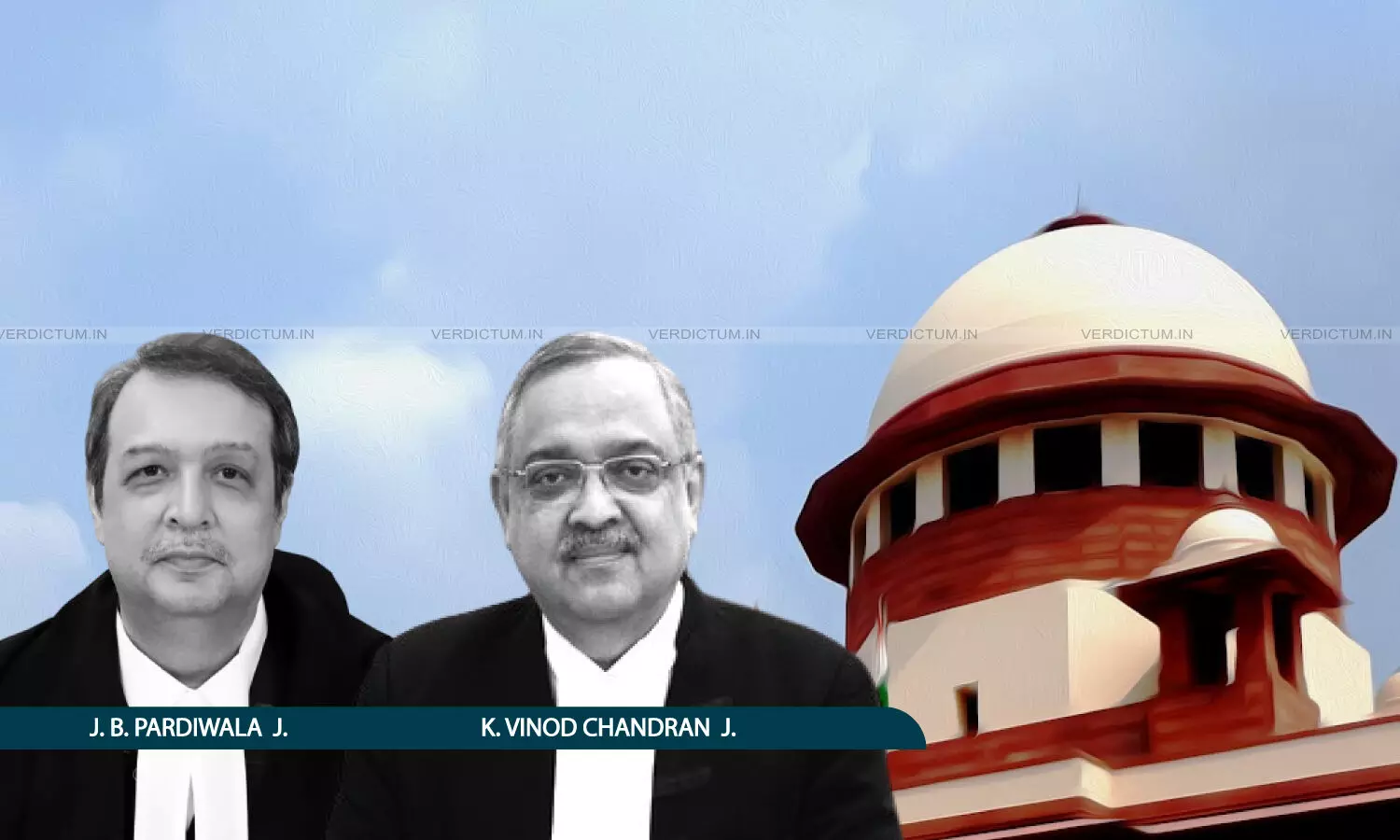
Justice J. B. Pardiwala, Justice K. Vinod Chandran, Supreme Court
National Highway Act| If Determination Of Compensation Is Made Before 01.01.2015, Solatium Payable Under Land Acquisition 1894: Supreme Court Clarifies Compensation Regime
 |
|The Bench noted that for acquisitions under the National Highways Act, the date on which the Competent Authority passes its award, not the date acquisition proceedings commenced, determines whether solatium, interest and interest on solatium are computed under the 1894 Act or the 2013 Act.
The Supreme Court has held that where the Competent Authority under the National Highways Act, 1956 determines compensation before January 1, 2015, the landowner's solatium, interest, and interest on solatium must be computed under the Land Acquisition Act, 1894, even though the Right to Fair Compensation and Transparency in Land Acquisition, Rehabilitation and Resettlement Act, 2013 had already come into force on January 1, 2014.
The Bench held that the entitlement to these benefits does not depend on when the acquisition proceedings began, but squarely on the date of the determination of compensation, observing that if the award was passed before the cut-off date, entitlement would be governed by the 1894 Act, and if passed after, by the 2013 Act.
A Bench comprising Justice J.B. Pardiwala and Justice K. Vinod Chandran observed, “…The intention as we discern is to provide a period of one year from the date of effect of the Act of 2013 for the Competent Authority under the NH Act to determine the compensation, deemed to be the initial award, insofar as the acquisition proceedings taken prior to the Act of 2013. If a determination of compensation has not been made before 01.01.2015, then necessarily the Act of 2013 was to apply. But if a determination of compensation is made by the Competent Authority under the NH Act before 01.01.2015, even if it is after 01.01.2014 solatium interest and interest of solatium would be payable under the Act of 1894”.
Senior Advocate Harin P. Raval appeared for the appellant and Senior Advocate Ankur Mittal appeared for the respondent.
The appellant's land was acquired for a national highway project pursuant to a notification published under Section 3A of the National Highways Act on June 7, 2011, followed by a declaration under Section 3D on January 20, 2012. The Competent Authority determined compensation by an order dated July 11, 2014, awarding a total sum, of which the appellant's share was disbursed in October 2014. Disputing the quantum, the appellant sought reference to an Arbitrator, who passed an award on January 13, 2016, which subsequently became the subject of challenge under Sections 34 and 37 of the Arbitration and Conciliation Act, 1996.
The appellant contended that since the Arbitrator's award was passed in 2017, after the 2013 Act's compensation provisions had been extended to the National Highways Act with effect from January 1, 2015, the more beneficial provisions of the 2013 Act ought to govern computation of solatium and interest. The National Highways Authority of India contended that since the Competent Authority's determination, being the equivalent of an "award" for this purpose, was made on July 11, 2014, prior to the cut-off date, the benefits had to be computed under the 1894 Act. The dispute reached the Supreme Court by way of a civil appeal.
The Court noted that Section 3J of the National Highways Act, which had excluded the applicability of the 1894 Act altogether, had earlier been declared unconstitutional, on the ground that a blanket denial of solatium and interest to landowners under the National Highways Act could not be sustained. It clarified that this earlier ruling established only that solatium and interest must be paid across the board, and did not lay down that such benefits, for awards made before January 1, 2015, must be computed under the 2013 Act. Relying on a Constitution Bench decision interpreting Section 24(1)(a) of the 2013 Act, the Court held that the applicable law is determined by whether an award had been made as of the relevant cut-off date, irrespective of when the acquisition proceedings themselves commenced.
“Even going by the Constitution Bench decision, the application of the Act of 2013 arises with reference to the award made, whether it be under the Act of 1894 or the Act of 2013; even if the proceedings for acquisition were commenced prior to 01.01.2014. If an award is made prior to 01.01.2014, the date of effect of the Act of 2013, then the compensation has to be determined under the provisions of the Act of 1894 in the reference under Section 18 of that Act and in any further challenge raised, wherein the solatium and interest will be as available under that Act. However, if the award is made after 01.01.2014, obviously, it has to concede to the more beneficial proceedings under the Act of 2013, even if the acquisition proceedings were commenced under the Act of 1894”, it noted.
The Bench rejected reliance on a subsequent government notification concerning unpaid "land holdings", finding it did not assist the appellant since the relevant portion of land had, on facts, already received compensation before the cut-off date.
Accordingly, it allowed the appeal only to the limited extent of directing that the compensation as determined by the Arbitral Award be conferred with solatium, interest and interest on solatium as computed under the Land Acquisition Act, 1894, and remanded the matter to the Competent Authority for computation and disbursal accordingly.
Cause Title: Manav Bhanot v. National Highway Authority of India (Neutral Citation: 2026 INSC 973)
Appearances:
Appellant: Harin P. Raval, Senior Advocate.
Respondent: Ankur Mittal, Senior Advocate.