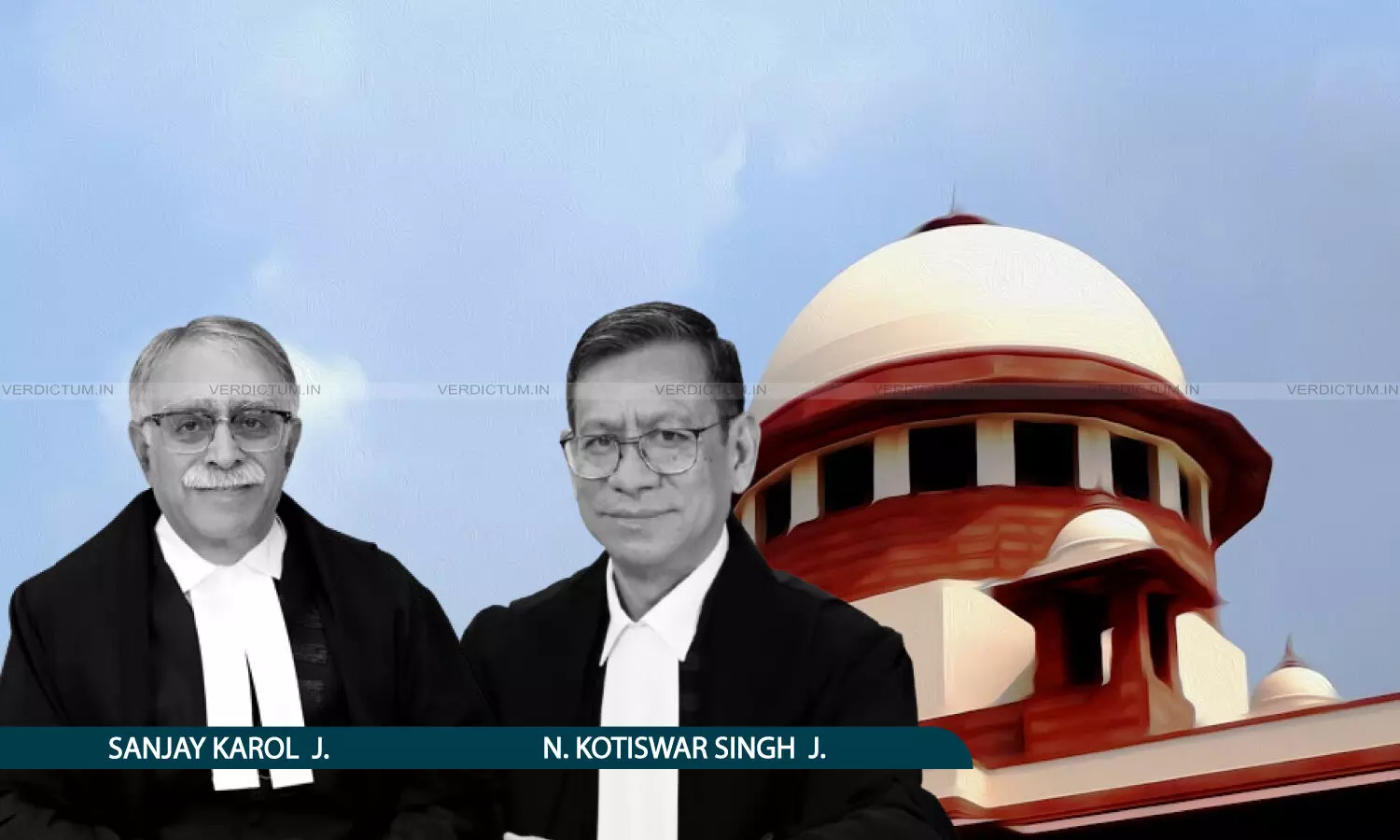
Justice Sanjay Karol, Justice N. Kotiswar Singh, Supreme Court
Section 22 Hindu Succession Act Applicable To Agricultural Land, Distinguishable From Punjab Pre-emption Act Struck Down In Atam Prakash: Supreme Court
 |
|The Court reaffirmed "right of substitution but not of re-purchase", and held preferential right among class-I heirs is intrinsically linked to succession and falls within Parliament's competence under Entry 5, List III.
The Supreme Court has held that Section 22 of the Hindu Succession Act, 1956, which confers a preferential right upon Class-I heirs to acquire the interest of a co-heir proposing to transfer his share in inherited property, applies with full force to agricultural land, rejecting the contention that the provision stands constitutionally infirm following the Constitution Bench's ruling in Atam Prakash v. State of Haryana(1986) 2 SCC 249 striking down a similarly structured pre-emption provision under the Punjab Pre-emption Act, 1913.
The Court further ruled that the observations in Atam Prakash, which held Section 15 of the Punjab Act unconstitutional solely because its list of preferential claimants bore no rational relationship to the theory of agnatic succession, cannot be imported wholesale to strike down an entirely different, unconnected statutory provision that was never under challenge in that case, holding that "...if duly enacted legislation could be so easily struck down by importing observations made elsewhere, we would invite a situation of judicially created anarchy...".
A Bench comprising Justice Sanjay Karol and Justice Nongmeikapam Kotiswar Singh observation, “…Section 22 of the HSA, by contrast, is confined strictly and exclusively to succession in respect of Class I heirs under the Schedule to the HSA, i.e., persons who have inherited together from the same intestate. No tenant, no distant blood relation, no co-owner can invoke Section 22 as in the case of the Punjab Act. It is a right that lives and dies with the succession relationship. The two provisions are, therefore, fundamentally different in character and scope, and thus, what was held in respect of Section 15 of the Punjab Act in Atam Prakash can have no bearing on interpreting Section 22 of the HSA”.
“The right of pre-emption as conferred under Section 22 of the HSA is, in its pith and substance, an incident of succession and nothing more…The right is, therefore, not independent of succession. Parliament, in enacting the HSA, conferred succession rights upon Class I heirs among others, in respect of all properties of the intestate, including agricultural land, and simultaneously placed a qualification upon those rights, that any heir wishing to transfer his inherited interest must first offer it to his co-heirs. The preferential right and the succession right are two limbs of the same legislative design dealing with succession amongst the Hindus under the Act…”, it noted further.
Senior Advocate Rameshwar Singh Malik appeared for the appellant and Advocate C Kranthi Kumar appeared for the respondent while Senior Advocate Indrajit Mahanty, assisted the Court as Amicus Curiae.
The plaintiff and defendants were siblings who had inherited agricultural land as Class-I legal heirs of their father. Defendant Nos. 1 to 7, directly or through legal heirs, collectively sold their shares to a third party by sale deed dated December 28, 2011.
The plaintiff had filed a petition under Section 22 of the HSA on December 8, 2011, prior to execution of the sale deed, seeking to exercise his preferential right to acquire the interest being alienated.
The Civil Court, Karnal, dismissed the suit relying on Atam Prakash, holding that Section 22 HSA was pari materia with Section 15 of the Punjab Act and must equally be struck down. The First Appellate Court reversed this, relying on Babu Ram v. Santokh Singh (2019), which had held Section 22 HSA applicable to agricultural land. The High Court dismissed the second appeal, finding no substantial question of law. The original defendants appealed to the Supreme Court, contending Babu Ram was wrongly decided for having overlooked Entry 6 of List III and Entries 14 and 18 of List II.
Tracing the historical and jurisprudential basis of pre-emption — including Audh Behari Singh v. Gajadhar Jaipuria (1954) 1 SCC 836 (Constitution Bench) and Bishan Singh v. Khazan Singh 1958 SCC OnLine SC 88 (Four-Judge Bench), the Court held pre-emption to be "a right of substitution but not of re-purchase," a weak right defeasible by acquiescence.
“Applying the well-settled doctrine of pith and substance, the true character of Section 22 of the HSA is that of a succession provision falling squarely within Entry 5 of List III, and any incidental connection it may have with the transfer of agricultural land does not displace its dominant character or affect the Parliament's competence to enact it… The submission that Parliament lacked competence to enact Section 22 of the HSA in respect of agricultural land is, therefore, not only incorrect in principle but also unsupported by any factual foundation in the present case. The question of noncompetence of the Parliament, thus, does not arise”, the Bench said.
On competence, the Court held Entry 18 of List II (transfer of agricultural land) was answered by Babu Ram's own illustration that where co-heirs inherit property together, Section 22 operates under Entry 5 of List III (intestacy and succession), which confers concurrent competence on Parliament.
The Bench concurring opinion added that the pre-Constitution Government of India Act, 1935 had expressly excluded agricultural land from the succession entry, and the deliberate omission of that exclusion in Entry 5 of List III under the current Constitution confirmed Parliament's unrestricted competence over succession to all property, including agricultural land.
The appeal was dismissed, and the findings of the First Appellate Court and the High Court were affirmed. The Court held that no occasion arose for Babu Ram to be referred to a larger Bench. No costs.
Cause Title: Mahinder & Others v. Puran Singh (Neutral Citation: 2026 INSC 698)
Appearances:
Appellants: Rameshwar Singh Malik, Sr. Adv., Jitesh Malik, Jatin Hooda, Abhaya Nath Das, Piyush Sharma, Barnali Basak, Madhulika Jha, Satish Kumar, AOR, Advocates.
Respondent: C Kranthi Kumar, Danish Saifi, Shafik Ahmed, Naman Dwivedi, S Subramaniam, Abida, Veshal Tyagi, Aravind C, Ananya Bhardwaj, Rashid N. Azam, AOR, Indrajit Mahanty, Senior Counsel, assisted the Court as Amicus Curiae.