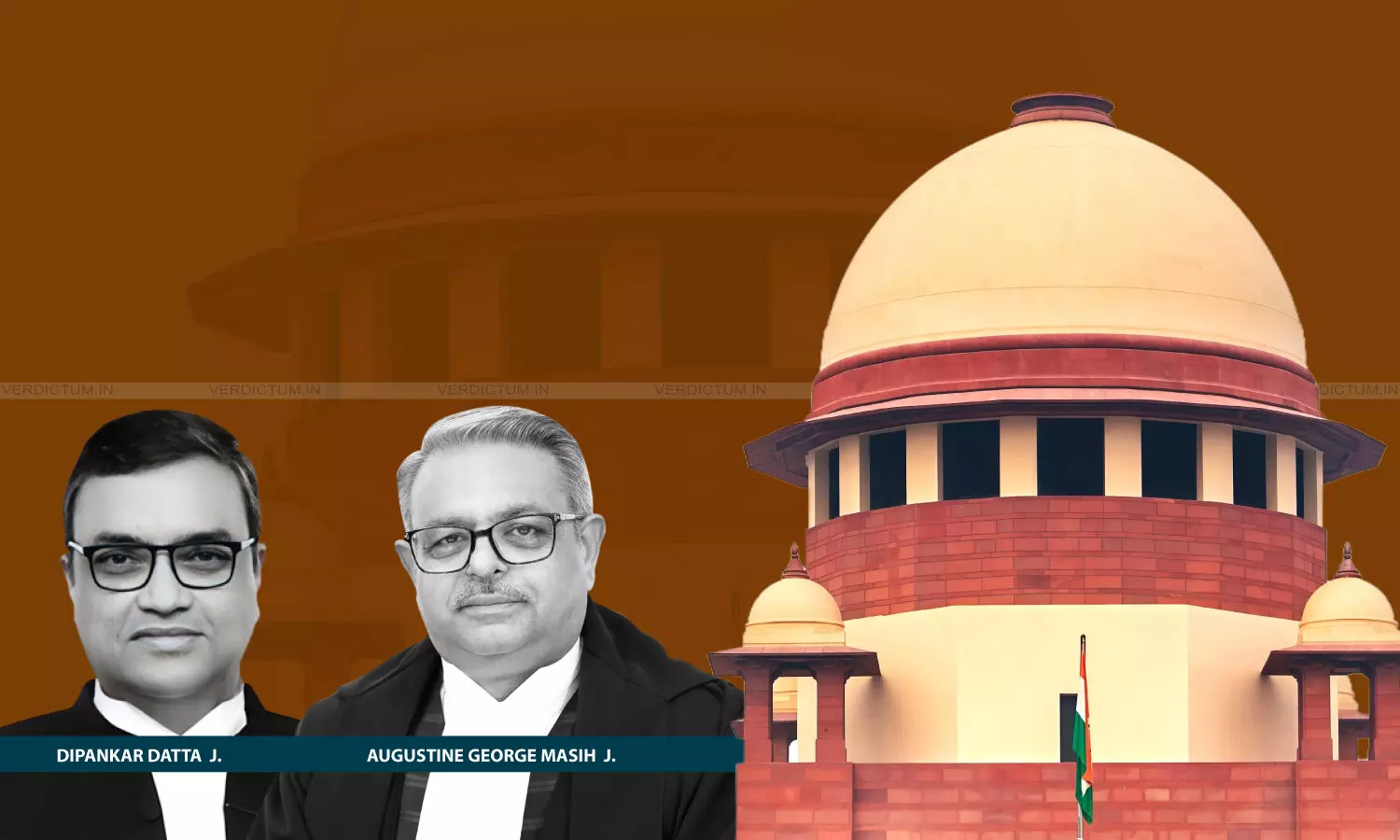
Justice Dipankar Datta, Justice Augustine George Masih, Supreme Court
Confirmed Auction Sale Under SARFAESI Act Can Be Set Aside If Process Adopted Is Legally Infirm Or Violates Statutory Rules: Supreme Court
 |
|The Court held that protection ordinarily available to auction purchasers and confirmed sales under the SARFAESI framework is not absolute and must yield where the sale process itself suffers from material statutory non-compliance affecting the legality of the auction.
The Supreme Court has held that the rights of an auction purchaser and the sanctity attached to a confirmed auction sale under the SARFAESI Act are not absolute and cannot override mandatory statutory requirements governing the auction process.
The Court observed that where the very process leading to the sale is shown to be legally infirm or inconsistent with the statutory framework, judicial scrutiny cannot be foreclosed merely because the sale has been confirmed.
The Court was hearing a civil appeal challenging the judgment of the Madras High Court, which had upheld recovery proceedings initiated under the SARFAESI Act culminating in the auction sale of a mortgaged property belonging to the legal heirs of a deceased guarantor.
A Bench of Justice Dipankar Datta and Justice Augustine George Masih observed: “While it is trite that the rights of an auction purchaser and the sanctity of a confirmed sale ordinarily merit due protection, such protection is by no means absolute. It must yield where the very process engendering the sale is demonstrated to be legally infirm or to be incongruous with the statutory framework.”
In the present case, the Bench added, “the non-adherence to the timeline that the SARFAESI Rules contemplate constitutes a material irregularity going to the root of the matter, …the mere factum that the sale stood confirmed cannot, therefore, foreclose judicial scrutiny”.
Senior Advocate Ratnakar Dash appeared for the appellant, while Senior Advocate Soumya Chakraborty and Advocate Brijesh Kumar Tamber appeared for the respondents.
Background
The case arose out of financial assistance availed by a borrower in the year 1984 from the Indian Bank. To secure the loan, the borrower’s guarantor had mortgaged his immovable property in favour of the bank.
After default by the borrower, the secured creditor instituted a civil suit and obtained a preliminary decree in 1997 for recovery of the outstanding dues. The guarantor subsequently died, leaving behind his legal heirs, including the appellant.
Nearly twelve years after the decree, the secured creditor then initiated proceedings under the SARFAESI Act by issuing a demand notice under Section 13(2), followed by a possession notice and a sale notice proposing auction of the mortgaged property.
The secured asset was auctioned in March 2010, and the second respondent emerged as the successful bidder with a bid amount of over Rs.2.11 crore. The auction purchaser paid 25% of the bid amount immediately, while the remaining 75% was admittedly paid only on 31.03.2010. A sale certificate was thereafter issued.
The legal heirs of the guarantor challenged the proceedings before the Debts Recovery Tribunal and later before the DRAT and the High Court, but all forums upheld the auction sale. The matter ultimately reached the Supreme Court.
Court’s Observations
The Supreme Court observed that Rule 9 of the Security Interest (Enforcement) Rules, 2002, governs confirmation of sale and payment of sale consideration in auctions conducted under the SARFAESI framework. The Court noted that Rule 9(3) requires immediate deposit of 25% of the sale price while Rule 9(4) mandates payment of the balance amount within fifteen days of confirmation of sale, unless time is extended through a written agreement between the parties.
The Bench observed: “Even upon a cursory perusal of Rule 9 of the SARFAESI Rules that existed at the time of the impugned sale, it is clear that these provisions are neither ornamental nor directory; they are couched in mandatory terms and go to the root of the validity of the sale.”
The Court further held: “A conjoint reading of the relevant sub-rules of Rule 9 underscores the mandatory character of these provisions, particularly accentuating the requirement of balance deposit under sub-rule (4), which is integral to the sanctity and credibility of the auction mechanism.”
The Supreme Court noted that although the auction sale was conducted on 11.03.2010, the balance 75% amount was paid only on 31.03.2010, beyond the outer statutory period of fifteen days.
The Court rejected the contention that the sale stood validly confirmed merely because the payment was subsequently accepted by the secured creditor.
The Supreme Court observed that Rule 9(4) permits extension of time only through a written agreement between the parties. However, the record did not disclose any material showing either a request for extension by the auction purchaser or any written agreement extending time.
The Court observed: “Nothing is borne out of the record to demonstrate that there was any prayer for extension of time made by the auction purchaser at any time prior to 31.03.2010 or that any written agreement extending the time was entered into by and between the secured creditor and the auction purchaser.”
The Bench therefore held that the statutory requirements under Rule 9 had not been complied with.
The Supreme Court acknowledged that auction purchasers ordinarily deserve protection and that confirmed sales under the SARFAESI framework carry sanctity. However, the Court held that such protection is not unconditional where the sale process itself is legally flawed.
The Court observed: “The object of proceedings under the SARFAESI Act is not the mere culmination of a sale in a mechanical manner, but the lawful realisation of the secured asset through a process that is fair, transparent and strictly compliant with the prescribed rules.”
The Court held that the failure of the legal heirs to repay the dues could not validate proceedings which were otherwise vitiated by statutory non-compliance.
The Supreme Court observed that after the death of the guarantor, the mortgaged property vested in his legal heirs and such heirs could not be divested of their lawful interests except through a procedure strictly compliant with the SARFAESI Act and the SARFAESI Rules.
The Court further noted that the appellant and other legal heirs had approached the DRT seeking permission to redeem the property and to set aside the consequences of the sale. The Court held that these applications sufficiently demonstrated their intention to redeem the mortgaged property.
Conclusion
The Supreme Court held that the auction sale conducted by the secured creditor stood vitiated on account of non-compliance with the mandatory timelines prescribed under Rule 9 of the Security Interest (Enforcement) Rules, 2002 and that there was no written agreement extending the period for payment of the balance sale consideration.
Accordingly, the Court set aside the judgments of the High Court, DRAT and DRT, and quashed the auction sale.
The Court directed a refund of the entire auction amount deposited by the auction purchaser, together with 7% interest per annum from the respective dates of deposit.
The Court further granted the appellant an opportunity to redeem the mortgaged property upon payment of the dues quantified by the Court together with interest, while clarifying that the secured asset could be re-auctioned if such payment was not made within the stipulated time.
Cause Title: M. R. Vasumathi v. The Authorized Officer & Ors. (Neutral Citation: 2026 INSC 633)