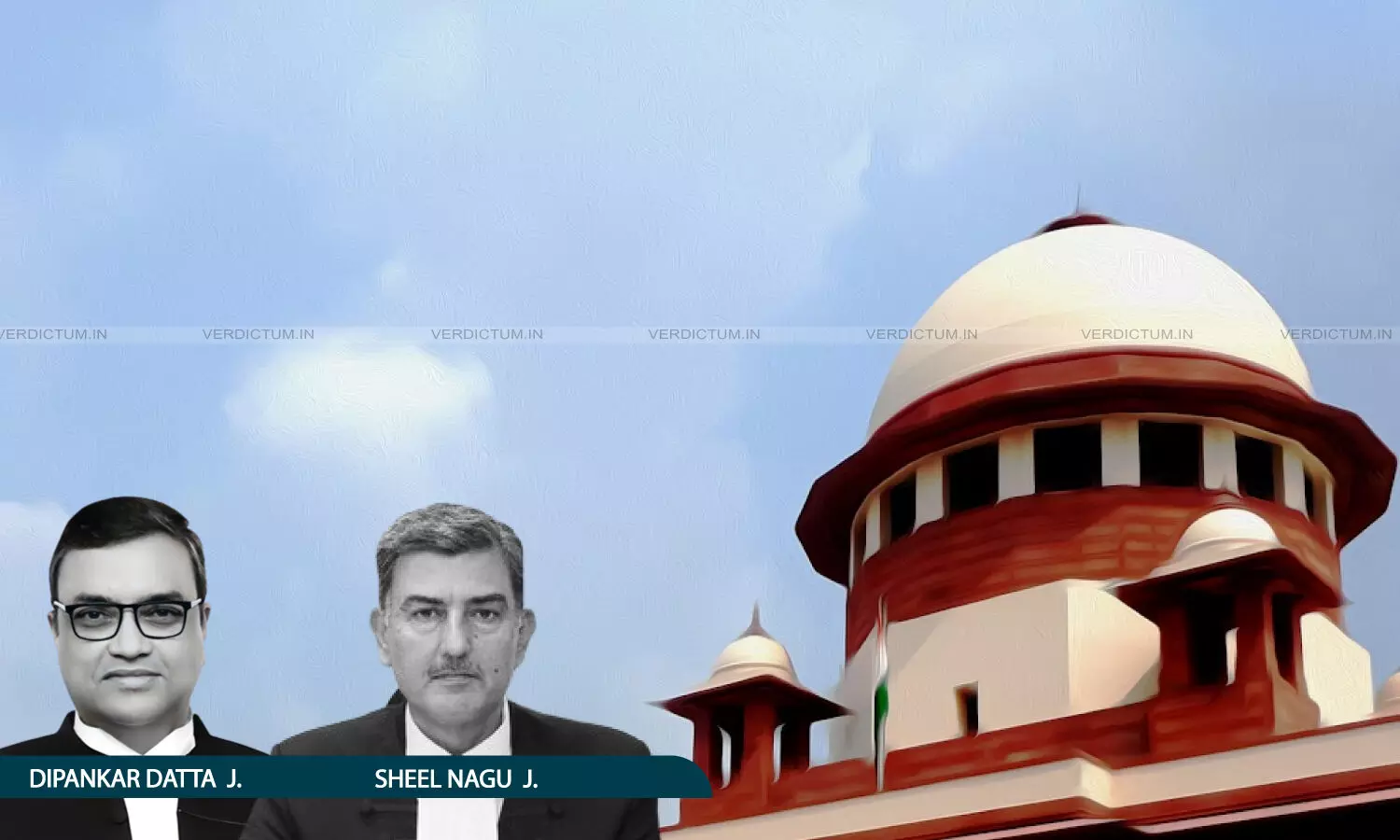
Justice Dipankar Datta, Justice Sheel Nagu, Supreme Court
Statutory Authorities Under Article 12 Of Constitution Are Not ‘States’ Eligible To Invoke Original Jurisdiction Under Article 131: Supreme Court
 |
|The writ petition was filed by the LDA seeking relief against the Union of India, the GOC-in-C, Central Command, and the Station Commander, Sub-Area Cantonment, Lucknow.
The Supreme Court has clarified that statutory bodies, while qualifying as an instrumentality of the State under Article 12 of the Constitution of India, cannot be equated with a 'State' for invoking the original jurisdiction of the apex court under Article 131 of the Constitution of India.
Accordingly, the Bench set aside an order of the Allahabad High Court, Lucknow Bench, which had dismissed a decades-old writ petition on the erroneous premise that the dispute was between the State of Uttar Pradesh and the Union of India. It remitted the writ petition back to the High Court for a fresh decision on merits. Considering that the writ petition had remained pending for nearly two and a half decades, the apex court requested the High Court to decide the matter in accordance with law expeditiously.
A Division Bench comprising Justice Dipankar Datta and Justice Sheel Nagu observed, “In our opinion, the High Court committed a gross error in visualising the dispute as one between the SoUP and the UoI. The SoUP had not invoked the writ jurisdiction of the High Court; instead, it was the appellant which was the writ petitioner. Appellant is a creature of a statute…The expression ‘States’ in Article 131 refers to the constituent States of the Union enlisted in the First Schedule of the Constitution, as distinct from a ‘State’ defined in Article 12. While the appellant may fall within Article 12 as an instrumentality of the State, it is not a State for the purposes of Article 131. The jurisdiction under clauses (a), (b) and (c) of Article 131 can be invoked only by the States specified in the First Schedule, and not by any authority or instrumentality covered by Article 12. Therefore, on the very terms of Article 131, it is not open to the appellant to approach this Court in its original jurisdiction”.
“It is indeed unfortunate that a writ petition, pending for nearly two and a half decades, has been dismissed by the High Court on such untenable reason”, it noted further.
Senior Advocate Arunabh Chowdhury appeared for the appellant and K.M. Nataraj, Additional Solicitor General appeared for the respondent.
The matter arose out of a writ petition filed by the Lucknow Development Authority seeking relief against the Union of India (through the Ministry of Defence), the GOC-in-C, Central Command, and the Station Commander, Sub-Area Cantonment, Lucknow.
The appellant had developed a residential colony and allotted plots and flats to allottees. However, defense officials interfered with physical possession, asserting title over the land. Swarg Ashram Shakari Awas Samiti Limited and the State of Uttar Pradesh were subsequently impleaded as respondents.
Attempts by the High Court to facilitate an amicable resolution between the authorities proved unsuccessful. Ultimately, via its order dated September 19, 2023, the High Court dismissed the writ petition, holding that the inter-se dispute between the State government and the central government could not be adjudicated in writ jurisdiction, granting liberty to the parties to initiate original proceedings under Article 131 of the Constitution.
Reversing the decision, the Supreme Court held that the High Court committed a gross error in visualizing the matter as a dispute between the State of Uttar Pradesh and the Union of India. The Court emphasized that the State of Uttar Pradesh was not the writ petitioner; rather, the proceedings were initiated by the Lucknow Development Authority.
Explaining the constitutional framework, the Bench observed that the appellant is a statutory creature constituted under Section 4 of the Uttar Pradesh Urban Planning and Development Act, 1973. The Court highlighted that the original jurisdiction under Article 131 is strictly restricted to disputes involving the Government of India and one or more constituent States specified in the First Schedule of the Constitution of India.
Cause Title: Lucknow Development Authority v. Union of India & Ors. (Neutral Citation: 2026 INSC 923)
Appearances:
Appellant: Arunabh Chowdhury, Sr. Adv., Mukesh Verma, Kamal Kumar Pandey, Shashank Singh, Advocates.
Respondent: K.M. Nataraj, Additional Solicitor General, S.N. Terdal, AOR.