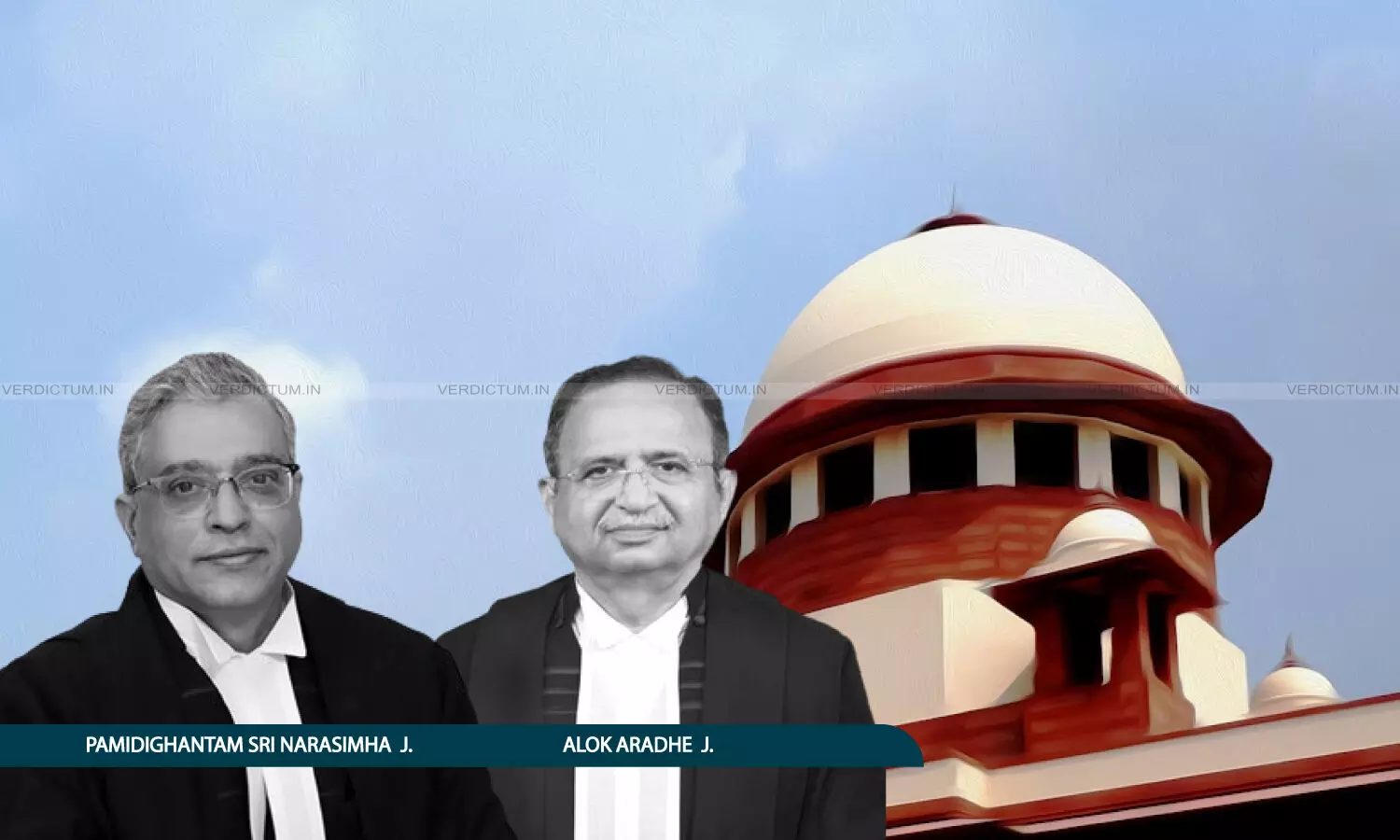
Justice Pamidighantam Sri Narasimha and Justice Alok Aradhe, Supreme Court
Shortfall In Earnest Money Deposit Does Not Invalidate SARFAESI Auction Once 25% Sale Price Is Paid & No Prejudice Is Caused: Supreme Court
 |
|The Apex Court also held that the borrower could not be penalised for the Bank’s omission to keep surplus sale proceeds in an interest-bearing account, and directed refund of ₹1.33 crore with 7% interest.
The Supreme Court has held that a shortfall in the deposit of earnest money under a possession-cum-sale notice does not affect the validity of a SARFAESI auction bid where the auction-purchasers deposited 25% of the sale price in compliance with Rule 9(3) of the Security Interest (Enforcement) Rules, 2002, and no prejudice or injustice was caused to the other bidder or the borrower.
The Court was hearing connected civil appeals arising from the Madras High Court’s common judgment dismissing writ petitions filed by the auction-purchasers and the Bank against orders of the Debts Recovery Appellate Tribunal in proceedings under the Securitisation and Reconstruction of Financial Assets and Enforcement of Security Interest Act, 2002.
A Bench of Justice Pamidighantam Sri Narasimha and Justice Alok Aradhe observed: “The auction-purchasers were statutorily obliged to comply with the 25% mark of the sale price on the same day which was made good. Therefore, any anterior shortfall in deposit of EMD pales into insignificance, the moment the 25% of the sale price was deposited. Thus, the non-conformity of the bid of the auction-purchasers insofar as it pertains to deposit of EMD has not resulted in any prejudice or injustice to the other bidder much less to the borrower. Therefore, the shortfall in deposit of EMD as required by Clause 7 of possession-cum-sale notice dated 18.03.2009 does not affect the validity of the bid of the auction-purchasers in any manner.”
Senior Advocate Niranjan Reddy appeared for the auction-purchasers; Senior Advocate Dhruv Mehta appeared for the Bank; Senior Advocate Jayant Bhushan appeared for the borrower.
Background
The borrower had availed a cash-credit facility from the Bank and failed to repay the loan. Its account was declared as a Non-Performing Asset, after which the Bank issued a demand notice under Section 13(2) of the SARFAESI Act for ₹88,52,741.
The secured asset was a parcel of land and building at Chennai. After an earlier possession-cum-sale notice was challenged before the Debts Recovery Tribunal, the Bank issued a fresh possession-cum-sale notice. Clause 7 of this notice required bidders to submit offers with an earnest money deposit of ₹21.50 lakh and stated that offers without an earnest money deposit would be rejected.
The borrower challenged the fresh notice before the DRT. The Tribunal granted a conditional stay but permitted the Bank to proceed with the auction, directing that the sale not be confirmed until a later date.
The auction-purchasers submitted their bid with ₹21.15 lakh as earnest money deposit, resulting in a shortfall of ₹35,000 from the stipulated sum. Their bid of ₹2,17,40,000 was the highest. On the same day, they deposited a further ₹33.20 lakh, bringing the total deposit to ₹54.35 lakh, constituting 25% of the bid amount. The DRT dismissed the borrower’s securitisation application, and the balance sale consideration was later deposited. A sale certificate was issued and registered in favour of the auction-purchasers.
The borrower appealed before the DRAT, which held that the auction was not conducted in compliance with Rule 8(5) of the Security Interest (Enforcement) Rules, 2002 and was vitiated by non-compliance with the auction notice. The High Court initially remitted the matter, but after the DRAT reaffirmed its earlier findings, the High Court dismissed the writ petitions filed by the auction-purchasers and the Bank.
Before the Supreme Court, the auction-purchasers argued that the EMD requirement was neither statutory nor mandatory, that 25% of the sale price had been deposited, that both bidders had the same ₹35,000 shortfall and that no prejudice had been caused. The Bank submitted that the EMD condition was for its benefit, and that a non-compliant bid could, at the highest, be questioned by a rival bidder. The borrower argued that no valid bid could exist without the requisite EMD and that the balance sale consideration was paid beyond the stipulated period.
Court’s Observations
The Apex Court first set out the principles governing tender conditions and deviation from prescribed standards.
The Court observed: “It is well-settled in law that requirements in a tender notice can be classified into following two categories: (i) those which lay down the essential condition of eligibility; and (ii) the others which are merely ancillary or subsidiary with the main object to be achieved by the condition. In the first case, the authorities issuing the tender may be required to enforce the condition rigidly whereas in other cases, it may be open to the authority to deviate from it and not to insist upon strict literal compliance of the condition.”
The Court further noted that deviation from a prescribed standard would not be bad if it did not cause substantial prejudice or injustice. It observed: “It is an equally established legal proposition that any non-conformity with or relaxation in the prescribed standard allowed in case of any tenderer, if not resulting in substantial prejudice or injustice to any of the parties or to public interest in general would not be bad.”
Applying these principles to the SARFAESI auction, the Court held that Clause 7 of the possession-cum-sale notice requiring EMD of ₹21.50 lakh was not a statutory condition.
The Court observed: “Clause 7 of possession-cum-sale notice dated 18.03.2009 which requires the bidders to deposit EMD amount of Rs.21,50,000/- is non-statutory and has been incorporated in the possession-cum-sale notice with an object to filter out non-serious bidders.”
The Court found that two bidders had submitted bids and both had deposited ₹21.15 lakh instead of ₹21.50 lakh. The Bank entertained and considered both bids.
The Court also recorded that the auction-purchasers’ bid was the highest and that they deposited 25% of the bid amount inclusive of EMD in accordance with Rule 9(3) of the Security Interest (Enforcement) Rules, 2002. It therefore rejected the borrower’s contention that deposit of EMD was an essential eligibility condition.
The Court also rejected the borrower’s argument that the balance sale consideration was paid after the stipulated 15-day period.
The Court held that this plea had not been taken before the DRT or the DRAT. It further found that Clause 7 of the possession-cum-sale notice permitted payment within 15 days or within the extended period allowed by the Bank.
The Court observed: “Clause 7 explicitly states that the balance amount shall be paid within fifteen days or within the extended period as allowed by the undersigned i.e., the Bank. It is also noteworthy that the borrower himself raised pleas to forbear the auction-purchasers from depositing the balance sale consideration.”
The Court noted that one of the auction-purchasers had stated in an affidavit that when they approached the Bank to pay the remaining 75%, the Bank issued a letter stating that, due to pendency of court proceedings, the date for balance payment would be intimated in time. It held that an inference could safely be drawn that the Bank had agreed to extend time.
The Court then dealt with the surplus amount remaining with the Bank after appropriation of sale proceeds.
It noted that the Bank was left with ₹1,33,94,054 and had offered the amount to the borrower by demand draft, which was declined presumably due to pending litigation. However, the Court held that the Bank ought to have kept the amount in an interest-bearing account.
The Court observed: “The Bank ought to have kept the aforesaid balance amount in an interest-bearing account. However, the Bank has failed to do so. For this omission on the part of the Bank, the borrower cannot be penalized. The borrower is entitled to refund of the balance sale consideration along with interest.”
Conclusion
The Supreme Court quashed the impugned judgment of the Madras High Court and the DRAT order. It directed the Bank to refund ₹1,33,94,054 to the borrower with interest at 7% per annum from the date when the surplus amount was kept in a non-interest-bearing account until payment.
The appeals filed by the auction-purchasers and the Bank were allowed, while the borrower’s appeals were disposed of. The Court made no order as to costs.
Cause Title: Lakshmi Mohan (Dead) Through LRs. & Anr. v. M/s. Airtech Projects Engineers Pvt. Ltd. & Anr. (2026 INSC 909)
Appearances
Appellants: Senior Advocate Niranjan Reddy with Advocates Mary Mitzy, M. Vijayanand, Vansh Verma, Gopal Singh Chauhan, B. Ravikiran and Shakun Sharma, AOR
Respondents: Senior Advocate Jayant Bhushan with Advocates V. Balachandran, Siddharth Naidu, Amartya Bhushan, Swantika Rajvanshi, V. Balachandran, AOR, M.A. Chinnasamy, AOR, C. Raghavendren and C. Rubavathi; Senior Advocate Dhruv Mehta