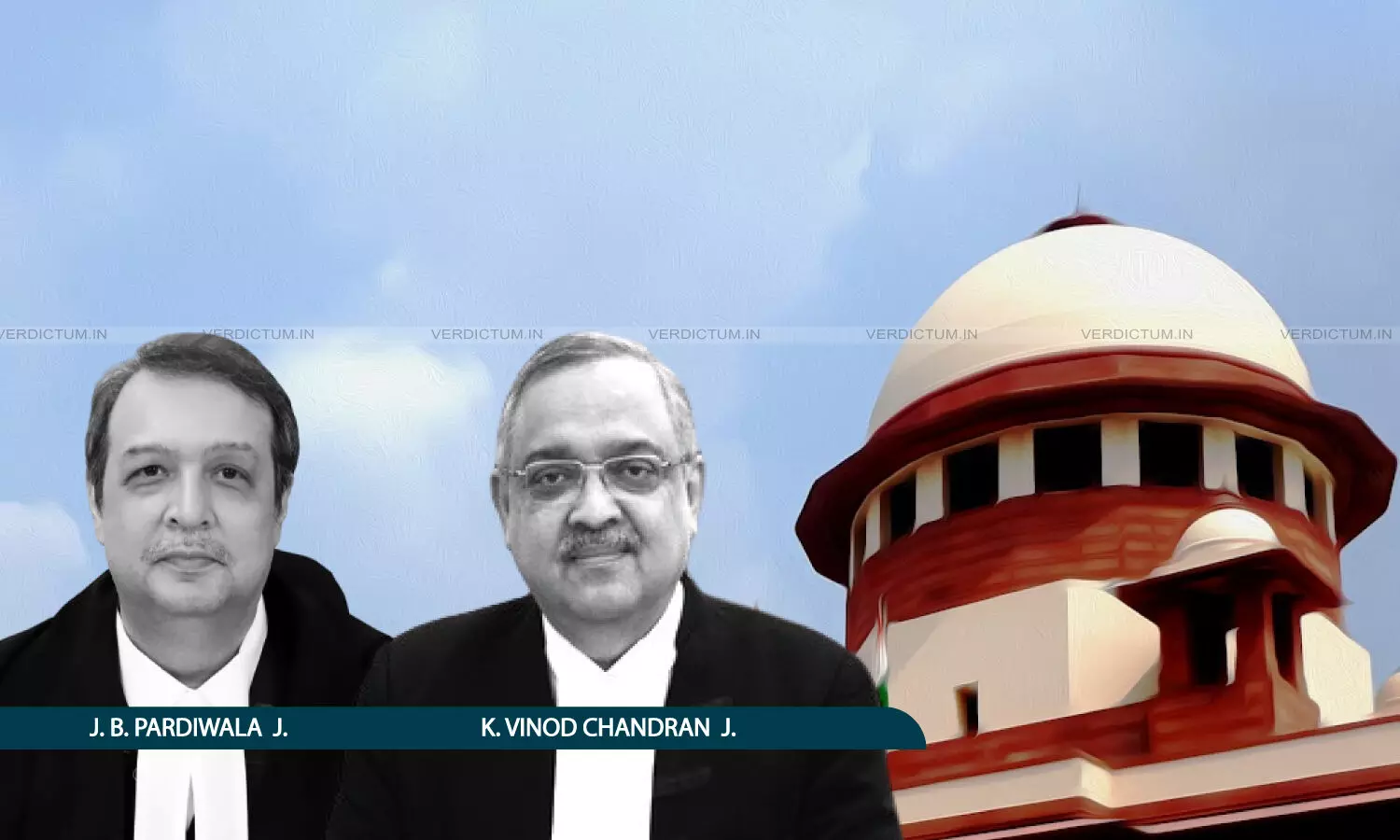
Justice J. B. Pardiwala, Justice K. Vinod Chandran, Supreme Court
Accused Refusing To Marry Because Mother Didn’t Permit Indicates Promise Made With Good Intention: Supreme Court Quashes FIR U/s.69 BNS
 |
|The appeal before the High Court was filed by the accused booked under Section 69, challenging the impugned judgment, refusing to quash the FIR.
The Supreme Court has quashed an FIR registered under Section 69 of the Bhartiya Nyaya Sanhita (BNS) after noting that the allegation that the accused refused to marry the complainant later because his mother did not permit it indicated that the promise was made with good intention, if at all it was made.
The appeal before the High Court was filed by the accused booked under Section 69, challenging the impugned judgment, refusing to quash the FIR.
The Division Bench of Justice J. B. Pardiwala and Justice K. Vinod Chandran held, “On the mere communication of the desire of the appellant to marry her, we are unable to find the appellant having used any deceitful means.In any event, the very complaint is that the appellant refused to marry her later, because his mother did not permit it, which indicates that the promise was made with all good intention, if at all it was made.”
Advocate Virat Popat represented the Appellant while Advocate Aneesha Rastogi represented the Respondent.
Factual Background
The complainant (second respondent) alleged that under the pretext of the promise to marry, the appellant entered into physical relations with the second respondent and later resiled from his promise on the allegation that his mother was not favorable to such a marriage with the second respondent. The High Court declined the prayer for quashing.
Reasoning
The Bench explained that under the IPC, the false promise of marriage was prosecuted under Section 375 read with Section 90, wherein the requirement was to find that the consent, if at all coming out from the facts, was tainted insofar as the victim having been led to believe a promise of marriage and physical relations having been permitted only on the belief that the promise will be complied with; which the promisor even at the time of giving such promise had no intention to comply with.
The Bench further explained that the BNS, by incorporating Section 69, brought in a separate offence carving out the fraudulent and deceitful conduct as spoken of therein from the grave offence of rape, while at the same time providing a penalty for the deceptive conduct alleged therein. “The word employed, “deceitful means or by making a promise to marry to a woman without any intention of fulfilling the same” brings in the same rigor of the promise having been given with an intention of never being fulfilled, which is the deceitful conduct sought to be punished”, it added.
On a perusal of the facts of the case, the Bench noted that the appellant and the complainant came into contact through a digital platform and a friendship developed between them, which later became a love affair. The Bench noticed that it was stated in the complaint that the appellant communicated his desire to marry the complainant on the first physical meeting and the complainant was said to have succumbed to his entreaties and allowed sexual intercourse.
The Bench thus stated, “The statements made in the complaint clearly indicate a consensual relationship and we do not find anything to find a deceitful conduct, of, the appellant having induced the complainant into sexual intercourse, which she succumbed to only on the promise to marry. Here we reiterate that on the first occasion when they met, the complainant succumbed to the appellant’s entreaties, is the specific statement made without even stating that it was on the promise to marry that physical relationship was permitted.”
Finding no reason to continue with the proceedings, the Bench quashed the FIR and allowed the appeal.
Cause Title: Kunal Rameshbhai Kalyani v. The State of Gujarat (Neutral Citation: 2026 INSC 987)
Appearance
Appellant: Advocates Virat Popat, Ajay Kumar Rai, Shubham Singh, Dillip Kumar Nayak, Prabhat Chowdhary, Dinesh Kumar Yadav, Shweta Lodha, AOR Lokesh Kumar Choudhary
Respondent: Advocate Aneesha Rastogi, AOR Swati Ghildiyal, Advocates Apoorva Anand, P S Sridhar Raj, AOR Prerana Chaturvedi, Advocate Abhishek Pandey